Reported: Blender segfaults when clicking Cancel on the "newer
autosave found" recovery popup shown by LoadProject at startup.

Root cause: LoadProject.execute()/invoke() triggered the recovery
popup via bpy.ops.bim.load_autosaved_recovery_popup("INVOKE_DEFAULT",
...) and returned that call's result ({'RUNNING_MODAL'}) as their own
return value, without LoadProject itself ever calling
modal_handler_add(). Blender's window manager takes a RUNNING_MODAL
return as a promise the operator registered its own modal handler;
since it hadn't, the WM's operator bookkeeping was left corrupted -
silently, since this is heap/state corruption rather than an
immediate crash. It only surfaced later, when the real modal operator
(the popup) closed and the WM reconciled its modal stack, which lines
up with the crash occurring specifically on dialog close regardless
of which button was pressed. check_autosave_recovery() now returns a
plain bool and fires the popup fire-and-forget; LoadProject reports
its own honest {"FINISHED"}.

Also hardened, as defense in depth: LoadAutosavedRecoveryPopup's
execute()/cancel() call back into bim.load_project(...), which (with
should_start_fresh_session) calls wm.read_homefile() and tears down
the window manager/screens. Doing that synchronously from inside this
popup's own execute()/cancel() - itself invoked from deep inside
Blender's modal handling for the popup's button click - risks the
same class of use-after-free as the timer bug fixed in the previous
commit. The reload is now deferred by one timer tick so it runs after
the popup's modal handling has fully unwound, and the deferred
callback closes over plain values rather than `self`, since the
operator instance may not survive past cancel()/execute() returning.

This defer-only change was tried and tested first, on the (incorrect)
assumption it was the root cause: it produced a byte-for-byte
identical crash backtrace on retest, which is what pointed at the
RUNNING_MODAL bug above as the actual cause - the defer change alone
was insufficient because the corruption happens when the popup is
first shown, not when it's closed.

Generated with the assistance of an AI coding tool.
The recovery popup used invoke_popup, which is dismissed the instant
the mouse leaves its bounds - closing the prompt without loading
either file, and with no visible feedback that anything happened.

Switches to invoke_props_dialog, which blocks the rest of the UI and
is only dismissed by an explicit action. Since Blender always renders
both a fixed "Cancel" button and one labelled by confirm_text on that
dialog type, the prompt is reframed as a direct Yes/Cancel question
("Do you want to load the autosaved version instead?") instead of
adding separate Load Original/Load Autosave buttons on top of those.

Folds the load logic directly into the popup's execute()/cancel(), so
the now-redundant LoadAutosavedRecovery operator is removed.

Generated with the assistance of an AI coding tool.

Co-Authored-By: Claude Sonnet 5 <noreply@anthropic.com>
Implemented as described in #5753, with two options:
- A nag dialog with save or cancel options.
- An autosaved file.

Settings are in preference to activate the feature (default: off), the period before prompting/saving,
and choosing between the two methods.

Prevent the autosave file being added to the recent files list when the user opens the original, but selects to open the autosaved version.

black/ruff

This commit was created using AI assistance. Cursor for the initial code, then Grok and I fixing all the errors
that Cursor made. Finally Copilot did a code review.

I have reviewed and tested the code, and I understand it, and it works and does not introduce any obvious bugs.

Co-authored-by: Copilot Autofix powered by AI <175728472+Copilot@users.noreply.github.com>
Co-authored-by: Grok
Co-authored-by: Cursor
IfcSurfaceFeature (e.g. road markings) adheres to a host element through
IfcRelAdheresToElement, a [1:1] cardinality hierarchical relationship in the
same family as aggregation, containment and nesting since IFC4.3. The spatial
traversal never followed it, so surface features had no resolvable parent or
container: on import they landed in the Unsorted collection instead of the
host's spatial collection, and were dropped entirely in DECOMPOSITION filter
mode.

Add get_adhered_element (feature to host) to the get_parent resolver chain and
walk HasSurfaceFeatures in get_decomposition, plus a get_surface_features helper
mirroring get_parts/get_contained. With get_parent resolving adherence,
get_container now returns the host's spatial container, so tool.Collector places
surface features under the host. Also follow HasSurfaceFeatures in the Bonsai
DECOMPOSITION filter path so they load in that mode.

Co-Authored-By: Claude Opus 4.8 <noreply@anthropic.com>
bpy.ops.bim.reload_link(link_index=...) from a script skips invoke(),
so self.query stayed at its empty default and execute() overwrote the
link's stored query, reloading everything. Only update link.query when
the property was explicitly set (dialog or script argument), and reload
using the stored query.

Co-Authored-By: Claude Fable 5 <noreply@anthropic.com>
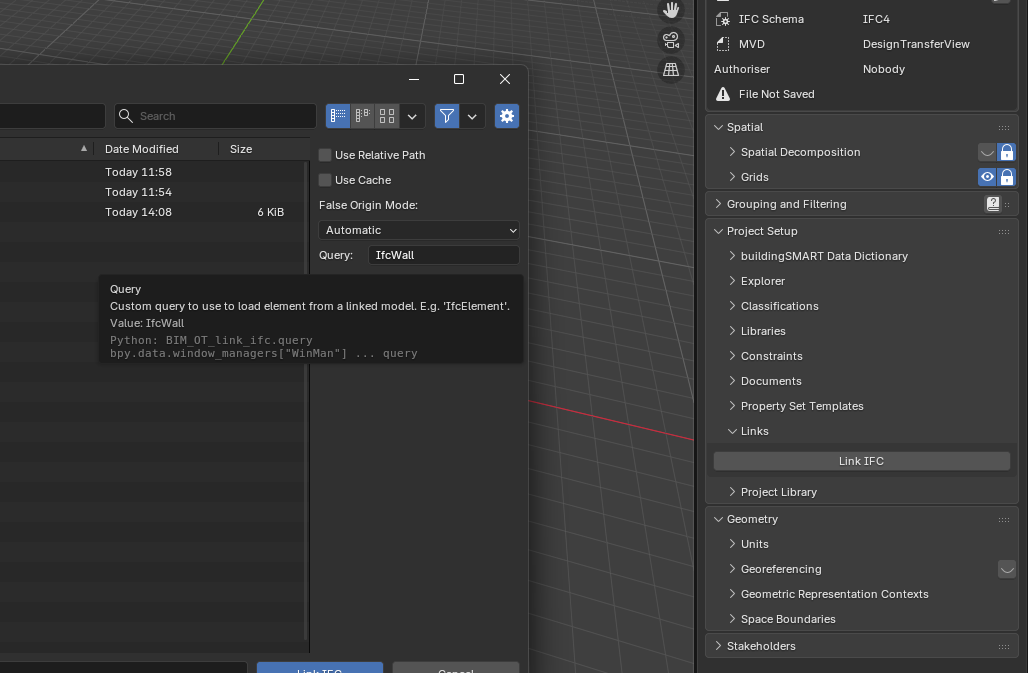
Store the selector query used at Link IFC time on the Link
PropertyGroup, restore it from the sidecar cache JSON on host
IFC reopen, and forward it through LoadLink and ReloadLink so
subsequent reloads replay the original filter instead of loading
every element. ReloadLink now opens a small dialog pre-populated
with the current query, allowing the user to edit it in place
without unlink-and-relink.
Also swap TestCalculateLinkMatrix off NamedTemporaryFile(delete=True)
which held an exclusive Windows handle and blocked the
code-under-test from reopening the sidecar path.
Closes#8219
Generated with the assistance of an AI coding tool.
Per IFC4+, IfcContext is the abstract supertype of IfcProject and
IfcProjectLibrary; library-only files legitimately contain only
IfcProjectLibrary as their root context. Bonsai assumed an IfcProject
was always present at three crash sites: the parent-library enum
(reported in #8183), RefreshLibrary's tree view, and AddProjectLibrary.
Introduce tool.Project.get_root_context() that prefers IfcProject and
falls back to IfcProjectLibrary, and route the three sites through it.
get_parent_library() now returns None for a root IfcProjectLibrary;
get_project_hierarchy() and the EditProjectLibrary parent-swap branch
handle that. AddProjectLibrary creates the nested sub-library via
IfcRelNests when the root is an IfcProjectLibrary, matching the
existing convention for library-under-library nesting.
For the separate "Open IFC Project" path, abort with a friendly error
pointing users to Project Setup -> Project Library -> Select Library
File instead of letting set_units() crash deep in the importer.
Closes#8183.
Partly generated with the assistance of an AI coding tool.
* Tolerate stale array child/parent GUIDs

A real-world IFC project (an arrayed door whose host got deleted
externally) crashed Bonsai's project load with "Instance with
GlobalId not found" inside setup_arrays.

tool.Blender.get_object_from_guid declared Optional return but let
RuntimeError propagate; callers iterating BBIM_Array child lists then
crashed instead of skipping. Honour the documented contract by
returning None on miss, matching the convention used by every other
by_guid lookup helper in tool/array.py, tool/ifc.py, tool/geometry.py.

Sweep the four user-action sites that resolve array child/parent
GUIDs without a guard - they shared the same bug class but were
reachable from different operators (regenerate_array, RegenerateArray
clear, duplicate_ifc_objects, process_arrays). An already-missing
entity is the desired terminal state for each, so the fix is
try/except RuntimeError: continue/skip.

setup_arrays now also collects each parent with at least one stale
child GUID into IfcImporter.broken_arrays, surfaced via a new Project
panel banner mirroring the existing pending_opening_recut UX. The
banner reports the count and offers "Select Elements" to navigate to
the affected array parents and a Dismiss button.

constrain_children_to_parent was being called once per layer inside
setup_arrays' for loop even though it always iterates all layers
internally - lifted out of the loop (pre-existing N x perf bug
that the stale-GUID print exposed).

Regression tests:
- test_returns_none_when_guid_not_in_file pins the get_object_from_guid
  Optional contract.
- test_remove_array_tolerates_stale_child_guid injects a fake child
  GUID into BBIM_Array.Data and asserts bim.remove_array completes
  cleanly.

Generated with the assistance of an AI coding tool.

* Black: wrap long bl_description in dismiss_pending_array_repair

Generated with the assistance of an AI coding tool.
Extract the pending_opening_recut tracking, three operators (apply /
dismiss / select), Project-panel banner, and the sibling
multi-instance warning banner (its backend helpers already landed
on this branch) from commit a85ed6032 on gizmos-8088.

All tool.* dependencies (Geometry.reimport_element_representations,
Blender.set_objects_selection, Array.*) and IfcImporter.gross_elements
are already on this branch -- no other diffs from a85ed6032 are
pulled.

The source's narrow except-tuple paraphrase comments are trimmed
to keep only the durable "don't swallow programmer errors" note,
per CLAUDE.md s4a.

Tests: 5 bim-lane tests in test/bim/module/project/
test_pending_opening_cuts.py covering apply happy-path + missing
entity, dismiss, select happy-path + cancellation.

Generated with the assistance of an AI coding tool.
Save-path:
* SaveProject._execute (project/operator.py) now calls
  preview_base.discard_pending_previews(context.scene) right after
  tool.Parametric.commit_pending_edits(). Previews are session-
  transient — discard rather than commit. Sibling gizmo polls gate
  on each preview's is_active flag; a stuck flag persisted through
  the save would silently hide them on reload. Mirrors the pattern
  already in gizmos-8088.

Preview-active gate hardening:
* preview_base.get_preview_props tolerates contexts without a
  ``scene`` attribute. Pre-existing tests use SimpleNamespace mocks
  for the context; the previous getattr(context.scene, ...) raised
  AttributeError before the inner default kicked in.

Test update:
* test_wall_header_refresh.test_geom_generation_invalidates_wall_geom_cache
  patches tool.Wall.read_geometry instead of the now-deleted local
  wall._read_wall_geometry (commit 7e5e7b8d6 migrated the call site).

Generated with the assistance of an AI coding tool.
The dialog's only outcomes were "Apply & Save" (same as silent save)
or "Cancel" (same as not saving) — net friction with no actual choice.
Auto-commit stays as the safety net; the count now suffixes the
existing save-success report so it isn't immediately overwritten.

Generated with the assistance of an AI coding tool.
Establish a single source of truth for parametric element types (door,
window, stair, railing, roof). tool.Parametric.EDIT_TYPES drives:
- BIM<Name>Properties PointerProperty attachment via the registry
- GizmoPreferences<Name> class registration in bim/__init__.py
- save-time auto-commit of pending draft edits
- the refresh_post_commit epilogue called from IfcStore after every IFC
  mutation, which fixes the stale-header bug where in-place hotkey
  mutations (S_E / C_E) left BIMModelProperties and the gizmo cache
  pointing at obsolete values.

Refactors door/window/railing/roof onto shared mixins from
bim/parametric_lifecycle.py (FeatureModifierEditMixin and
PathPreservingEditMixin); stair gets the lock-gizmo refactor and
frame-cache integration. Behavior preserved.

Adds BaseParametricGizmoGroup._prime_frame_caches so the parametric
gizmos stop re-deriving preferences, view direction, and billboard
rotation per frame; reorders poll() to short-circuit on the cheapest
predicate first. Adds the icon library + BillboardingGizmoGroupMixin
that the wall feature in the next commit will consume.

Generated with the assistance of an AI coding tool.
Refactored methods for accessing objects in linked models and added a simple operator to select object in linked model by providing guid.

A quick demo - https://files.catbox.moe/sjjw37.mp4
* Enhance AddReferenceImage operator to use file browser instead of independent popup dialogue

* Fix dimensions assertion in TestAddReferenceImage

* Remove error in return in _execute (it is not execute)

* Add  IFC2X3 support to AddReferenceImage

* Adde unit="LENGTH" to the x/y properties (every length dimension everywhere in the UI is in project length units. No need to say it explicitly)

* Manually create the texture always, not just for IFC2X3

* Add poll method to AddReferenceImage operator to check for loaded IFC project

* Refactor AddReferenceImage to add representation manually following pattern in root/operator.py's bim.add_element

* Improve File explorer options between new and select from existing project Ifc Reference Images

* Refactor get_existing_reference_images to use selector for filtering image annotations

* No extra args needed after should_add_representation is False

* Doing clean=True deletes everything

* Don't manually add geometry and materials, don't call bpy.ops. Only create IFC data, then use preexisting loading functions to create geometry.

* Black formatting, also now we can start to remove this operator as it becomes obsolete

* Consolidate duplicate UV generation into Loader.load_generated_uv_map

Replace 3 identical XY-UV baking blocks (create_object IMAGE,
bm_add_image_plane, ImageScalingTool) with a single reusable
classmethod in tool.Loader.

* Fix IFC4 texture display in Solid viewport Texture mode

IFC4 IfcTextureCoordinateGenerator Mode=COORD is used, load_texture_maps
falls back to load_generated_uv_map to bake XY-UV data onto the mesh.

* Fix IFC2X3 texture display

* This looks wrong

* Remove legacy override image feature, because we now have a proper styles and texture manager

* Remove legacy override existing image element, because we now have a dedicated styles texture manager

* Remove unnecessary roundtrip to bmesh and mesh

---------

Co-authored-by: Dion Moult <dion@thinkmoult.com>
* Linked IFC projects enhancement (multiple links to same project file)

- Implement link management system using UUIDs as identifiers to support multiple links to the same IFC file
- Add georeferencing compatibility detection and UI display (NONE, NOT_COMPATIBLE, PARTIAL_COMPATIBLE, FULL_COMPATIBLE)
- Support for duplicate link creation with Shift+D shortcut and automatic position offset
- Add false origin and project north calculation from 3D cursor for MANUAL mode
- Only store one cache per file, regardless of the amount of links
- Prevent duplicate links based on filepath and position comparison
- Improve error handling for missing files and loading failures
- Update tests

* Remove duplicate georef UI

I try to avoid duplicate UI (especially for one that can be as
sophisticated as georef - e.g. missing is WCS) as it means double the
code, double the tests, potential user confusion. BTW the note about
vertical datum isn't quite accurate as it may be included in the CRS
definition so vertical datum is optional.

* Remove depsgraph_update_post handler for update_link_ui_on_transform as per core developer feedback

* Move get_projected_crs to geolocation module

* Refactor get_projected_crs to simplify as per core developer feedback

* Remove unused import of bonsai.tool from project module

* Use IfcDocumentInformation per linked file and IfcDocumentReference for locaiton information

* Refactor SaveBlendMetadataFile operator to remove  try-except blocks and remove linked projects collections since they are recreated by bonsai

* Cleanup removing empty collection instances for linked models in metadata.blend file and call determine_georeferencing_compatibility on link reload

* Add locking mechanism for linked models and update UI to reflect lock status

* Update logic that track IFC to execute_ifc_duplicate_operator instead of having it in execute() which does not track IFC undo/redo

* Refactor link handling to use get_link_empty_handle and set_link_empty_handle methods which in turn use the standard blender-ifc integrations patters (tool.Ifc.get_object(doc_reference) and tool.Ifc.link(doc_reference, empty_handle)

* remove operator.DuplicateLink and move it to tool.Project.duplicate_link()

* Refactor link handling to use sequential identifiers (no need for STEP ID DocRef)

* Refactor IFC linking logic to handle cases without a parent IFC file loaded. Firts link flase origin becomes parent origin

* Lock should not affect selection.

This makes it consistent with grid / spatial lock, and also toggle
selectability is already implemented.

* Remove unnecessary check for loaded library as Blender seems to do this internally already

* Rename util to get_crs because in IFC4X3 you can also have geographic CRS not just projected

* Remove unnecessary call to determine_georeferencing_compatibility

This function is already always called prior to calculate_link_position
so shouldn't be called here. It's also a very expensive function: as it
currently stands, just to link a single IFC, ifcopenshell.open() is
called 3 times. This reduces it to 2.

* Store CRS as metadata for linked models, and compare metadata when indicating georeferencing compatibility

Previously, to check georeferencing compatibility, ifcopenshell.open()
was used. When linking large models, this adds considerable time and
memory usage. This instead captures the georef as standard metadata in
our .cache.json. This now reduces the ifcopenshell.open() calls back
down to only 1 as necessary (see previous commit).

* Use link index instead of link name to fetch link collection item

Link name runs into issues with name uniqueness. This is why you created
a function for "get next link ID". After this refactoring, we can no
longer worry about uniqueness and that function may be removed.

* Simplify reloadlink into just unload and reload (with cache disabled)

This function should not be responsible for editing any data.

* Remove unnecessary get_next_link_id as names no longer need uniqueness

This now frees up the name variable to track a more meaningful, human
name like IfcDocumentInformation's Name attribute.

* Rewrite get / set link_empty_handle to just use the link directly

This prevents needless logic to fetch the link and also removes issues
related to duplicate names.

* Temporarily remove logic in prop callback

Right now, pretty much all the logic is done in a prop callback. In
general logic in prop callbacks should be minimised, since it's hard to
test and easily triggered as a domino effect of another change, and may
also impact undo/redo.

* Remove code that unnecessarily removes cache

This code removes cache, which means any project unlinking an IFC auto
clears the cache for any other project which doesn't make sense, and
also breaks the ability to readd it quickly.

* Rewrite link, unlink, load, and unload IFC

There were a few issues tackled here:

 - Operators that change any IFC data must use tool.Ifc.Operator and
_execute, otherwise undo/redo will break. That's one of the risks of
using prop callbacks, as it is not explicit when an IFC edit happens.
 - The usage of IfcDocumentReference was not correct. The Location
should store the URL, _not_ the position. The position should be in the
Identification attribute.
 - The URL was stored in IfcDocumentInformation location, which does not
work in IFC2X3. There are a few changes here to make it IFC2X3
compatible.
 - Generally move logic in operators, not prop callback.

* Remove restriction around manual mode.

Users should be able to use manual mode if they want.

* Restore AUTOMATIC mode to identical behaviour to file open

This is the first step to reusing cache files agnostic of the host.

* Revert tests for a fresh start for updating tests

* Revert "test_feature - clean up .ifc.cache. files after test was executed"

This reverts commit 99ae768ddf.

* Update tests and reimplement calculations for matrix of empty handle

Previously, the empty would always be placed at the origin, unless a
"position" offset was present. This is a problem, because the "position"
is simply a local offset relative to the Blender cache! If the cache was
regenerated, the offsets would be outdated. Also, the cache appeared in
different locations depending on the false origin mode, so the offset
would mean different things to different people.

Instead, a more robust method is:

 1. When you link a file, a Blender cache is generated. The Blender
origin of this cache is arbitrary! It depends on the user's false origin
mode and is purely a Blender session specific thing.
 2. When you load a link, a link is _always_ loaded into the correct
location with regards to IFC global coordinates. All math is done from
the perspective of IFC.
 3. If you choose to transform (move / rotate / scale!?) this link from
its correct location, that gets recorded as a 4x4 transformation matrix.
Note: I haven't implemented this properly yet.

Tests all pass, with a minor modification to the new behaviour that
false origin mode now won't affect the location it ends up in, only the
generation of the cache.

* Remove arbitrary convention around display name

Not needed anymore now that A/M/D is a detail and not significant on
actual coordinates, and also that the UUID is no longer needed.

* Simplify implementation of loading linked models when opening an IFC

* Move link matrix calculation from operator to tool for reuse

* Implement editing link location and calculation of transformation matrix

I changed my mind on the is_locked thing, since it isn't clear to the
user that locking need to be done to save changes.

* Remove old is_locked, prop update callback no longer needed (dedicated operator instead), remove old calculation code

* Simplify code related to placed_as_per_georef

* For now, simple skip for duplicate / delete

IMO duplicate / delete / move a link are very rare and explicit
operations.

* Update tests

* Remove host_model coordinate data as cache is no longer host model dependent

* Move icons outside list because there are too many

* Minor tweaks

---------

Co-authored-by: Dion Moult <dionmoult@gmail.com>
Co-authored-by: Dion Moult <dion@thinkmoult.com>
 Stephen Boddy