assign_cost_item_quantity skipped every IfcSpatialElement, which also
swallowed IfcSpace. Spaces are legitimate quantifiable objects, so their
Qto_SpaceBaseQuantities (for example GrossFloorArea) were never picked up
and count based cost items fell back to 0. Keep skipping spatial
containers (site, building, storey) but allow IfcSpace.

Co-Authored-By: Claude Opus 4.8 <noreply@anthropic.com>
copy_cost_item appends the copy to the inverse relationships of the
original cost item, which for a root cost item includes the source
schedule's IfcRelAssignsToControl. copy_cost_schedule then assigned that
same cost item to the new schedule as well, so the copies showed up in
both schedules and deleting them from one removed them from the other.

Unassign the copy from the source schedule before assigning it to the
new one.

Co-Authored-By: Claude Opus 4.8 <noreply@anthropic.com>
`values` dictionary was missing and variables were never collected to it, so `FormulaEvaluator(values)` was always resulting in missing variable error.
poe ty's sequence only reaches ty-ios once ty-bonsai passes, so these
never surfaced until now:

- util/alignment.py: drop the stale `include_referent=False` kwarg from
  add_zero_length_segment() - that parameter was removed from the function's
  signature in 45ea5eb07 but this caller in a different file was missed,
  leaving a latent TypeError if this code path is ever exercised.
- ifcopenshell_wrapper.pyi: add the optional trailing `logger` parameter to
  parse_ifcxml/open/construct_iterator*, matching the real SWIG signatures
  in src/ifcwrap/*.i (all declare `Logger& logger = Logger::Root()`) that
  the hand-maintained stub never picked up.
- ifcopenshell/__init__.py: remove a stale `ty: ignore[unknown-argument]`
  comment that ty confirms is no longer suppressing anything.
- assign_cost_item_quantity.py: OPERATORS mixes 2-arg binary operators with
  the 1-arg `operator.neg` (for ast.USub), but FormulaEvaluator has no
  visit_UnaryOp so USub can never reach this lookup via visit_BinOp.
  Suppressed at the call site rather than touching the dict, since this
  looks like scaffolding for unary-minus support rather than dead code.
- Explicit submodule imports (ifcopenshell.geom / api.alignment / util.unit
  / api.aggregate / api.context / api.spatial) added where accessed but
  only reachable by accident of import order.
remove_deep is deprecated and can silently delete elements still in use.
remove_deep2 requires zero inverses before removal, making it safer.
Also fixes a double-removal bug in remove_grid_axis and prevents
removing the last prop template from a pset template.

Co-Authored-By: Claude Opus 4.6 <noreply@anthropic.com>
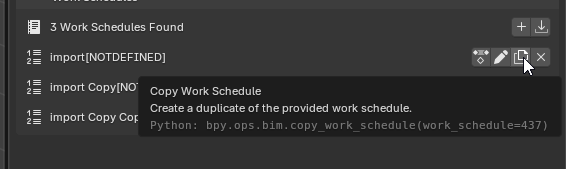
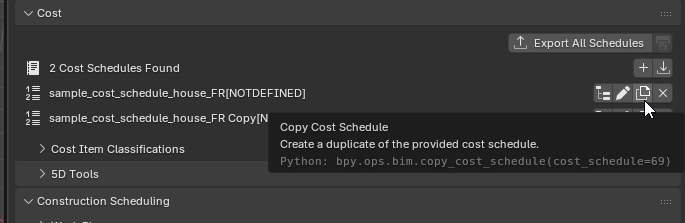
A feature allowing duplicate existing IfcCostSchedule - either from API or from Bonsai UI
Button location in Bonsai - https://files.catbox.moe/ct058q.png
That way all assigned resources will be added as cost values to cost items and it will be more apparent what resources were used for the last calculation and what costs/quantities they had at the time.
It's py.types requirement, similar to 6e2edbf

Example issue without __all__:
import ifcopenshell
import ifcopenshell.api.project

# "create_file" is not exported from module "ifcopenshell.api.project"
ifcopenshell.api.project.create_file()
In IFC4X3 IfcQuantityCount is now more strict and requires only interger values.
Error for a reference:
TypeError: attribute 'CountValue' for entity 'IFC4X3.IfcQuantityCount' is expecting value of type 'INT', got 'float'.
 Petru Conduraru