I generally like to minimise knobs and dials, so this is now part of the
wizard but now defaults to a "NONE" unit. You also now have the option
to choose "NONE" for area / volume units which makes things consistent.
Enum names also match the IFC lowercase convention for conversion based
units. This also simplifies the core logic and treats all units the same
way instead of special cases for each unit type. (length is still
special and required in Bonsai as we are inherently graphical)
- is_skipped is calculated upstream instead of reimplementing logic
 - the viewer now shows cardinality (not just in edit mode) to make it
clear what the requirements are
 - prohibited specs are not allowed to have any requirements, so that
section is hidden
 - failed prohibited specs now shows list of failed (applicable)
entities
The report_specification() method in the Json reporter class was raising
an UnboundLocalError when processing IDS specifications with certain
minOccurs/maxOccurs combinations that weren't explicitly handled.

Problem:
The cardinality variable was only assigned for three specific cases:
- minOccurs=1, maxOccurs="unbounded" → "required"
- minOccurs=0, maxOccurs="unbounded" → "optional"
- minOccurs=0, maxOccurs=0 → "prohibited"

However, the IDS schema allows other valid combinations such as:
- minOccurs=0, maxOccurs=1 (commonly used for optional specifications)
- minOccurs=1, maxOccurs=1 (exactly one occurrence required)
- Any other valid XML Schema cardinality values

When processing IDS files with these combinations, the cardinality
variable remained unassigned, causing an UnboundLocalError at line 382
when attempting to use it in ResultsSpecification().

Solution:
Added fallback logic to handle all valid IDS cardinality combinations:
- If minOccurs >= 1: cardinality = "required" (must occur at least once)
- Otherwise (minOccurs == 0): cardinality = "optional" (may occur)

This maintains semantic compatibility with the existing codebase, which
expects cardinality to be one of the semantic strings ("required",
"optional", "prohibited") rather than numeric ranges. This is critical
for:
- HTML template rendering (line 457: .capitalize())
- Conditional logic for skipped specs (line 454)
- UI rendering for prohibited specs (line 456)

Testing:
- Tested with IDS file containing minOccurs=0 without explicit maxOccurs
  (defaults to 1 per XML Schema specification)
- Validation now completes successfully without UnboundLocalError
- HTML report generation works correctly with semantic cardinality labels
- Maintains backward compatibility with existing IDS files

Fixes: Validation failure when using valid IDS cardinality combinations
* black .

* add typing

* move function

* add get_class_relations

* add test for class relation

---------

Co-authored-by: Dion Moult <dionmoult@gmail.com>
Demo - https://files.catbox.moe/extsxf.mp4

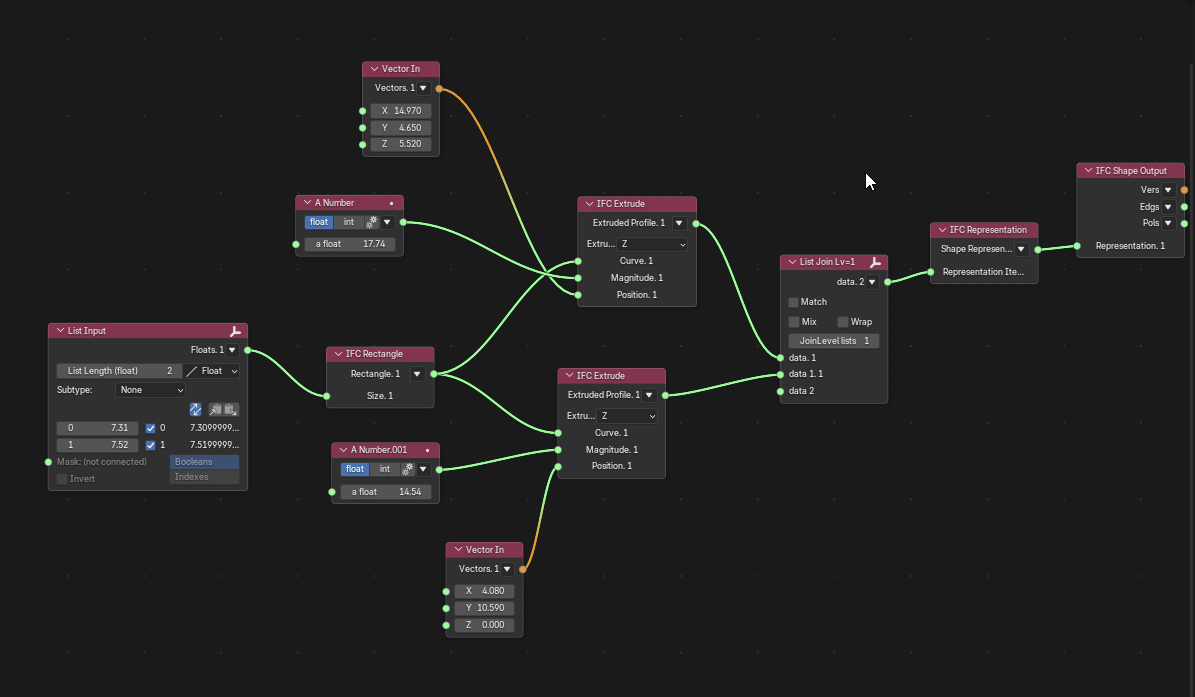
But now it requires ifcsverchok graph to be nested inside a subgroup because we need a way to indicate which graph parameters are important, so user can modify them from Parametric Geometry tab without actually explicitly opening sverchok graph.
This reverts commit 96fe9b5398.

This commit contains a logical error where hide_viewport is checked in
the if statement but hide_set() is used as the effect. This causes a
regression in tests about project visibility. `hide_viewport` is the
correct hiding setting to use, because hide_set is more ephemeral and
affected by Shift-H, Alt-H etc.
Previously, when the add occurrence modal operator was executed, on
every modal loop (i.e. every mouse movement) it would fetch the mesh
geometry to be previewed, store the verts / edges / faces in mesh
collections, then the decorator would fetch that geometry, the clear the
collections, in a loop.

I've removed the Blender collections. Instead the same strategy is used
as in ItemDecorator i.e. the mesh and verts are fetched once during
decorator installation, then on each draw call only a single vertex loop
to multiply by the transformation matrix for snapping and mouse
position.

You can test with the LOD400 model in #7566. On my machine it would
cause lag on anything with >500 faces. Now it seems to work without lag
on a 26k polygon mesh.
 Thomas Krijnen