When enabling text editing, align_vertical and
align_horizontal were not populated from the existing
IFC BoxAlignment value, causing them to revert to
their Blender property defaults.

Generated with the assistance of an AI coding tool.
edit_text was missing a call to edit_text_alignment,
so align_vertical/align_horizontal prop changes were
never exported to IFC.

Additionally, edit_text_alignment was called before
edit_text_literals, which deletes and recreates the
IFC literal entities — discarding the alignment change
immediately. Moved the call to after edit_text_literals.

EditText operator was also being replayed by Blender's
undo/register stack with stale prop values, overwriting
the correct alignment. Guarded _execute with is_editing
to make replayed calls no-ops.

Also fixed a ValueError in is_camera_moved where
np_frombuffer_legacy returns a flat (9,) array but the
rotation dot product requires (3,3). Fixed with reshape.

Generated with the assistance of an AI coding tool.
Objects with hide_select=True could not be selected during
isolation, causing hide_view_set to incorrectly hide them.
Objects with hide_viewport=True had their H-key hide state
modified as a side effect of hide_view_clear/hide_view_set.
Both are now left unaffected by bim.activate_drawing.

Generated with the assistance of an AI coding tool.
Use EPset_Parametric.LayerSetDirection exclusively to
determine horizontal vs vertical layer rendering in type
thumbnails, rather than hardcoding IfcSlabType checks.
Also fix line drawing to use the is_horizontal flag
consistently.

Generated with the assistance of an AI coding tool.
Fix Sphinx docs: replace csv-table with list-table for formatting functions

The documentation table of formatting/query functions was not rendering
because `.. csv-table::` requires strict RFC4180 CSV escaping. The table
contains nested quotes, inch marks (e.g. `3' - 0"`), backticks, and code
examples, which cause the CSV parser in docutils to treat rows as malformed
and drop the entire directive.

Replaced the directive with `.. list-table::`, which parses reStructuredText
instead of CSV and safely supports inline code, quotes, and multi-line cells.

Also moved the examples text outside the directive block and ensured a blank
line after the table so Sphinx does not interpret following paragraphs as
table rows.

No content changes — documentation now renders correctly.

Generated with the assistance of an AI coding tool.
* Enhance AddReferenceImage operator to use file browser instead of independent popup dialogue

* Fix dimensions assertion in TestAddReferenceImage

* Remove error in return in _execute (it is not execute)

* Add  IFC2X3 support to AddReferenceImage

* Adde unit="LENGTH" to the x/y properties (every length dimension everywhere in the UI is in project length units. No need to say it explicitly)

* Manually create the texture always, not just for IFC2X3

* Add poll method to AddReferenceImage operator to check for loaded IFC project

* Refactor AddReferenceImage to add representation manually following pattern in root/operator.py's bim.add_element

* Improve File explorer options between new and select from existing project Ifc Reference Images

* Refactor get_existing_reference_images to use selector for filtering image annotations

* No extra args needed after should_add_representation is False

* Doing clean=True deletes everything

* Don't manually add geometry and materials, don't call bpy.ops. Only create IFC data, then use preexisting loading functions to create geometry.

* Black formatting, also now we can start to remove this operator as it becomes obsolete

* Consolidate duplicate UV generation into Loader.load_generated_uv_map

Replace 3 identical XY-UV baking blocks (create_object IMAGE,
bm_add_image_plane, ImageScalingTool) with a single reusable
classmethod in tool.Loader.

* Fix IFC4 texture display in Solid viewport Texture mode

IFC4 IfcTextureCoordinateGenerator Mode=COORD is used, load_texture_maps
falls back to load_generated_uv_map to bake XY-UV data onto the mesh.

* Fix IFC2X3 texture display

* This looks wrong

* Remove legacy override image feature, because we now have a proper styles and texture manager

* Remove legacy override existing image element, because we now have a dedicated styles texture manager

* Remove unnecessary roundtrip to bmesh and mesh

---------

Co-authored-by: Dion Moult <dion@thinkmoult.com>
Guidelines for external contributors using AI coding tools,
covering licensing, AI disclosure requirements, PR scope,
commit style, code formatting, and testing expectations.

Generated with the assistance of an AI coding tool.
Previously, there was a dance between invoke, execute, and draw. This
can probably be resolved, but is a high-risk for undo bugs. This
simplifies the logic flow to just a traditional _invoke -> _execute.

I add a new feature test to at least make sure it does something, and
this also fixes the segfault in tool tests as it no longer requires the
launching of the file browser.
In my previous commit, I mistakenly believed that there was an API change from
snap_angle_increment to snap_angle_increment_3d
But since the feature was introduced in blender 4.2 the setting is called
snap_angle_increment_3d.
Previously it was implemented inline. This now implements it as a
tool.Blender function with tests. Also the previous tests didn't
actually run and weren't actually testing any tools despite being in a
tool tests.
IfcSectionedSurface and IfcSectionedSolidHorizontal both of CrossSectionPositions attributes which are lists of IfcAxis2PlacementLinear. The implementation of each class used its own bespoke mapping of IfcAxis2PlacementLinear, which were identical to each other and slightly different than IfcAxis2PlacementLinear. Now the two sectioned classes use the one and only mapping for IfcAxis2PlacementLinear
* Linked IFC projects enhancement (multiple links to same project file)

- Implement link management system using UUIDs as identifiers to support multiple links to the same IFC file
- Add georeferencing compatibility detection and UI display (NONE, NOT_COMPATIBLE, PARTIAL_COMPATIBLE, FULL_COMPATIBLE)
- Support for duplicate link creation with Shift+D shortcut and automatic position offset
- Add false origin and project north calculation from 3D cursor for MANUAL mode
- Only store one cache per file, regardless of the amount of links
- Prevent duplicate links based on filepath and position comparison
- Improve error handling for missing files and loading failures
- Update tests

* Remove duplicate georef UI

I try to avoid duplicate UI (especially for one that can be as
sophisticated as georef - e.g. missing is WCS) as it means double the
code, double the tests, potential user confusion. BTW the note about
vertical datum isn't quite accurate as it may be included in the CRS
definition so vertical datum is optional.

* Remove depsgraph_update_post handler for update_link_ui_on_transform as per core developer feedback

* Move get_projected_crs to geolocation module

* Refactor get_projected_crs to simplify as per core developer feedback

* Remove unused import of bonsai.tool from project module

* Use IfcDocumentInformation per linked file and IfcDocumentReference for locaiton information

* Refactor SaveBlendMetadataFile operator to remove  try-except blocks and remove linked projects collections since they are recreated by bonsai

* Cleanup removing empty collection instances for linked models in metadata.blend file and call determine_georeferencing_compatibility on link reload

* Add locking mechanism for linked models and update UI to reflect lock status

* Update logic that track IFC to execute_ifc_duplicate_operator instead of having it in execute() which does not track IFC undo/redo

* Refactor link handling to use get_link_empty_handle and set_link_empty_handle methods which in turn use the standard blender-ifc integrations patters (tool.Ifc.get_object(doc_reference) and tool.Ifc.link(doc_reference, empty_handle)

* remove operator.DuplicateLink and move it to tool.Project.duplicate_link()

* Refactor link handling to use sequential identifiers (no need for STEP ID DocRef)

* Refactor IFC linking logic to handle cases without a parent IFC file loaded. Firts link flase origin becomes parent origin

* Lock should not affect selection.

This makes it consistent with grid / spatial lock, and also toggle
selectability is already implemented.

* Remove unnecessary check for loaded library as Blender seems to do this internally already

* Rename util to get_crs because in IFC4X3 you can also have geographic CRS not just projected

* Remove unnecessary call to determine_georeferencing_compatibility

This function is already always called prior to calculate_link_position
so shouldn't be called here. It's also a very expensive function: as it
currently stands, just to link a single IFC, ifcopenshell.open() is
called 3 times. This reduces it to 2.

* Store CRS as metadata for linked models, and compare metadata when indicating georeferencing compatibility

Previously, to check georeferencing compatibility, ifcopenshell.open()
was used. When linking large models, this adds considerable time and
memory usage. This instead captures the georef as standard metadata in
our .cache.json. This now reduces the ifcopenshell.open() calls back
down to only 1 as necessary (see previous commit).

* Use link index instead of link name to fetch link collection item

Link name runs into issues with name uniqueness. This is why you created
a function for "get next link ID". After this refactoring, we can no
longer worry about uniqueness and that function may be removed.

* Simplify reloadlink into just unload and reload (with cache disabled)

This function should not be responsible for editing any data.

* Remove unnecessary get_next_link_id as names no longer need uniqueness

This now frees up the name variable to track a more meaningful, human
name like IfcDocumentInformation's Name attribute.

* Rewrite get / set link_empty_handle to just use the link directly

This prevents needless logic to fetch the link and also removes issues
related to duplicate names.

* Temporarily remove logic in prop callback

Right now, pretty much all the logic is done in a prop callback. In
general logic in prop callbacks should be minimised, since it's hard to
test and easily triggered as a domino effect of another change, and may
also impact undo/redo.

* Remove code that unnecessarily removes cache

This code removes cache, which means any project unlinking an IFC auto
clears the cache for any other project which doesn't make sense, and
also breaks the ability to readd it quickly.

* Rewrite link, unlink, load, and unload IFC

There were a few issues tackled here:

 - Operators that change any IFC data must use tool.Ifc.Operator and
_execute, otherwise undo/redo will break. That's one of the risks of
using prop callbacks, as it is not explicit when an IFC edit happens.
 - The usage of IfcDocumentReference was not correct. The Location
should store the URL, _not_ the position. The position should be in the
Identification attribute.
 - The URL was stored in IfcDocumentInformation location, which does not
work in IFC2X3. There are a few changes here to make it IFC2X3
compatible.
 - Generally move logic in operators, not prop callback.

* Remove restriction around manual mode.

Users should be able to use manual mode if they want.

* Restore AUTOMATIC mode to identical behaviour to file open

This is the first step to reusing cache files agnostic of the host.

* Revert tests for a fresh start for updating tests

* Revert "test_feature - clean up .ifc.cache. files after test was executed"

This reverts commit 99ae768ddf.

* Update tests and reimplement calculations for matrix of empty handle

Previously, the empty would always be placed at the origin, unless a
"position" offset was present. This is a problem, because the "position"
is simply a local offset relative to the Blender cache! If the cache was
regenerated, the offsets would be outdated. Also, the cache appeared in
different locations depending on the false origin mode, so the offset
would mean different things to different people.

Instead, a more robust method is:

 1. When you link a file, a Blender cache is generated. The Blender
origin of this cache is arbitrary! It depends on the user's false origin
mode and is purely a Blender session specific thing.
 2. When you load a link, a link is _always_ loaded into the correct
location with regards to IFC global coordinates. All math is done from
the perspective of IFC.
 3. If you choose to transform (move / rotate / scale!?) this link from
its correct location, that gets recorded as a 4x4 transformation matrix.
Note: I haven't implemented this properly yet.

Tests all pass, with a minor modification to the new behaviour that
false origin mode now won't affect the location it ends up in, only the
generation of the cache.

* Remove arbitrary convention around display name

Not needed anymore now that A/M/D is a detail and not significant on
actual coordinates, and also that the UUID is no longer needed.

* Simplify implementation of loading linked models when opening an IFC

* Move link matrix calculation from operator to tool for reuse

* Implement editing link location and calculation of transformation matrix

I changed my mind on the is_locked thing, since it isn't clear to the
user that locking need to be done to save changes.

* Remove old is_locked, prop update callback no longer needed (dedicated operator instead), remove old calculation code

* Simplify code related to placed_as_per_georef

* For now, simple skip for duplicate / delete

IMO duplicate / delete / move a link are very rare and explicit
operations.

* Update tests

* Remove host_model coordinate data as cache is no longer host model dependent

* Move icons outside list because there are too many

* Minor tweaks

---------

Co-authored-by: Dion Moult <dionmoult@gmail.com>
Co-authored-by: Dion Moult <dion@thinkmoult.com>
IfcOpenshell read file, and write file without changes. This round trip introduces truncation noise. It should not hurt to increase the precision to keep this clean.
Replace hardcoded 5-degree angle snapping with Blender's
snap_angle_increment setting in create_wall_from_2_points()
and create_profile_from_2_points().

Co-Authored-By: Claude Opus 4.5 <noreply@anthropic.com>
Replace hardcoded 5-degree angle snapping with Blender's
snap_angle_increment setting in handle_lock_axis() for:
- Initial angle rounding when locking axis (A key)
- Angle rounding and increments on Shift+Wheel scroll

Co-Authored-By: Claude Opus 4.5 <noreply@anthropic.com>
Replace hardcoded 5-degree angle snapping with Blender's
snap_angle_increment setting in calculate_distance_and_angle().

Co-Authored-By: Claude Opus 4.5 <noreply@anthropic.com>
This function retrieves the angle snap increment from Blender's
tool_settings.snap_angle_increment property, which was added in
Blender 4.2. This allows users to configure the angle snap value
through Blender's native UI instead of using hardcoded values.

Co-Authored-By: Claude Opus 4.5 <noreply@anthropic.com>
Previously, sort, reverse list, and join functionality was implemented
as special cases in Bonsai itself. Given that it has usecases
(especially in material lists, but any sort of list applies) I've moved
this function into the IOS formatting language.

The IOS formatting language previously wasn't capable of this, but the
awesome addition by @falken10vdl made the formatting language accept
queries inline, so that means it can handle lists. I also added tests
for all the new functions and expression syntax (+-*/ operators).

I simplified the code that gets the evaluated text literal - previously
it seems to call format() multiple times.
Previously, copy attribution was coupled with text editing. This meant
that you couldn't just do something like change the font or alignment
without also affecting literals. Now like most apps you can just select
bunch of text and change font size etc, using the same UI look and feel
that copying attribute has when editing attributes.

This refactor also removes the need for explicit props tracking each
possible attribute to copy, and the settings collection group. Bulk
applying is now done in core with no calls to UI.
Turned out `aud` module we had in our makefile had nothing to do with Blender built-in `uad` module 🫣
So no need to install anything from PyPI since this module is generally available in Blender
This isn't complete yet, but it hopefully demonstrates a preferred
implementation:

 * Logic in core, not operator
 * Loop done in core, without needing to call other core functions, so
the overhead of enabling and disabling editing per object is removed. No
more Blender logic, just straight editing in IFC.
 * Reuse existing function to grab text attributes instead of
reimplementing it twice.
 * Remove dead code, there seems to be a function
apply_to_selected_objects which was completely unused and duplicated
code twice.
Fix issue where selected text annotations remained in editing mode after
applying changes. Now properly restores original editing state for each
selected object.
Sync children was a bit odd because it's not actually an "array
parameter" per se, just a way to regenerate. It's now an operator.

There was a deeper issue I encountered where the way arrays work is that
they duplicate the parent element. (first encountered in e51d2d )
However, the duplication code has special array handling too. To avoid
issues with this cyclical coupling the previous solution was to
reimplement object duplication (with all sorts of pitfalls that has).
Now, I've tried to decouple it further by clearing all array psets prior
to any change, and readding the pset after everything has been
regenerated.

This can be improved upon but I don't feel confident until there is more
comprehensive test coverage for the duplicate operator.
This has a few advantages:

 - The collection logic is centralised
 - The collection logic is configurable based on the collection mode
 - The name is not hardcoded
This reimplements @theoryshaw 's commit 9adbd4 but has a few upgrades:

 - Considers all parent / child relationships, not just aggregates
 - Puts business logic in core where it belongs and tool code in tool
 - Uses existing utils where possible like get_decomposition
 - Does not use name based collection checking which is fragile
 - Reuses tool.Collector
 - Makes container assignment handle the API's capability to do things
in bulk instead of one by one in a loop, so it's faster
 - Tests
This is a cool idea, but users have all sorts of Blender collection
strategies and I think it's a good idea for Bonsai code to just touch
Bonsai's stuff and leave everything else. Separate functionality can be
built for non-Bonsai workflows and preferrably in a more discoverable
way than in individual Bonsai features.
When joining objects with mismatched representation types, deselect and
skip incompatible objects rather than canceling the entire operation.
This allows users to join compatible objects even when the selection
includes incompatible ones.
The previous fix by @theoryshaw had the correct conclusion but had some
issues:

 1. Don't implement anything that fetches IFC data in the UI draw calls.
This historically has lead to race conditions and crashes. The data
classes are much preferred.
 2. Rather than load the inapplicable attribute then selectively omit it
in the UI, it's preferred to just never load it in the first place.
Reuse tool.Geometry.duplicate_ifc_objects because that's where all
duplication logic should stay instead of half reimplementing it every
time which introduces subtle bugs.
I generally like to minimise knobs and dials, so this is now part of the
wizard but now defaults to a "NONE" unit. You also now have the option
to choose "NONE" for area / volume units which makes things consistent.
Enum names also match the IFC lowercase convention for conversion based
units. This also simplifies the core logic and treats all units the same
way instead of special cases for each unit type. (length is still
special and required in Bonsai as we are inherently graphical)
- is_skipped is calculated upstream instead of reimplementing logic
 - the viewer now shows cardinality (not just in edit mode) to make it
clear what the requirements are
 - prohibited specs are not allowed to have any requirements, so that
section is hidden
 - failed prohibited specs now shows list of failed (applicable)
entities
The report_specification() method in the Json reporter class was raising
an UnboundLocalError when processing IDS specifications with certain
minOccurs/maxOccurs combinations that weren't explicitly handled.

Problem:
The cardinality variable was only assigned for three specific cases:
- minOccurs=1, maxOccurs="unbounded" → "required"
- minOccurs=0, maxOccurs="unbounded" → "optional"
- minOccurs=0, maxOccurs=0 → "prohibited"

However, the IDS schema allows other valid combinations such as:
- minOccurs=0, maxOccurs=1 (commonly used for optional specifications)
- minOccurs=1, maxOccurs=1 (exactly one occurrence required)
- Any other valid XML Schema cardinality values

When processing IDS files with these combinations, the cardinality
variable remained unassigned, causing an UnboundLocalError at line 382
when attempting to use it in ResultsSpecification().

Solution:
Added fallback logic to handle all valid IDS cardinality combinations:
- If minOccurs >= 1: cardinality = "required" (must occur at least once)
- Otherwise (minOccurs == 0): cardinality = "optional" (may occur)

This maintains semantic compatibility with the existing codebase, which
expects cardinality to be one of the semantic strings ("required",
"optional", "prohibited") rather than numeric ranges. This is critical
for:
- HTML template rendering (line 457: .capitalize())
- Conditional logic for skipped specs (line 454)
- UI rendering for prohibited specs (line 456)

Testing:
- Tested with IDS file containing minOccurs=0 without explicit maxOccurs
  (defaults to 1 per XML Schema specification)
- Validation now completes successfully without UnboundLocalError
- HTML report generation works correctly with semantic cardinality labels
- Maintains backward compatibility with existing IDS files

Fixes: Validation failure when using valid IDS cardinality combinations
* black .

* add typing

* move function

* add get_class_relations

* add test for class relation

---------

Co-authored-by: Dion Moult <dionmoult@gmail.com>
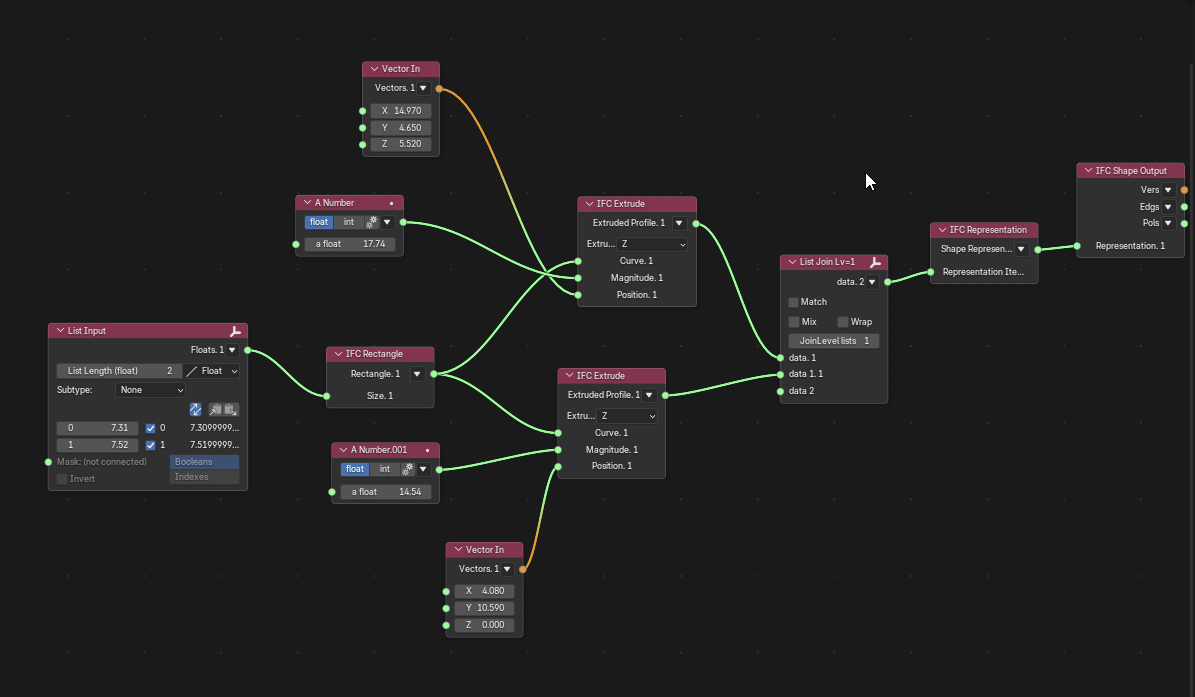
Demo - https://files.catbox.moe/extsxf.mp4

But now it requires ifcsverchok graph to be nested inside a subgroup because we need a way to indicate which graph parameters are important, so user can modify them from Parametric Geometry tab without actually explicitly opening sverchok graph.
This reverts commit 96fe9b5398.

This commit contains a logical error where hide_viewport is checked in
the if statement but hide_set() is used as the effect. This causes a
regression in tests about project visibility. `hide_viewport` is the
correct hiding setting to use, because hide_set is more ephemeral and
affected by Shift-H, Alt-H etc.
Previously, when the add occurrence modal operator was executed, on
every modal loop (i.e. every mouse movement) it would fetch the mesh
geometry to be previewed, store the verts / edges / faces in mesh
collections, then the decorator would fetch that geometry, the clear the
collections, in a loop.

I've removed the Blender collections. Instead the same strategy is used
as in ItemDecorator i.e. the mesh and verts are fetched once during
decorator installation, then on each draw call only a single vertex loop
to multiply by the transformation matrix for snapping and mouse
position.

You can test with the LOD400 model in #7566. On my machine it would
cause lag on anything with >500 faces. Now it seems to work without lag
on a 26k polygon mesh.
Although it is a very cool trick, I feel this essentially duplicates the
UI in two spots, and is an outlier in UX. I'd prefer for all IFC data
and relationships to be in one location only (the panels). I think there
are a better unified solutions (e.g. favourite bookmark panels) for
quick access for things like this.
Some files were not shown because too many files have changed in this diff
Show More
Reference in New Issue
Block a user
Blocking a user prevents them from interacting with repositories, such as opening or commenting on pull requests or issues. Learn more about blocking a user.
 Ryan Schultz