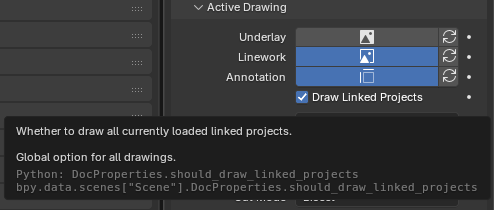
Add a "Copy" option to bim.cad_offset. When enabled (the
default) it offsets a new copy of the selected edges as
before; when disabled it moves the existing edges to the
offset location instead. The toggle is exposed in the CAD
tool's Offset panel and the operator redo panel.
Generated with the assistance of an AI coding tool.
IFC2X3 representations have no HasShapeAspects inverse; opening the
Geometry & Materials subpanel on an IFC2X3 object raised AttributeError
and left the items list empty. Wrap the access with a getattr default
so pre-IFC4 schemas return an empty iterable, and pin the contract with
an AST forward-compat guard that scans bim/, tool/, and core/ for any
future direct .HasShapeAspects access.
Closes#8157
Generated with the assistance of an AI coding tool.
The check `len(bytedata) == n * 2` was wrong: float64 is 8 bytes per
element, not 2. Legacy float64 checksums fell through to the float32
reader and produced a (2n,)-shaped array, breaking is_moved() and
is_camera_moved() with `ValueError: operands could not be broadcast`
on .blend files saved by Blender <5.0.
Adds a parametrized regression test covering both n=3 (translation)
and n=9 (rotation) for both dtypes.
Generated with the assistance of an AI coding tool.
GizmoWallEdition.position_gizmos used props.anchor_x / props.length
for the in-range check (split icon visibility) and perpendicular
gizmo placement. Those props mirror IFC and are re-primed by
_maybe_resync_wall_props_from_ifc — any operator path that skips
the re-sync leaves the perpendicular gizmo clamped to the previous
wall extent, so the icon parks at the old wall end instead of the
cursor's orthogonal projection. Visible after a wall mutation as
the perpendicular icon landing way off the cursor in top-down view.
Switch to the mesh bbox along local X. recreate_wall rebuilds the
mesh to match the current IFC body on every wall mutation, so
bound_box is authoritative without an explicit props sync.
Generated with the assistance of an AI coding tool.
MEP elements imported as tessellation / brep (no IfcExtrudedAreaSolid
or IfcSweptDiskSolid in their body representation) can't be
parametrically edited — the gizmos offer affordances the geometry
kernel has no path to honour. tool.System.has_parametric_body
inspects the Model/Body/MODEL_VIEW representation and returns True
only when at least one item resolves to one of the two
profile-sweep primitives.
The gate is wired into:
- GizmoMEPActions.is_eligible_object (the action icon group)
- _active_is_flow_segment / _active_is_bend_fitting visibility
predicates the icon row consults per-icon
- GizmoPipeSegmentEdition / GizmoDuctSegmentEdition is_element_type
tool.Parametric.is_pipe_segment / is_duct_segment stay IFC-class-only
so their truth-table contract test keeps reading a single concern.
Generated with the assistance of an AI coding tool.
Pure-math parallelism check (value ≡ 0 mod π within VTX_PRECISION)
that lived as a module-private helper in mep.py belongs next to
tool.Cad.is_x — same comparator family, no MEP-specific knowledge.
Other features with rotation-difference checks (wall fillet, roof
slope, railing terminus) now have a sanctioned spelling.
Generated with the assistance of an AI coding tool.
Four standalone test files pinning contracts the production code
already honours:
- test_mep_actions_cache.py: GizmoMEPActions visibility-predicate
cache evicts on selection or generation change.
- test_mep_bend_preview_cache.py: bend decorator polyline cache
re-uses within a generation and rebuilds on generation bump.
- test_mep_distribution_fit_smoke.py: bim.fit_flow_segments
round-trips a 3-segment polyline without raising.
- test_preview_cancel_ops_forward_compat.py: AST scan ensures every
preview Enable* operator has a paired Cancel* operator with the
matching prop reset.
Generated with the assistance of an AI coding tool.
Two small refactors:
- apply_transform_modal_draw_gate(group, context) replaces the
three-line _is_transform_modal_active + _hide_all_non_modal_gizmos
pair that BillboardingGizmoGroupMixin, BaseParametricGizmoGroup
and BaseSchematicGizmoGroup all repeat in draw_prepare.
- decorator.py renames _stroke_lines_alpha to a public-scope
draw_polyline_segments and drops the no-longer-private companion
docstring reference; the function is now usable by sibling
decorators that draw polyline overlays.
Plus a few one-liner tweaks in tool/model.py and opening.py
following the helper rename.
Generated with the assistance of an AI coding tool.
Two hot paths the gizmo polls fire every viewport event memoise
their result against tool.Parametric.get_geom_generation():
- tool.Blender.Modifier.any_selected_array_child caches the
per-selection scan against the selection identity-set + the
IFC generation token so a stable selection during a drag
doesn't re-walk every selected object's BBIM_Array pset every
frame.
- bim/module/model/wall.py grows a pair-predicate + connection
cache that the wall topology gizmos hit; both keyed on
(pair_uids, predicate_kind, generation) so a wall split or
axis edit invalidates correctly via the generation bump.
Behavioural contract is unchanged — stale entries are evicted
on generation bump; cache miss returns the same value the
un-cached path returned.
Generated with the assistance of an AI coding tool.
bim/module/model/conftest.py exposes the autouse _require_real_bpy
skip-guard, four make_* factories (obj / element / context /
ifc_file), and a patched_tool context-manager factory that wires
the half-dozen tool.* boundary patches every gizmo + decorator
test was repeating.
Existing test files in the directory drop their local copies of
_require_real_bpy and adopt the patched_tool / make_* fixtures
where the call site simplifies — test_mep_port_operators.py is
the biggest beneficiary (−89 LOC).
No production behaviour change.
Generated with the assistance of an AI coding tool.
Three concerns bundled by file boundary (all in mep.py):
- Extract bend preview operators + GizmoBendPreview into a focused
mep_bend_preview.py module; preview_base.py grows the shared helper
set both bend and other previews now consume; classes tuple in
model/__init__.py updated to register the new module.
- Surface ERROR reports on five silent CANCELLED returns in
MEPUnjoinAtPort / MEPRemoveTerminalFitting / MEPUnjoinPair so a
degenerate IFC file ("fitting has no Blender object", "connected
port leads nowhere") shows up in the popup instead of looking like
a no-op.
- DRY: _resolve_active_mep_segment + _require_port_state factor the
segment-id-or-active-object resolve + port-state guard out of every
port operator's prologue; _wire_anchored_icon_targets pulls the
GizmoMEPActions setup() body into an exercise-without-MRO helper so
the wiring-contract tests can hit it without instantiating the
GizmoGroup.
Drops the now-unused preview_base import that the extraction left
behind.
Generated with the assistance of an AI coding tool.
The opening preview's outline used a single-batch two-pass scheme that
dimmed the occluded back pass via alpha=0.25. The visible front pass also
inherited the source decorator color's modest alpha, so the outline read
as subtle on both sides.
Replace with a CAD hidden-line convention: solid full-alpha front pass on
the visible side, world-space dashed back pass on the occluded side. Both
passes use POLYLINE_UNIFORM_COLOR so depth and line-weight paths match.
The dashed batch is built once per object epoch by a new pure helper
tool.Blender.build_dashed_line_segments (pre-segments edges into world-
space dash chunks), then cached via the existing batch-cache mechanism
under "<uid>_dashed".
The solid front pass is rendered at a slightly wider line width than the
dashed back pass so its halo overpowers Blender's WIRE-display overlay
bias at outline pixels — without the asymmetry the wire's anti-z-fight
forward bias makes the LESS_EQUAL comparison narrowly fail and the
dashed pass wins on visible edges too.
Generated with the assistance of an AI coding tool.
MEPConnectElements took obj1_name/obj2_name (Blender object names),
which break when objects are renamed or replicated by array
duplication. Switch to obj1_guid/obj2_guid resolved via
ifc_file.by_guid, with by_guid RuntimeError surfaced as an operator
error rather than a stack trace. DrawPolylineProfile (the sole
in-tree caller) updates to pass GlobalIds.
Generated with the assistance of an AI coding tool.
Pins the geometry contracts the hand-meshed bend body relies on
while IfcSweptDiskSolid round-trip is broken upstream (#8106):
- profile cross-section sampling: circle returns 16 evenly-spaced
points starting at (radius, 0); rectangle returns the four
canonical corners; anything else returns None so the rep swap
is skipped rather than meshed against the wrong section
- parallel-transport framing keeps the cross-section continuous
around L-shaped corners — pinned via start / end ring planes
- initial_basis override seeds the first ring with the source
segment's local +X / +Y axes, fixing the asymmetric-rectangle
twist the world-Z seed produces
Generated with the assistance of an AI coding tool.
Pins which IFC mutation each port operator commits and which
inputs each refuses with CANCELLED:
- MEPUnjoinAtPort removes the fitting + reconnects the two free
ports; refuses if the named port is free or terminal
- MEPRemoveTerminalFitting deletes the terminal element + leaves
the segment's port free; refuses on bridged fittings
- SelectMEPPathMembers walks IfcRelConnectsPorts in both
directions from the active segment and selects every fitting /
segment reachable through the port graph
Boundary mocks for tool.Ifc, tool.System and MEPGenerator stand
in for the IFC fixture; tests assert against the recorded
ifcopenshell.api.* calls.
Generated with the assistance of an AI coding tool.
Pins two regressions the live MEP gizmo group can hit:
- per-icon setup() must write `position` (and `mode` on open-lock
icons) onto every target_set_operator result; the test stands in
for the AttributeError on bim.mep_add_obstruction that surfaced
when a field was dropped from the operator declaration
- each visibility_condition lambda must stay total against None /
non-IFC inputs, since a single raising predicate silently disables
every sibling icon in the group
Generated with the assistance of an AI coding tool.
ProfileDecorator.draw_faces (used by the roof path-edit overlay) and
SystemDecorator.draw_faces called bmesh.ops.triangulate on the live
bmesh — both mutated the input and produced ear-clip fans that rendered
as visible streaks across n-gon roof faces at alpha 0.1. The opening
DecorationsHandler edit-mode branch had a separate bug: it computed
triangles from obj.data.calc_loop_triangles() while iterating the
edit-mode bmesh, so any topology added mid-edit desynced the indices.
Centralise the correct draw path on tool.Blender.draw_bmesh_face_tris
(wraps bm.calc_loop_triangles, non-mutating, beauty triangulator) and
route all three call-sites through it. A forward-compat AST guard walks
every *Decorator / DecorationsHandler class under bim/module/ and pins
the no-bmesh.ops.triangulate rule against future regressions.
Generated with the assistance of an AI coding tool.
A user clicking the pen icon on a typed-product occurrence whose body
representation is mapped from its type would silently mutate every
sibling occurrence's geometry. Add a confirmation dialog at the pen-icon
dispatcher (the single chokepoint every feature routes through) showing
the sibling count, with a session-scoped suppress checkbox.
The check is read-only: tool.Model.get_sibling_occurrence_count wraps
tool.Geometry.get_elements_by_representation against the resolved body
rep and subtracts self + type. A forward-compat AST guard pins the
dispatcher monopoly so any future feature that binds pen_gizmo directly
to a feature-specific enable op fails the test before merge.
Generated with the assistance of an AI coding tool.
Once a bend was created, the only way to retune start_length /
end_length / radius was to delete and recreate from scratch.
EnableBendPreviewFromBend re-opens the preview on an existing
parametric bend: it walks the bend's ports to resolve the two
connected segments, reads start / end length and radius from the
bend type's BBIM_Fitting pset, and sets editing_bend_id on the
preview props. MEPAddBend then deletes the old bend + its port
connections (single undo step) before the recreate path runs, so
finish replaces the bend in place and cancel discards the edit
without touching the original.
GizmoMEPActions surfaces a pen icon on single bend-fitting
selections via the new _active_is_bend_fitting predicate; the icon
dispatches the new operator. Mirror of the wall fillet re-edit
flow (EnableWallFilletPreviewFromCorner + editing_corner_id in
CreateWallFillet).
Test coverage: registration probe for the new operator, an attached
editing_bend_id field probe on the preview umbrella, and a
parametrized truth-table for the _is_bend_fitting predicate
(IfcFlowFitting with BEND PredefinedType, with other PredefinedType,
with no type, IfcFlowSegment, IfcWall, None).
Generated with the assistance of an AI coding tool.
Wall topology mutations (merge / join / extend-to-wall / unjoin /
fillet) applied to a Bonsai array child are silently overwritten by
the next ``regenerate_array``; merge also orphans a GUID listed in
the parent's ``BBIM_Array.Data``. Add a central
``tool.Blender.Modifier.any_selected_is_array_child`` predicate and
gate the five wall topology gizmo groups plus the six bound operators
behind it. Operator gating is defence in depth against keymap / F3
invocation paths that bypass the gizmo.
The base ``_wall_gizmo_poll_gate`` keeps its loose two-check shape
(viewport gizmos + no preview). A new
``_wall_topology_gizmo_poll_gate`` wraps it with the array-child
filter and is what the topology gizmos use. Host-opening gizmos
deliberately stay on the loose gate: openings authored on a child
are preserved through ``regenerate_array`` and track with the
replicated instance.
A forward-compat AST guard walks wall.py for ``GizmoGroup`` subclasses
and asserts each routes its poll through the tighter gate or the
central predicate, with an allow-list for the parametric-edit and
preview-owner exceptions. New wall topology gizmos inherit the
contract by construction.
Generated with the assistance of an AI coding tool.
Selecting a Bonsai-parametric IfcDoor now shows the swing arc(s)
without entering edit mode. A new viewport decorator polls on the
active object, reads the door's BBIM_Door pset, and draws the same
arcs the parametric door swing gizmo would draw — matching the
hinge / panel-width / x-mirror contract minus the is_editing gate.
A forward-compat test walks every door operation type and cross-
checks the readonly decorator's arc selection against the gizmo's
swing-arc config table, so future enum additions fail in both
surfaces simultaneously.
Also disables the inherited 8-pass dark halo on GizmoArc: an open
curve has no enclosed silhouette, so the offset passes read as
ghost arcs rather than a uniform outline. The arc's own cross-
section thickness keeps it legible without the halo.
Generated with the assistance of an AI coding tool.
The MEP bend feature's IfcSweptDiskSolid representation produces
geometrically correct output but fails to round-trip through the
OpenCascade geometry kernel (upstream issue #8106) — the body is
dropped on the next file load. Until upstream is fixed, MEPAddBend
captures the bend centerline in world space before the segments are
extended (otherwise the post-extension axes no longer reach the
original intersection and arc reconstruction is wrong), then after
the fitting is placed it hand-meshes the bend body and swaps the
type's swept-disk representation for an IfcTessellatedFaceSet via
tool.Geometry.export_mesh_to_tessellation + tool.Model.
replace_object_ifc_representation.
The centerline includes the straight start_length / end_length legs
in addition to the arc so the bend covers the full segment-to-
segment span. Sweep uses parallel-transport framing — each ring's
(right, up) basis is rotated by the minimum rotation that maps the
previous tangent to the current one, eliminating the twist a fixed
world-axis reference produces when the tangent crosses the
reference. Cross-section orientation seeds from the source segment's
matrix_world local +X / +Y so asymmetric IfcRectangleProfileDef
ducts land with XDim / YDim on the same axes the segment expects;
parallel transport then preserves that alignment around the arc.
Centerline radius is radius + profile_dim[lateral_axis] to match
MEPAddBend's ref_point_radius — without this offset, the bend legs
fall short of the extended segments by profile_dim * tan(angle/2).
Face winding is left to the caller to correct via
bmesh.ops.recalc_face_normals on the closed bend tube.
Two FIXME(#8106) markers (capture site + helper call site) so both
can be dropped once upstream lands a swept-disk round-trip fix.
Generated with the assistance of an AI coding tool.
IfcTriangulatedFaceSet/IfcPolygonalFaceSet were introduced in
Fix#7992: IFC4 and do not exist in IFC2X3. Previously, requesting an
IfcTessellatedFaceSet representation in an IFC2X3 file silently
fell back to a faceted brep after unassigning material sets.
Add a guard in the update_representation operator (user-facing
error) and in the add_representation API (ValueError) so the
unsupported request is caught instead of failing silently.
Generated with the assistance of an AI coding tool.
GizmoWallEdition gains a fourth cursor-anchored icon that
spawns a perpendicular branch wall from the cursor's
orthogonal projection on the source wall axis. Click forms
a T-junction; shift+click forms an L-corner with the source
wall trimmed at the projection, keeping its longer portion.
The branch inherits the source's spatial container and
centerline baseline so its authored axis matches the source's
alignment rather than the type's default.
Also includes a floor-plane preview quad for the new gizmo,
a floor-Z cross line on the split preview for top-down
visibility, a small bump to QUAD_ALPHA for clearer preview
fills, and a stacking-offset helper that centralises the
cursor-row screen-up step across three call sites.
Generated with the assistance of an AI coding tool.
The MEP one-shot operators (join, unjoin variants, terminal removal,
path-select, obstruction add/remove) had no viewport surface. This
commit adds GizmoMEPActions — the icon-action gizmo group that
surfaces them as billboarded icons around selected MEP elements.
Three anchor regions: a horizontal row above the bbox top
(selection-cardinality icons), per-port endpoints for the three-state
lock / unjoin icons (open lock for PORT_FREE, closed for
PORT_TERMINAL, unjoin for PORT_JOINED — resolved per-frame from
port_connection_state), and the predicted join location
(compute_mep_join_location, shared with the bend preview) for the
join / unjoin_pair pair. Unjoin icons render at full
DEFAULT_BILLBOARD_SCALE with warning-red hover; endpoint lock icons
shrink so the lock row stays subordinate to the row icons. The
group hides itself entirely while a bend preview is active.
MEPAddObstruction grew a position enum (CURSOR / START / END) and a
mode enum (ADD / REMOVE / TOGGLE) so the gizmo can target a specific
port without touching the cursor and dispatch ADD or REMOVE based on
the click target — the lock_open icons drive ADD with position
pinned, the lock_closed icons drive bim.mep_remove_terminal_fitting.
Without the new fields the gizmo wiring (op_props.position = ...)
crashed at setup() with AttributeError on the obstruction operator.
validate_bend_preconditions extracts the type-match and profile-kind
checks MEPAddBend enforces so EnableBendPreview surfaces the
rejection immediately — the user no longer tunes a preview only to
learn at commit time that the segments use an unsupported profile
(e.g. IfcArbitraryClosedProfileDef).
Generated with the assistance of an AI coding tool.
Four discrete one-shot operators driven by the MEP segment's port
state. mep_unjoin_at_port deletes the IfcFlowFitting bridging a
segment's named port to a second element when the port is in the
JOINED state. mep_remove_terminal_fitting deletes the terminal
fitting at a port (closed-lock state) and dispatches by fitting
type — OBSTRUCTION fittings go through MEPGenerator.remove_obstruction
so the segment absorbs the freed length, other terminal fittings go
through the standard delete path. mep_unjoin_pair finds the single
fitting bridging two selected MEP segments and deletes it.
select_mep_path_members walks the connected MEP network from the
active element via IfcRelConnectsPorts and replaces the selection
with every reachable member. Foundation for the MEP Actions gizmo
group which surfaces these operators as icon affordances around
selected segments.
Generated with the assistance of an AI coding tool.
The extend icon used a pure screen-space billboard that always
pointed +X across the screen — the arrow ran horizontally
regardless of the pipe / duct's orientation. The new
billboarded_along_axis helper rotates the gizmo about the camera-
forward axis so its local +X aligns with the segment's local +Z
projected onto the screen, keeping the icon camera-facing but
visually following the extrusion direction. The flip-mirror branch
now reads from cursor-vs-current-end along the segment axis (not
screen-X), so the arrow points away from the current endpoint
regardless of viewport orientation. The split icon stacks
perpendicular to the rotated extend arrow in screen space so the
two don't overlap.
The decorator's green preview line no longer clamps the cursor
projection to min_projected_length — it follows the raw projection
so the line stays visible when the cursor crosses behind the
segment origin (the user still sees where they're pointing even
though the operator floors the actual commit).
Generated with the assistance of an AI coding tool.
The bend preview gizmo group (commit 2) populated a Scene draft but
the user saw nothing in the viewport until they hit finish — they
had to commit blindly. This commit ports the BendPreviewDecorator
(centerline arc + two leg projections on valid geometry, warning-red
axes on invalid in-segment intersections) and the interactive
GizmoBendPreview group (three dimension widgets for start_length /
end_length / radius plus validate / cancel icons). The bend axis
math lives in a pure compute_bend_preview_polylines helper, fed
into both the gizmo group's per-frame positioning and the GPU
decorator's draw path. MEPSegmentExtendPreviewDecorator lands at
the same time because it shares the decorator install / uninstall
plumbing — renders the extend-to-cursor preview line for the
GizmoPipeSegmentEdition / GizmoDuctSegmentEdition extend icons
when hovered, clamping the projected endpoint to the operator's
minimum so the preview matches where the commit lands. The
MEPJoinSegments dispatcher routes two selected MEP segments to
mep_add_transition (parallel) or enable_bend_preview (non-parallel)
— the F3 search entry point that makes the bend preview testable
before the gizmo-icon dispatch lands.
11 new tests in test_mep_bend_preview.py cover the geometry helper
truth table (parallel rejection, right-angle happy path, near-
collinear rejection, in-segment invalid_axes), the
_intersection_past_near parametrized boundary, registration probes
for the lifecycle operators / join dispatcher / gizmo group /
decorator, and the FinishBendPreview RuntimeError catch contract.
6 extend-preview-line tests (deferred from commit 3) join the
existing 35 in test_mep_segment_edition.py.
Generated with the assistance of an AI coding tool.
Spatial.get_root_element walks aggregate / nest / filled-void /
voided-element chains and core.assign_container assigns the container
to whatever the walk returns. For an IfcDoor the filled-void hop
redirects to the IfcOpeningElement, then voided-element to the host
wall, so a user who selects a door and runs bim.assign_container ends
up targeting the wall — and silently no-ops on the door if the wall is
already in the target storey.
Per IFC4 / IFC4.3 (IfcDoor, IfcWindow): the spatial containment of a
filling is defined independently of the filling relationship. Major
exporters (Revit, ArchiCAD, Tekla, Allplan) emit independent
ContainedInStructure on doors / windows accordingly. Drop the
filled-void / voided-element hops from the walk; aggregate and nest
remain — those are true sub-part relationships where the parent
legitimately owns the container.
New TestGetRootElement in test/tool pins the new contract (filling
resolves to itself) plus the retained aggregate / nest / loose-element
paths so a future PR that re-adds either hop is caught. Two new
TestAssignContainer cases in test/core pin filling-to-self through the
core layer and per-element can_contain filtering.
Generated with the assistance of an AI coding tool.
Pipe and duct segments had no parametric-edit affordance — the only
length edit path was a property panel value with no live preview.
This commit ports the per-segment parametric edit triad
(enable / finish / cancel) plus a cursor-anchored extend operator
and a cursor-projected split operator into one gizmo group per
segment type. The two PropertyGroups (BIMPipeSegmentProperties,
BIMDuctSegmentProperties) host the draft length plus snap fields
so cancel / no-op-finish restore the segment to its exact pre-edit
visual state including a non-identity pre-edit scale. Length
commits are written through DumbProfileJoiner.set_depth and
auto-dispatch bim.regenerate_distribution_element so adjacent
fittings track the port move. The split operator preserves
downstream port connectivity and runs through tool.Ifc.run for
single-step undo. The two segment types are now first-class
entries in tool.Parametric.EDIT_TYPES, which resolves the FIXME
on auto-commit-on-save dispatch.
35 unit tests cover predicate truth tables, segment_world_length
geometry, preview-via-scale / restore-scale helpers, gizmo class
wiring, lifecycle operator registration, dimension matrix_position
rotation respect, and lifecycle drift-handling. The 6 extend-
preview-line decorator tests stay deferred until the bend preview
decorator commit lands MEPSegmentExtendPreviewDecorator.
Generated with the assistance of an AI coding tool.
Parametric gizmos (wall/door/window/stair/roof/array/MEP) recompute
matrix_basis every frame from obj.matrix_world. While Blender's
transform modal (G/R/S and the Bonsai macro overrides) drags the
matrix, the gizmos slide off-cursor and fight the transform overlay.
Detect via context.window.modal_operators (Blender 4.2+) — the
collection of running modal operators. Gate poll() (forward-compat)
and draw_prepare() (production path: gizmo.hide=True preserves the
GizmoGroup across the drag instead of destroying it). Cover the
Bonsai macro override for G key (and Shift/Alt/Ctrl+Shift+D) by
matching the BIM_OT_* macro idnames that surface in modal_operators.
Forward-compat test walks every parametric-edit module for GizmoGroup
subclasses and asserts poll returns False with the detector mocked,
so new gizmo groups inherit the hide automatically.
Generated with the assistance of an AI coding tool.
Every preview operator (commit + cancel for both bend and wall
fillet) was inlining the same 3-4 line cleanup: set is_active to
False, zero every *_id IntProperty. The new clear_preview_state
helper in preview_base.py introspects bl_rna and applies that
contract generically — adopters become a single call. Two new tests
pin the contract: every *_id IntProperty zeroes, non-id fields stay.
Generated with the assistance of an AI coding tool.
Extract the pending_opening_recut tracking, three operators (apply /
dismiss / select), Project-panel banner, and the sibling
multi-instance warning banner (its backend helpers already landed
on this branch) from commit a85ed6032 on gizmos-8088.
All tool.* dependencies (Geometry.reimport_element_representations,
Blender.set_objects_selection, Array.*) and IfcImporter.gross_elements
are already on this branch -- no other diffs from a85ed6032 are
pulled.
The source's narrow except-tuple paraphrase comments are trimmed
to keep only the durable "don't swallow programmer errors" note,
per CLAUDE.md s4a.
Tests: 5 bim-lane tests in test/bim/module/project/
test_pending_opening_cuts.py covering apply happy-path + missing
entity, dismiss, select happy-path + cancellation.
Generated with the assistance of an AI coding tool.
MEPAddBend exists on the main flow but commits bend geometry with
hardcoded defaults (start_length=0.1, end_length=0.1, radius=0.2)
with no opportunity to tune before commit. The new scene-level
BIMBendPreviewProperties hosts a draft (start_segment_id,
end_segment_id, start_length, end_length, radius); EnableBendPreview
populates it from the two selected MEP segments after asserting they
are non-parallel, FinishBendPreview dispatches MEPAddBend with the
tuned values and clears the draft, CancelBendPreview discards it.
Scene-level placement follows CLAUDE.md 2.9: a bend creates a new
fitting entity between two segments, so neither segment alone owns
the draft. Foundation for the upcoming bend preview gizmo group and
decorator.
Generated with the assistance of an AI coding tool.
When an operator mutated IFC then raised mid-execute the user was left
staring at a raw traceback with the IFC graph captured by the active
transaction but the Blender side stale. Blender does not push an undo
step for a raised operator (the same gap that the CANCELLED-modal arm
patches via bpy.ops.ed.undo_push), so the WARNING the framework can
emit is only honest if it pushes that undo step too. The framework
now detects partial state via ifc_file.transaction.operations,
pushes a Recover undo step, then reports a WARNING naming Ctrl+Z so
the recovery path is discoverable. The bespoke try/except wrapper in
UnjoinWallPathConnection becomes redundant and is retired in the
same change.
Generated with the assistance of an AI coding tool.
Three files flagged by black --check on the lint-formatting job:
* bim/module/geometry/operator.py — single-arg `.update(...)` rejoined
onto one line under the 120-char budget.
* test/bim/module/model/test_wall_gizmos.py — same join on a
_make_path_rel call.
* test/modal/test_modal.py — pre-existing baseline noise picked up
via the upstream merge: PEP-8 blank-line separators between top-
level functions, `0.68+` → `0.68 +`, double quotes, trailing
whitespace stripped.
No behavioural change; pure whitespace.
Generated with the assistance of an AI coding tool.
The toggle_openings icon lived outside the IconSlot layout — each
host (wall, roof) declared an ad-hoc setup_pen_row_toggle_openings_icon
+ update_pen_row_toggle_openings_icon pair, and GizmoArrayEdition
queried a hardcoded _FEATURE_IDLE_MAX_X dict to position past it.
On an arrayed wall the dict was shadowed: find_for_element returns
"array" before "wall" in EDIT_TYPES order, the wall reservation was
never consulted, and the first per-layer ARRAY icon (local X=0.37)
landed 13cm from the wall's toggle_openings (X=0.50) — visually on
top of each other.
Promote idle-row icons into the slot system instead of patching the
dict:
* IconSlot gains an Optional visible_when predicate for state-driven
visibility (toggle_openings only when the host carries openings).
* BaseParametricGizmoGroup gains idle_slots: ClassVar[tuple[IconSlot]]
+ _idle_slot_x_positions() + _idle_row_right_edge() helpers; the
setup + idle-branch positioning loops mirror the existing
feature_slots path.
* Wall and roof declare toggle_openings as an idle_slot and drop
their ad-hoc setup/update calls.
* GizmoArrayEdition's _resolve_feature_idle_max_x walks
BaseParametricGizmoGroup.REGISTRY and takes the max
_idle_row_right_edge() across peers whose poll passes — no more
hardcoded dict, no more find_for_element-order shadowing.
* setup_pen_row_toggle_openings_icon + update_pen_row_toggle_openings_icon
helpers deleted from drawing/gizmos.py.
* 3 forward-compat AST guards pin the new contract.
Also bundles an unrelated array-test fix: TestUsingArrays in
test/tool/test_model.py was asserting against bpy.context.selected_objects
which is a fragile signal after remove_array / apply_array. A new
_array_objects() helper filters bpy.data.objects via the BIM_Array
pset's IfcActuator type instead.
Layout on an arrayed wall after the fix:
pen X = 0.00
toggle X = 0.50 (idle_slot 0)
array[0] X = 0.87 (one ICON_ARRAY_GAP past idle row)
array[1] X = 1.27
All separated by the standard inter-icon spacing.
Generated with the assistance of an AI coding tool.
In plan view world-Z collapses to zero on screen, so every wall-edit
icon anchored on the floor — the projected 3D cursor, wall endpoints,
wall-to-wall corners, IfcRelConnectsPathElements connection points —
projects onto the click target it represents. The result on a typical
extend / split / unjoin action: the icon sits on top of the cursor
crosshair (or the corner the user wants to click), defeating precise
positioning.
Add shared ``gizmo.top_down_clearance(context, billboard_rot)`` to
bim/module/drawing/gizmos.py: returns a screen-up Vector in top-down
view (cosine cone around world Z, matching ``is_view_top_down``) and a
zero Vector elsewhere, so call sites apply it unconditionally before
``billboarded_at``. Default distance 0.4 m aligns with the inter-icon
stack spacing already used by GizmoWallJoinIntersection so single
icons and stack bases land at consistent screen-up positions when
multiple groups render around the same wall endpoint.
Apply at the seven wall-edit anchor sites:
* GizmoWallEdition cursor stack (top-down branch only — non-top-down
already stacks along world-Z at structural points clear of the
cursor).
* GizmoWallExtendVertically (single icon at wall origin endpoint,
active-object Z elevation).
* GizmoWallJoinIntersection corner stack base + merge midpoint.
* GizmoWallUnjoinSingle link-toggle pool (one icon per IFC path
connection, previously sitting exactly on the connection point).
* GizmoWallFilletReedit pen icon at fillet corner.
* GizmoWallFilletToggleOpenings.
The clearance is a pure visual offset — bound operators still read
the world-space anchor (cursor / endpoint / connection point) at
execute time, so the action's target is unaffected.
Also tighten GizmoWallUnjoinSingle: gate poll on ``props.is_editing``
so the link-toggle icons only surface during the wall edit lifecycle
(matching every other edit-row icon), and downsize them via a new
``ICON_SCALE = 0.35`` constant since 16 of them at default scale
cluttered the viewport on path-heavy walls.
ruff + black clean. Wall gizmos test lane 14/14 pass.
Generated with the assistance of an AI coding tool.
Some distributions (e.g. Fedora) ship only a shared RocksDB that exports
RocksDB::rocksdb-shared rather than RocksDB::rocksdb. The CMake target
selection now falls back to the shared target when the static one is absent.
Newer RocksDB also changed DB::Open and DB::OpenForReadOnly to take
std::unique_ptr<DB>* instead of DB**. IfcFile.cpp uses SFINAE tag dispatch
to build against both old and new APIs without version detection.
CGAL 6.x deleted operator< from Point_d, so std::map<Point_d, ...>
no longer compiles. Adds a custom lexicographic comparator and updates
the three affected maps in snap_halfspaces and snap_halfspaces_2.
bim/handler.py was importing two feature-module internals
(wall_offset_gizmos.clear_caches, preview_base.discard_pending_previews)
to drain load-transient parametric state alongside the existing
tool.Parametric.heal_stale_edit_flags() call inside
_apply_save_file_invariants. Each new parametric drain added one
top-level import and one inline call — every load_post drain leaked
into handler.py's namespace.
Hide all three drains behind tool.Parametric.on_load_post(scene),
sited adjacent to heal_stale_edit_flags. The two feature-module
imports become late imports inside on_load_post — same pattern as
refresh_post_commit's existing `import bonsai.bim.handler` — which
sidesteps the tool.parametric -> bim.module.model.preview_base ->
bonsai.tool registration-time cycle.
The forward-compat AST contract that pinned "every module-scope
GenerationKeyedCache + clear_caches MUST be drained on load_post"
follows the call site to its new home — the test now walks
tool.Parametric.on_load_post instead of _apply_save_file_invariants.
No behaviour change. 45/45 affected bim tests pass
(test_handler_forward_compat, test_preview_base,
test_wall_offset_gizmos, test_parametric_registry).
ruff + black clean on all touched files.
Generated with the assistance of an AI coding tool.
Three feature-specific decorators previously lived in
bim/module/model/decorator.py despite owning state only their
home module reads:
* ArrayPreviewDecorator + ArraySelectionHighlightDecorator +
draw_array_layer_children_bbox -> array.py (read array
edit-state props and walk BBIM_Array psets)
* WallGizmoPreviewDecorator + draw_wall_partner_bbox -> wall.py
(dereference wall.py-private classes and helpers via lazy
imports)
decorator.py keeps cross-cutting infrastructure
(BoundingBoxDecorator, SlabDirectionDecorator, WallAxisDecorator,
WallFilletPreviewDecorator, PolylineDecorator, ProductDecorator)
and the shared bbox primitives (bbox_world_edges,
draw_polyline_segments, _BBOX_EDGES, _stroke_lines_alpha,
_fill_quads_alpha) that several feature files now import.
handler.py and gizmos.py update their import paths; the
wall-feature lazy imports inside WallGizmoPreviewDecorator
methods collapse to direct references now that the decorator
lives in wall.py.
No behaviour change. Wall lane 37/37, array lane 15/15, wall
forward-compat 6/6, parametric-registry 8/8 still pass.
Generated with the assistance of an AI coding tool.
Three concerns sharing the same architectural theme (collapse inline
bbox / edit-state lookups, drop overrides that re-do base-class work):
== Bbox helpers and array operator DRY ==
* tool/blender.py: add a "dimensions" tuple key to both
get_object_bounding_box and get_object_world_bounding_box return
dicts. The (max - min) per-axis extent — which callers previously
computed via local helpers — is now a key alongside min_x / max_x
/ min_point / max_point / center. Distinct from Blender's built-in
obj.dimensions (which folds object-level scale): the local variant
is the intrinsic mesh bbox extent; the world variant is the
matrix_world-applied AABB.
* bim/module/model/array.py: drop the local _bbox_dims helper; the
two callers now read tool.Blender.get_object_bounding_box["dimensions"]
directly.
* Rename _parent_geometry_changed -> _array_children_need_rebuild.
The old name suggested "did the parent change just now", implying
the function was a parent-edit-finish trigger. It actually runs
only inside the array-edit-finish path as a drift safety net (the
upstream-deliberate design — see commit 83d97d7e9 "Fix #7616. Make
regenerate array an operator instead of an array preference" —
means the array doesn't auto-regen when its parent geometry edits
finish). New name matches the call-site phrasing
``if X: _wipe_array_children(layers)`` and clarifies that this is
a children-state check, not a parent-edit trigger.
* Extract _resolve_array_edit_props(context) — returns the active
object's array props during an active edit lifecycle, or None.
Collapses the obj-active-then-is-editing prologue (3 lines + return)
to one resolver call across 4 sites: ToggleArrayMethod.execute,
AdjustArrayCount.execute, RemoveArrayLayerFromEdit._execute and
.poll. Each call site shrinks from 7 lines to 3.
* Migrate two inline bbox reads inside GizmoArrayEdition to the new
dict keys: get_axis_world_face_center collapses the manual
xs/ys/zs min/max + center math to bbox["center"] + bbox["max_x"] /
["max_y"] / ["max_z"]; get_element_height collapses
``max(corner[2] for corner in obj.bound_box)`` to
tool.Blender.get_object_bounding_box(obj)["max_z"].
The _BBOX_EQUALITY_EPS = 1e-5 tolerance stays inline as a single-
consumer constant — no other call site needs tolerance-equality on
dimension tuples, so extracting it to a shared util would be
speculative abstraction.
== Drop dead code ==
* GizmoArrayEdition.update_editing_gizmos override + its
_has_other_parametric_type helper: redundant with
hide_pen_button = True at line 1024. The base class already hides
the pen in every idle case (when hide_pen_button is truthy) AND in
every editing case (unconditionally). The override's conditional
hide-when-parametric only re-hid a pen that was already hidden in
both branches. Removes the only remaining path that could re-show
the array's pen icon; array-edit entry is now uniformly via the
per-layer ARRAY icons (which is the documented preferred
affordance, see the hide_pen_button comment).
* _wall_fillet_preview_active in wall.py: defined but never called.
_wall_fillet_props (the sibling thin-wrapper around
preview_base.get_preview_props) is heavily used; the
is_preview_active wrapper was added speculatively and never picked
up a consumer.
Generated with the assistance of an AI coding tool.
Bundled bug fixes + the forward-compat AST guard that prevents the
underlying class of bug from coming back.
* bim/module/model/wall.py: FinishEditingWall._execute early-returns
CANCELLED when props.is_editing is False. Without this guard, a
failed enable (e.g. on a wall without IfcMaterialLayerSetUsage)
leaves is_editing False but a press on finish still walked the
sub-ops below, which dereferenced layer-set-dependent state and
crashed.
* tool/model.py: Model.offset_wall now guards against
ifcopenshell.util.element.get_material returning None before
calling .is_a("IfcMaterialLayerSetUsage"). Fixes the pre-existing
test/bim/module/model/test_wall_header_refresh.py crash that has
been the only failing test in the wall lane since this branch
started.
* bim/handler.py: _apply_save_file_invariants drains
wall_offset_gizmos.clear_caches() on load_post. The module-scope
GenerationKeyedCache instance survives the .blend reload; without
the drain the cache may serve entries whose bpy_struct references
point into the freed bpy.data of the previous file.
* test/bim/test_handler_forward_compat.py: AST-walk test that
enumerates every bim/module/model/*.py source declaring both a
module-scope GenerationKeyedCache assignment AND a top-level
clear_caches function, and asserts each module appears as a
<module>.clear_caches() call in _apply_save_file_invariants. Pins
the contract: any future module-scope geom cache that exposes
clear_caches must wire into the load_post drain.
* test/bim/feature/model.feature + test/bim/test_feature.py: wall
edit-lifecycle scenarios switch from "add cube + assign as
IfcWallType" to "load the demo construction library + add an
occurrence of the WAL100 wall type", so the parametric edit runs
against a real LAYER2 wall with IfcMaterialLayerSetUsage rather
than a vanilla-mesh promotion that lacks one. The demo-library
step also picks the schema-matching library file (IFC2X3 /
IFC4 / IFC4X3) so the appended types remain valid across schemas.
Door saved-height assertion updates from 2.5 → 2500 to reflect
that BBIM_Door pset stores project units (METRIC_MM in the
empty-project fixture).
Generated with the assistance of an AI coding tool.
Fixes builds with newer GCC/libstdc++ that no longer provide <cstdint>,
<cstring>, <cfloat>, <memory>, <algorithm> etc. transitively. Also
disambiguates visit<> calls in taxonomy.h with the full namespace and
casts the character value in IfcCharacterDecoder to uint32_t to silence
ambiguous overload warnings.
When HDF5 is found via its CMake config file, the code previously hardcoded
the hdf5_cpp-static target. On distributions that ship only shared HDF5
(e.g. Fedora rawhide where the config file was added in a newer package),
this caused a link failure. Now checks for hdf5_cpp-static, hdf5_cpp-shared,
and hdf5::hdf5_cpp-shared in order, falling back to module-mode discovery.
bpy.ops.bim.new_project(preset='demo') crashed in
refresh_bim_tool_headers: the post-commit hook fired for every
nested bpy.ops.bim.append_library_element during template
loading, and the operator context Blender hands to
programmatically-invoked nested operators is stripped of the
view-layer attributes the refresh reads.
Two changes resolve it.
Gate the header refresh in tool.Parametric.refresh_post_commit
on operator.bl_idname being one of the EDIT_TYPES finish_op
idnames. Only validate-gizmo commits (bim.finish_editing_<name>)
now trigger the refresh; demo-loader and other non-edit
operators skip it. Querying the registry directly is the
canonical signal — string-prefix matching would silently drift
if ParametricObject.finish_op changes derivation.
Harden tool.Blender.get_active_object so its view_layer fallback
also uses getattr; the 150+ callers routed through it now
tolerate stripped contexts. _resolve_bim_tool_context applies
the same defensive pattern to mode / workspace.
Tests:
- test_handler_restricted_context covers get_active_object's
defensive path and the BimTool-family whitelist (excludes
annotation, spatial, structural).
- test_handler_forward_compat AST-pins that the gate consults
EDIT_TYPES (not a string prefix).
- test_wall_header_refresh rewritten — three tests cover the
gated-by-registry contract: counter bumps for every commit,
finish_op operators refresh headers, others don't.
Hotkey-driven in-place edits (S_E / C_E) no longer trigger the
refresh — they were caught by the pre-refactor "every commit"
design. Left out of scope; the new skip-non-finish test pins
this as intentional.
Generated with the assistance of an AI coding tool.
Two related cleanups bundled because each was too small on its own.
== Drop dead Geometry.has_material_styles duplicate ==
Two parallel has_material_styles implementations existed on HEAD:
* Geometry.has_material_styles (tool/geometry.py:853, added by
3483683cb "Add tool.Geometry helpers for body representation +
placement"): checks each material via tool.Material.get_style
for an IfcSurfaceStyle. This is the implementation gizmos-8088
uses — its core/root.py:58 calls geometry.has_material_styles.
* Root.has_material_styles (tool/root.py:75, added by e76455913
"Route _has_material_styles through tool.Root.has_material_styles"):
checks each material for a HasRepresentation inverse. Added to
fix the test/core/test_root.py::TestCopyClass::test_AAAAAAAAAAAA
failure by routing the check through a Prophecy-mockable seam.
HEAD's core/root.py:59 calls root.has_material_styles. The Geometry
version became orphaned by that migration — zero callers historically
(git log -S "Geometry.has_material_styles" returns nothing). The
Root placement is the right architectural home: has_material_styles
pairs with assign_body_styles in the copy_class flow as "is there
material-defined styling? if not, apply body styling" — both
decisions live on the same interface, called in sequence from the
same caller.
The semantic delta (HasRepresentation vs IfcSurfaceStyle) is a close
approximation in real IFC files where HasRepresentation almost always
indicates a styled material; if precision becomes necessary, the
Root impl can be tightened independently of this cleanup.
Drop the Geometry method + its abstract declaration in core/tool.py.
== Sanitation sweep per CLAUDE.md §4a ==
Eight rot-prone references in code we authored on this branch get
their first-draft mistakes cleaned up. The §4a rule (no sibling
symbol names, no test paths, no motivation history in docstrings)
got added during this branch, so older commits sometimes named their
siblings in prose; this is a focused cleanup of the worst offenders.
* bim/module/model/wall.py:201 — _CommitWallDraftsFirstMixin
docstring carried motivation history ("...that every multi-wall
operator … used to repeat at the top of _execute"). Rewrite to
describe only the current contract.
* bim/module/model/wall.py:1910 — cycle_type_operator comment named
two sibling methods. Rephrase to describe what happens at the slot.
* bim/module/model/wall.py:2025 — _active_instances ClassVar comment
named WallGizmoPreviewDecorator. Rephrase to "the wall-gizmo
preview decorator" (role, not class).
* bim/module/drawing/gizmos.py:3402 — GizmoFillet hit_uses_bbox
comment named GizmoWallJoinIntersection. Rephrase to "the wall-join
gizmo group".
* bim/module/drawing/gizmos.py:3887 — GizmoCountLabel docstring had
a :meth:`set_count` cross-reference. Drop — reader sees the method
next to the class.
* bim/module/model/host_add_opening_gizmo.py:201 — poll-exclusion
comment named GizmoWallEdition + GizmoRoofEdition. Rephrase to
describe why we skip ("walls and parametric roofs both render
their own toggle in the pen row").
* bim/module/void/operator.py:45 — preserve_placement comment named
FilledOpeningGenerator.generate. Rephrase to "the filling-opening
generator gates its snap-to-wall-axis block on this flag".
* bim/parametric_lifecycle.py:64 — module docstring named the test
file path (test/bim/test_parametric_registry.py). Rewrite to
"enforced by the registry contract tests".
Sweep otherwise clean: no third-party software names in this-branch-
authored comments (upstream Revit / Tekla / ArchiCAD references are
legitimate external-constraint workarounds, §4a-allowed). No
PR/issue numbers we authored except the FIXME(PR5) in
tool/parametric.py:150, deliberately preserved until PR6's MEP slice
resolves it.
Generated with the assistance of an AI coding tool.
The 7 multi-wall operators (UnjoinWalls, UnjoinWallPathConnection,
ExtendWallsToUnderside, ExtendWallsToWall, SplitWall, MergeWall,
JoinWallsIntersection) each opened their _execute with an identical
prologue:
_commit_pending_wall_edits_for_selection(context)
# ... operator-specific logic
— flushing any in-progress wall parametric drafts so the operator
acts on committed IFC state rather than the draft preview box.
Extract that prologue into _CommitWallDraftsFirstMixin: its _execute
calls the commit helper, then delegates to a subclass-supplied
_perform. Subclasses inherit the mixin first in their bases tuple so
the mixin's _execute resolves first via the MRO. The IFC transaction
opened by tool.Ifc.Operator.execute still wraps both the commit and
the perform.
Behaviour-equivalent — same call, same order, same selection scope.
Architectural cleanup only: a future multi-wall operator can no
longer forget the commit step. The named helper
_commit_pending_wall_edits_for_selection stays as the single
encapsulation of the names=("wall",) filter; its docstring loses
the stale "every multi-wall operator calls it at the top of
_execute" sentence and now just describes the filter contract.
Matches gizmos-8088's _CommitWallDraftsFirstMixin pattern.
Generated with the assistance of an AI coding tool.
The regular bim.add_opening click on the host-add-opening gizmo
(wall + door/window co-selected) routes through
FilledOpeningGenerator.generate, which snaps the filling to the
wall's reference-line axis, optionally rotates 180° when the
filling sits on the opposite side, and re-applies an rl1 / rl2
Z-elevation default. That is the right default for "drag a fresh
door onto a wall and let the model place it for me", but defeats
the workflow where the user has already positioned the filling
precisely (e.g. snapped to a window in an adjacent wall, copy-
pasted at an exact Z, aligned to a reference object).
Holding SHIFT while clicking the gizmo now opts into a
"preserve placement" mode: the filling stays at its current
matrix_world and the opening is created at the filling's existing
position. The opening / filling rels and representation work are
unchanged — only the snap-to-axis branch is skipped, so the IFC
graph is identical to the regular click; only the spatial
position of the filling differs (user-chosen vs auto-snapped).
Implementation:
* bim/module/void/operator.py: AddOpening gains a hidden
preserve_placement BoolProperty + an invoke() that sets it from
event.shift. The call into FilledOpeningGenerator.generate
forwards the flag. bl_description documents the SHIFT modifier
so it surfaces in F3 search / hover tooltip.
* bim/module/model/opening.py: FilledOpeningGenerator.generate
accepts preserve_placement (default False — backwards-compatible
with the other caller, tool.Model.add_filled_opening). The
voided_obj.data-gated snap block (raycast + axis projection +
rl-Z default + filling_obj.matrix_world write) skips entirely
when the flag is True. The opening's matrix_world reads from
filling_obj.matrix_world below the gate, so the opening lands
at the filling's preserved position automatically.
Generated with the assistance of an AI coding tool.
The door / window / stair edit-row's type-cycle icon advanced one
type per click (CycleDoorType / CycleWindowType / CycleStairType
bound to cycle_type_operator). DoorType has 8 IFC variants,
WindowType 9, StairType 3 — so cycling past the target was the norm.
Threshold rule for cycle-vs-menu: cycle is appropriate for exactly 2
values (advance-one-per-click stays predictable). Three or more
values warrants a popup menu. Door / window / stair all qualify;
roof (RoofGenerationMethod has 2 values) keeps cycle. Wall has no
type cycle. Array is unaffected.
Swap to the popup-menu pattern (PickTypeMixin already on HEAD at
bim/parametric_lifecycle.py:442): clicking the icon opens a menu
listing all type_literal values; selecting one applies it in a
single undo step. The hamburger icon (VIEW3D_GT_menu) is wired into
BaseParametricGizmoGroup.setup_editing_gizmos whenever
pick_type_operator is set (mutually exclusive with
cycle_type_operator). Matches gizmos-8088's pattern exactly.
Per-feature shape:
* door.py: PickDoorType replaces CycleDoorType.
GizmoDoorEdition.cycle_type_operator → pick_type_operator.
* window.py: PickWindowType replaces CycleWindowType. Same swap.
* stair.py: PickStairType replaces CycleStairType (no
tool.Ifc.Operator inheritance — stair-type changes
BIMStairProperties only, no IFC mutation). Same swap.
* bim/module/model/__init__.py: registration entries renamed
Cycle* → Pick*.
* bim/module/drawing/gizmos.py: drop the
CycleTypeMixin / PickTypeMixin / TypeAccessorBase shim re-export —
its own docstring already noted "PR5 cleanup drops these" and the
three callers (door / window / stair Cycle*Type) it served are
gone. Roof's CycleTypeMixin import was already direct from
bim.parametric_lifecycle. Also update GizmoMenu docstring to
reflect the 2-vs-3+ threshold.
Generated with the assistance of an AI coding tool.
When entering parametric edit on a door or window that fills a
wall opening, four dimension gizmos now measure the distances
from the wall edges to the filling's jambs and from the wall's
base/top to the sill/header. Dragging any gizmo translates the
filling along the wall's local axis; 180°-flipped fillings and
slanted LAYER2 walls round-trip correctly. The has_host_wall
predicate hides all four when the filling → opening → wall
chain cannot be resolved.
Generated with the assistance of an AI coding tool.
Four concerns that together make the cursor-anchored gizmos
(extend_x_gizmo, extend_z_gizmo, split_gizmo on GizmoWallEdition)
fully functional and visually informative without entering parametric
edit mode first:
* Drop the props.is_editing gate in _update_cursor_gizmos. The three
bound operators (bim.extend_wall_to_cursor,
bim.extend_wall_height_to_cursor, bim.split_wall_at_cursor) already
poll on wall-selected and commit any pending wall edit before
acting, so single-click without entering edit mode is now the
canonical flow. Matches gizmos-8088's always-on behaviour.
* Register GizmoWallEdition instances in a per-region weakref map
(_active_instances) populated at setup_element_specific_gizmos
time. The WallGizmoPreviewDecorator dereferences this map to read
live is_highlight state off the cursor icons. Without the
registration its _cursor_icon_hovered always returned False and
the hover-gated GPU previews silently never drew. Mirrors the
same pattern already in place on GizmoWallJoinIntersection.
* Add post-operator resync to all three cursor operators
(_maybe_resync_wall_props_from_ifc for the single-wall split /
extend-height paths, _resync_walls_after_mutation for the
selection-wide extend-X path). Without this, props.length /
props.height stayed stale after the operator ran, so the
orientation flips _apply_wall_extend_flips computes from
cursor_local vs wall dimensions kept using the pre-extend values
until the next selection change. Matches gizmos-8088's pattern.
* Hover-gated GPU previews per icon:
- extend-X: filled Z=0 floor quads spanning the wall's offset to
offset+thickness Y band, visible from plan view without side-
view clutter. Grow case (cursor beyond either endpoint): one
green decorator_color_selected quad over the extension. Shrink
case (cursor inside extent): green quad for the portion that
REMAINS + red decorator_color_error quad for the portion the
operator REMOVES.
- extend-Z: vertical lines at the cursor's projected X in the
wall's y=0 reference-line plane. Grow case (cursor above wall
top): one green segment from z=height to z=cursor.z. Shrink
case: green from z=0 to z=cursor.z (REMAINS) + red from
z=cursor.z to z=height (REMOVES).
- split: one red vertical line at the cursor's projected X from
base to wall top — the cut plane.
Quads use QUAD_ALPHA=0.25 so the underlying wall body stays
visible.
* New module-level _fill_quads_alpha helper next to
_stroke_lines_alpha, plus a per-decorator _fill convenience method
and a _wall_floor_quad corner builder.
Modal-active gizmo hiding (is_gizmo_hidden_by_modal) is preserved.
Generated with the assistance of an AI coding tool.
Add openings — GizmoWallAddOpening only fired when a wall was active +
co-selected with a non-host; slabs and roofs got no in-viewport handle.
GizmoHostAddOpening covers all three host types via is_supported_host,
dispatching walls to the axis-projection anchor and slabs/roofs to a
world-Z anchor lifted just above the host's top face (predictable
height regardless of the void's vertical position).
Show openings on hosts with their own parametric-edit toolbar —
GizmoRoofEdition gains an idle-row toggle_openings_gizmo parallel to
the wall's, parked at the cancel-slot X next to the pen. Visible only
when the host carries HasOpenings and the edit triad is idle. Roof
overrides get_element_height to return the mesh's world-AABB top in
object-local Z, so the WHOLE pen-row anchors visibly above sloped or
stepped roof bodies. The wall's idle-row toggle now also hides when
HasOpenings is empty.
Show openings on hosts WITHOUT a parametric-edit toolbar —
GizmoHostToggleOpenings scoped strictly to the fallback case: a single
host selected, HasOpenings non-empty, NOT a path-connectable wall, NOT
a parametric roof. Covers slabs today plus any foreign-authored IfcRoof
without BBIM_Roof. Anchored at object origin XY + world-AABB top Z.
When slab parametric-edit eventually lands, the slab predicate joins
the exclusion list and this gizmo's poll narrows automatically.
Operator move — ToggleWallOpenings was already host-agnostic; renamed
to ToggleHostOpenings in opening.py (bl_idname bim.toggle_host_openings).
Three callers (the wall idle-row binding, GizmoWallFilletToggleOpenings,
and workspace.py's hotkey_A_O for Alt+O) now route through the renamed
operator. The Alt+O binding is surfaced in the operator's
bl_description so it appears in F3 search and hover tooltips.
DRY refactors —
* GizmoWallAddOpening deleted (subsumed by GizmoHostAddOpening)
* tool.Blender.get_object_world_bounding_box added as the world-AABB
sibling of the existing local helper; 3 inline call sites in
tool/misc.py (set_object_origin_to_bottom, scale_object_to_height)
and gizmos.py adopt it (2 other sites in drawing/operator.py and
project/operator.py inherently need raw transformed corners for
per-corner plane / NDC tests — not AABB candidates)
* BaseParametricGizmoGroup gains setup_pen_row_toggle_openings_icon +
update_pen_row_toggle_openings_icon; wall + roof + any future host
gizmo wire up the idle-row toggle with two one-line calls
* _resolve_active_host shared poll prologue between the two host
gizmos (gate + selection count + active-in-selected + entity lookup
+ supported-host check)
* HasOpenings non-empty checks at 3 sites route through
tool.Geometry.has_openings
* hotkey_A_O body collapsed to bpy.ops.bim.toggle_host_openings()
The forward-compat AST guard pinning "must accept fillet-corner walls"
retargets from GizmoWallAddOpening.poll to is_supported_host.
Generated with the assistance of an AI coding tool.
The extend-X / extend-Z / split icons share the cursor's projected X
on the wall axis, separated only by world Z (floor / cursor / wall
top). World Z collapses to a single screen point in plan view, so
every icon piled onto extend-X's hit target and only the topmost was
clickable.
Two refinements ported from gizmos-8088:
* When ``tool.Blender.is_view_top_down(context)`` reports the camera
is near plan-view, swap world-Z stacking for screen-up stacking:
anchor all icons at the floor world position and offset each by
``index * CURSOR_STACK_OFFSET`` along ``tool.Blender.get_screen_up_world(context)``.
Each icon lands in its own screen-space slot regardless of view
rotation.
* In the same top-down branch, drop ``extend_z_gizmo`` entirely. A
vertical-intent gizmo has no readable cue when looking down +Z —
clicking it would mutate the wall in a direction the user can't
see change.
* Bonus: split's local Z now goes through
``core.extrusion_depth_from_vertical_height(props.height, props.x_angle)``
so the icon lands on the slanted top edge of sloped walls (x_angle
!= 0) instead of the vertical-height target the wall isn't at.
All three helpers (``is_view_top_down``, ``get_screen_up_world``,
``extrusion_depth_from_vertical_height``) already on HEAD from PR2/PR3.
Non-top views unchanged — same world-Z stacking + cascading bumps as
before.
Generated with the assistance of an AI coding tool.
Hover-gated viewport preview lines that show where a wall-join /
extend / split operator would land before the user clicks. Four
preview paths, each gated on a specific icon's ``is_highlight`` state:
* **Join intersection** — two LAYER2 walls selected in the ``intersect``
state (non-joined, non-collinear, non-parallel). Draws four lines:
each wall's axis at both base and top Z, extending from the wall's
nearer endpoint to the projected XY intersection. The pair of lines
per wall communicates the full plane the join welds at, not just
the floor edge.
* **Cursor extend** — single LAYER2 wall, hover on ``extend_x_gizmo``.
One line from the wall's nearer X endpoint to the cursor's projected
X on the wall axis.
* **Cursor extend-Z** — hover on ``extend_z_gizmo``. Vertical line at
the cursor's projected X from wall base to cursor Z (the new total
height).
* **Cursor split** — hover on ``split_gizmo``. Vertical line at the
cursor's projected X from wall base to wall top — the cut plane.
Warning-red colour matches the icon's destructive-action signal.
Hover colour rules for the join preview:
* **Join or Fillet hover** → all four lines highlight in
``decorator_color_selected``. Both icons commit a symmetric corner
meet, so every line is part of the operation.
* **Extend-to-Wall hover** → only the non-active wall's two lines
(base + top) highlight. The default-direction extend operator
moves the non-active wall into the active one's axis; only that
wall's preview should signal motion.
* No hover → all four lines in ``decorations_colour``.
Three coordinated changes:
* ``bim/module/model/wall.py`` gains the ``_classify_wall_join_state``
wrapper over ``core.classify_wall_join_state`` (feeds the
``_are_walls_joined`` flag the core helper expects) AND a
``_active_instances`` per-region weakref ClassVar on
``GizmoWallJoinIntersection`` populated in ``setup()``. Without the
weakref registration, the decorator's ``_lookup_active_instance``
call returns None every frame and the hover gates silently
evaluate False — the symptom would be preview lines that never
switch colour. Both pieces ported from gizmos-8088.
* ``bim/module/model/decorator.py`` gains
``WallGizmoPreviewDecorator`` (~280 LOC across the four preview
paths + shared helpers ``_stroke`` /
``_active_layer2_wall_for_gizmo_preview`` /
``_join_group_hover_state`` / ``_extended_wall_index``). All
cross-file dependencies (``core.classify_wall_join_state``,
``core.wall_join_preview_lines``, ``_stroke_lines_alpha``,
``_cursor_icon_hovered``, ``_lookup_active_instance``,
``tool.Parametric.is_path_connectable_wall``,
``_wall_axis_world_segment_from_geom``) already on HEAD.
* ``bim/handler.py`` wires ``WallGizmoPreviewDecorator.install()`` /
``.uninstall()`` alongside the other always-on preview decorators.
The decorator self-polls every frame; cost is one selection-count
check + one ``is_highlight`` read when no eligible state is active.
Verified: headless smoke green, ruff + black clean. Live testing
confirms the four preview paths fire correctly when hovering each
icon.
Generated with the assistance of an AI coding tool.
GizmoWallJoinIntersection used to place its icons at state-specific
world points: join at floor Z, extend-to-wall at the active wall's
top Z, fillet stacked screen-up above join. Same XY at different Z
collapses to a single screen pixel in plan / top view, so two icons
became one hit target — invisible from above.
* position_gizmos now always-stacks along screen-up at a wall-top
anchor in both the joined (unjoin + fillet) and the intersecting
(extend + join + fillet) states. Order bottom-up is
extend / L / fillet. Collinear-merge keeps its single boundary
icon (no stack needed).
* New _stack_anchor_z picks the active wall's top Z (or the taller
of the two on mid-selection-transition frames). New _stack_at
lays a tuple of icons along screen-up at the resolved anchor.
* Glyph swap: join_icon -> VIEW3D_GT_wall_corner (L), extend_to_wall_icon
-> VIEW3D_GT_wall_tee (T). Both classes already existed in
bim/module/drawing/gizmos.py from an earlier commit; only the
setup() bl_idname strings changed. The previous arrow-merge /
arrow-extend pair read as the same direction once stacked.
Forward-compat AST contracts in test_wall_gizmos_forward_compat.py
pin the new invariants: the L and T bl_idnames must appear in
setup(), and position_gizmos must route through _stack_at so a
regression that reintroduces a direct billboarded_at write for any
state-specific icon fails CI before it flattens the stack again.
Also folds in a one-line typo fix in core/spatial.py:
assign_container's per-element can_contain check iterated `e` but
predicate-tested `root_element` (the outer for-loop variable), so
every element in the comprehension was tested against the same
container/element pair. Switch the argument to `e`.
Generated with the assistance of an AI coding tool.
Bring in 13 commits from upstream v0.8.0 (tip f158ae737):
- Add regenerate_wall_to_underside operator + has_underside_connection
Model interface (closes#7943)
- Extend/regenerate walls to multiple undersides
- Fix duplicate booleans in extend_walls_to_underside
- Fix extend_walls_to_underside ridge artifact
- Regenerate connected walls when recalculating a slab
- Fix validate_type corruption; remove debug prints
- Lazy BVH tree construction in SnapObj + early-terminate solid raycasts
in non-xray mode + optimize 2D projection in ray_cast_by_proximity_2d
- Fix crash in update_bim_tool_props when selected type isn't a valid
ifc_class
- Fix assign_container in spatial.py (#8079)
- Fix sign of temporary offset restore in sweep_along_curve
Auto-merge resolved all overlap files cleanly:
- bim/handler.py: work branch's update_bim_tool_props refactor and
upstream's try/except hardening converged on identical try/except
around props.ifc_class assignment (no net change).
- bim/module/model/__init__.py: upstream's wall.RegenerateWallToUnderside
entry and work branch's roof gizmo entries occupy disjoint sections.
- bim/module/model/wall.py: upstream's RegenerateWallToUnderside operator
and work branch's GizmoWallEdition/IconSlot refactors occupy disjoint
sections.
- core/tool.py: upstream's four new Model stubs and work branch's
Root.has_material_styles stub occupy different classes.
Partly generated with the assistance of an AI coding tool.
Completes the PR4/PR5 cleanup the FIXME at tool/blender.py
flagged: every is_<type> / Array.<helper> shim on
tool.Blender.Modifier delegated one-for-one to tool.Parametric /
tool.Array. Callers now reach the canonical home directly, and the
shim block — seven is_<type> classmethods plus the inner class Array
— comes out.
Renames (no semantic change):
* tool.Blender.Modifier.is_<door|railing|roof|stair|wall|window>
→ tool.Parametric.is_<x>
13 sites across tool/loader.py, bim/import_ifc.py,
bim/module/geometry/{data,operator}.py, bim/module/model/{door,
railing,roof,stair,ui,wall,window}.py.
* tool.Blender.Modifier.Array.<helper> → tool.Array.<helper>
4 sites across tool/root.py, bim/import_ifc.py,
bim/module/geometry/operator.py.
* test_parametric_registry.py: the two getattr probes that hunt
predicates by name now look on tool.Parametric. Docstring + the
test function name (test_every_entry_has_modifier_predicate →
test_every_entry_has_parametric_predicate) follow the move.
Kept on tool.Blender.Modifier (non-shim, no equivalent on
tool.Parametric): try_applying_edit_mode,
try_canceling_editing_modifier_parameters_or_path,
is_eligible_for_<x>_modifier (×5), is_array_child, is_slab.
Verified: 109 model-lane tests + 8 parametric-registry tests pass
(the one pre-existing failure in test_wall_header_refresh.py is
unrelated — it patches handler.update_bim_tool_props which has been
renamed). git grep for tool\.Blender\.Modifier\.(is_<type>|Array\.)
returns empty. black + ruff clean on every touched file.
Generated with the assistance of an AI coding tool.
Ports roof parametric edit gizmo group from gizmos-8088 and folds in
three roof-mesh bug fixes surfaced during live testing.
Port:
* ``CycleRoofGenerationMethod`` operator (bim.cycle_roof_generation_method)
cycles props.generation_method between "HEIGHT" and "ANGLE". Shift+click
cycles in reverse via the ``CycleTypeMixin`` contract.
* ``GizmoRoofEdition`` gizmo group: 3 dimension gizmos for height
(visible in HEIGHT mode) / slope angle with tan/atan2 rise round-trip
+ degree formatter (ANGLE mode) / roof_thickness. All three handles
anchor at the object's local origin and separate visually via their
declared axes (height/slope +Z, thickness -Z) — height + slope are
mutually exclusive via ``visibility_condition`` so they never paint
at the same time. Anchoring at the origin sidesteps the first-click
default-identity-matrix symptom that footprint-derived anchoring
would have hit on a stale ``RoofData`` cache.
* Lifecycle factory swap: explicit ``EnableEditingRoof / CancelEditingRoof
/ FinishEditingRoof`` classes replaced by ``tool.Parametric.build_edit_lifecycle("roof", _RoofEditMixin, ...)``.
Same bl_idnames out, no external caller changes.
* Registration: ``CycleRoofGenerationMethod`` + ``GizmoRoofEdition``
added to ``bim/module/model/__init__.py`` classes tuple.
* Tests: ``test_roof_gizmos.py`` covering slope round-trip, visibility
gates, cycle operator metadata, and origin-anchored positioning.
Bug fixes:
* ``generate_hipped_roof_bmesh`` flipped the bottom slab face's normal
at low slope angles. The kernel's outward-inference becomes
ambiguous on near-flat geometry once ``remove_doubles`` and
internal-face deletion run, and the early ``recalc_face_normals``
pass at line 389 ran BEFORE the topology was final. A second pass
on the final closed mesh fixes the eave plane (now reliably points
down regardless of slope).
* ``bpypolyskel.polygonize`` can emit a face whose vertex list
contains the same index twice on certain footprint/slope
combinations (a straight-skeleton ridge collapse). ``bm.faces.new``
rejects those with ``found the same (BMVert) used multiple times``,
aborting the whole rebuild. Filter the degenerate faces out so the
rest of the roof renders.
* ``_RoofEditMixin._restore_viewport_after_cancel`` now rebuilds the
bmesh from the just-restored draft via ``update_roof_modifier_bmesh``.
The hook was abstract on ``PathPreservingEditMixin`` and raised
``NotImplementedError`` on cancel-after-edit, leaving the user
stranded.
Also folds in a parallel ``tool/loader.py`` swap from
``tool.Blender.Modifier.is_railing`` to ``tool.Parametric.is_railing``
(consistent with the rest of the loader using ``tool.Parametric.*``).
Verified: headless smoke green, test_parametric_registry.py 8/8,
test_roof_gizmos.py 15/15. ruff + black clean on the touched files.
Generated with the assistance of an AI coding tool.
Three wall-gizmo fixes:
* GizmoWallFilletPreview crashed on every draw_prepare after the
DRY-colors refactor moved decoration lookups onto
self.get_decoration_colors() — that method lives on
BillboardingGizmoGroupMixin / BaseParametricGizmoGroup, but
GizmoWallFilletPreview inherited only from bpy.types.GizmoGroup.
setup() AttributeError'd silently, leaving radius_dim and friends
unset. Add the mixin to the bases; rename _position_gizmos to
position_gizmos so the mixin's refresh/draw_prepare dispatch lands
correctly and drop the now-redundant overrides.
* GizmoWallAddOpening's poll gated on the strict is_wall predicate,
which rejects fillet-corner walls (no LAYER2 usage by IFC spec).
Switch to is_path_connectable_wall on both the active and the
partner-exclusion checks so the add-opening icon surfaces over
curved corners — matching every other wall-state gizmo's host gate.
* Show / hide openings was only available on LAYER2 walls because
GizmoWallEdition's parametric edit pipeline (which carries the
toggle) refuses fillet bodies. Add GizmoWallFilletToggleOpenings,
a dedicated single-icon group that polls on is_fillet_corner_wall
and reuses bim.toggle_wall_openings — the body stays untouched.
Forward-compat AST guards in test_wall_gizmos_forward_compat.py pin
both invariants: every wall GizmoGroup that calls
self.get_decoration_colors() must inherit a mixin that provides it,
and GizmoWallAddOpening.poll must keep using the looser predicate.
Generated with the assistance of an AI coding tool.
tool.Parametric.refresh_post_commit was calling update_bim_tool_props
after every IFC mutation. The function does two things — refresh
read-only header values (extrusion_depth/length/x_angle) and re-target
user-intent enums (ifc_class, relating_type_id) from the active object.
Doing both on the commit path crashed on IfcAnnotation actives (the
type isn't in the bim_tool ifc_class enum) and silently overwrote the
user's "what to build next" choice on every other element.
Split the function: update_bim_tool_props remains selection-driven and
does both halves; new refresh_bim_tool_headers is header-only and is
what refresh_post_commit now calls. Behaviour on selection change is
preserved. Also ports the upstream PR #8136 try/except guard onto the
props.ifc_class write for the selection-driven path. Adds
test_handler_forward_compat.py to pin both contracts via AST.
Generated with the assistance of an AI coding tool.
Two bugs in BIM_PT_array:
1. The "is this layer in edit mode" predicate compared a BoolProperty
against an int (props.is_editing == i). Python evaluates False == 0
as True, so layer 0 always rendered the per-layer edit form even
when no edit was active — clicking validate/cancel then dispatched
against a phantom edit state. Switched to
props.editing_item_index == i, which defaults to -1 and matches
exactly one layer when an edit is active.
2. The panel's CHECKMARK and CANCEL buttons called bim.edit_array /
bim.disable_editing_array, a parallel lifecycle that only cleared
editing_item_index. Entering edit mode via the viewport gizmo
(bim.enable_editing_array, the triad enter) sets is_editing=True
and hides array children; the legacy panel exit unwound neither —
so committing or cancelling from the panel left is_editing=True
with children hidden, and the viewport gizmo thought the edit was
still in progress. Re-bound both panel buttons to the canonical
triad operators (bim.finish_editing_array /
bim.cancel_editing_array), which _ArrayEditMixin already owns and
which the viewport gizmo group already uses. Panel and gizmo now
share one exit path.
The three now-unreachable operators are deleted with their
registration entries: EditArray (bim.edit_array), DisableEditingArray
(bim.disable_editing_array), and EnableEditingArrayItem
(bim.enable_editing_array_item, never called from any UI). The two
test/tool/test_model.py sites that drove bim.edit_array as a commit
step are switched to bim.finish_editing_array.
External scripts or user keymaps bound to bim.edit_array /
bim.disable_editing_array will need to update — the replacements are
bim.finish_editing_array and bim.cancel_editing_array, both taking no
parameters (the layer is read from props.editing_item_index).
Partly generated with the assistance of an AI coding tool.
The recent per-gizmo-prefs cleanup left ``update_swing_gizmos`` with a
stale ``prefs`` reference that raised NameError mid-refresh, so the flip
arc's ``matrix_basis`` was never reassigned and the gizmo drifted to the
world origin. SINGLE_SWING_RIGHT also lacked an X-mirror on the primary
arc, so the swing extended past the door's right edge instead of
sweeping back over the panel.
Five related fixes / additions:
* Drop the leftover ``prefs.decorations_colour[:3]`` per-frame colour
override (the setup-time ``decorator_color_special`` is the durable
contract — there's no reason to overwrite it every refresh).
* Add X-mirror to RIGHT-hinged single-panel transforms so the arc
sweeps back over the door rather than past the right edge.
* Treat DOUBLE_DOOR_SINGLE_SWING as a two-panel layout: 4 arcs total
(left + right panels, each with its own Y-mirrored flip) scaled to
``overall_width / 2``.
* Hide all swing arcs for SLIDING_TO_LEFT / SLIDING_TO_RIGHT /
DOUBLE_DOOR_SLIDING — sliding doors don't swing. A slide-direction
indicator is deferred to a separate change.
* Pin ``select_bias = -1000.0`` on every arc gizmo so the big
quarter-arc hit shapes don't steal clicks from the smaller dimension
and edit gizmos drawn on top.
Architectural cleanup driven by the same diff: the imperative
4-create + 50-line update block is replaced by a declarative
``swing_arc_props`` list of ``SwingArcConfig`` entries (mirrors the
existing ``dimension_gizmo_props`` pattern). Setup iterates the list
and creates one (main, flip) pair per entry under
``gizmo_swing_arc_<name>`` / ``gizmo_swing_arc_<name>_flip``; update
iterates the same list and positions each pair via the lambdas. Adding
a hypothetical multi-panel variant becomes a config entry rather than
two more attribute names plus a transform branch.
``ToggleDoorSwing`` gets a ``description`` classmethod that returns
user-facing wording per ``flip_geometry`` branch so the tooltip on
hover stops reading like operator internals.
``test/bim/module/model/test_door_gizmos.py`` (new) pins the
per-door-type contract: 11 cases covering LEFT / RIGHT hinge positions,
DOUBLE_SWING parity with SINGLE_SWING, DOUBLE_DOOR 4-arc layout, the
sliding-types hide invariant, ``is_editing=False`` hide invariant,
flip-arc matrix re-assignment, and world-matrix pre-multiplication.
Verified: ``pytest test/bim/module/model/test_door_gizmos.py`` 11/11
green; combined wall + stair + door gizmo lanes 37/37 green; ruff +
black clean on the three touched files.
Generated with the assistance of an AI coding tool.
props.ifc_class is an EnumProperty whose items list only the element/space
types present in the model. Assigning element_type.is_a() crashed with
`enum "<class>" not found` when the selected element's type wasn't a member
(e.g. a raw IfcTypeProduct, or a stale item list mid-rebuild), aborting the
post-commit refresh.
Wrap the assignment in the same try/except TypeError guard already used for
the sibling relating_type_id assignments (added in 233cc344fa).
Co-Authored-By: Claude Opus 4.8 <noreply@anthropic.com>
Add a clickable "xN" badge to GizmoStairEdition's edit row, mirroring
the array's popup-input UX: click opens a number dialog (no more
shift+click-into-modal). Text-only — no 2x2 grid glyph.
Structural changes that enable this cleanly:
* IconSlot.placeholder=True: slots reserve an X position in the row
without auto-creating a gizmo. Subclasses resolve the reserved X via
_slot_x_positions()[name] to place their own dynamic gizmos. Drops
the brittle "remember to add extra_gap_before" workaround that would
silently rot on slot reorders.
* Array bug fix: the count badge collided with the "-" icon because
the slot manager placed count_minus at the cycle position (X=0.87)
where ICON_NUMBER_X also lives. Migrating the badge to a placeholder
slot lets the manager allocate the X naturally and the "-" no longer
overlaps. ICON_NUMBER_X constant removed.
* IntegerInputDialogMixin in parametric_lifecycle.py: extracts the
popup-dialog plumbing shared between InputArrayCount and the new
InputStairTreads. Subclasses declare an IntProperty + attr_name +
props_getter; the mixin owns invoke/execute. _resolve_props helper
factors the common obj/props/requires_editing prologue.
Tests: BIM_GT_count_label registration; IconSlot placeholder contract
(no gizmo_idname required; gizmo_attrs() returns empty); the stair
edit-row slot layout reserves the label position between tread_lock
and plus at one ICON_ARRAY_GAP each; visibility propagates from
props.is_editing.
Partly generated with the assistance of an AI coding tool.
Three related cleanups in one pass:
* **Per-gizmo preferences removed.** The ``visibility_pref`` field on
IconSlot, the ``prefs.gizmos.<feature>.<icon>`` PropertyGroups, and
the dispatcher that surfaced them in the addon preferences UI are
all gone. ``update_gizmo_visibility`` loses its ``pref_enabled``
parameter — visibility is now driven purely by editing state and
modal gating. bim/ui.py drops ~257 lines of dead PropertyGroup
definitions; bim/__init__.py and tool/parametric.py shed their
matching wiring; door / wall slot declarations stop referencing
the now-nonexistent prefs.
* **Dynamic-wall face normals fixed.** ``regenerate_wall_mesh_from_props``
in wall.py now calls ``bmesh.ops.recalc_face_normals`` before writing
the mesh. Without it, walls regenerated from the parametric edit
draft could ship with inward-facing normals on some faces, which
rendered as visual holes under any backface-cull or normal-aware
shading. ``test/bim/module/model/test_wall_preview_mesh.py`` pins
the invariant (every face's normal points away from the wall centre).
* **Color constants DRY.** ``COLOR_RED`` / ``COLOR_GREEN`` /
``COLOR_BLUE`` / ``COLOR_NEUTRAL`` now live at module scope in
gizmos.py; the BaseParametricGizmoGroup class attributes alias the
same tuples so ``self.COLOR_GREEN`` keeps working. IconSlot
declarations in stair.py (plus / minus) and array.py (count_minus /
count_plus / delete) now reference the named constants instead of
duplicating the RGB tuples inline.
Verified: headless smoke green at 1267 BIM_OT_ classes,
test_parametric_registry.py 8/8, wall lane 31/31 (includes the new
preview-mesh test). ruff + black clean on the touched files.
Generated with the assistance of an AI coding tool.
Hovering a wall-junction link-toggle icon today only swaps the icon
shape — the user doesn't see which wall the click will disconnect from
until after they click. ATPATH (T-junction) configurations especially
make the partner ambiguous when multiple connections sit close together.
On hover, paint a wireframe bbox around the partner wall using the same
shader, constants and color the array module already established for
its layer-children highlight (POLYLINE_UNIFORM_COLOR, decorator_color_special,
line width 1.8, alpha 0.8). The line-width / alpha constants in decorator.py
are renamed from _ARRAY_LAYER_BBOX_LINE_* to _BBOX_HIGHLIGHT_LINE_* and
shared between draw_array_layer_children_bbox and the new
draw_wall_partner_bbox so the two highlights stay in lockstep.
The trigger lives in a new GizmoWallLinkToggle subclass in wall.py
which keeps the base gizmos.GizmoLinkToggle generic (per the
generic-naming convention for shared widgets). The subclass's draw()
calls super().draw(context) then on self.is_highlight outlines its
partner_obj via the shared decorator helper. Same trigger pattern as
GizmoArrayLayerIndicator.
Blender's Gizmo API exposes target_set_operator but no symmetric
getter, so the partner reference can't be read back from the bound
operator handle. Instead GizmoWallUnjoinSingle.position_gizmos
mirrors the resolved partner_obj onto each visible icon every frame
next to the existing other_wall_guid write — the icon's draw() reads
from its own __slots__-declared attribute.
A forward-compat AST test pins the contract: GizmoWallLinkToggle.draw
must reference is_highlight and call draw_wall_partner_bbox. Catches
the regression where someone tidies the draw() override into super()
or replaces the shared helper with an ad-hoc draw call.
Generated with the assistance of an AI coding tool.
The parametric edit toolbar row used to assign each feature icon its
own ICON_<NAME>_X constant, with a separate FEATURE_ICON_MAX_X override
each subclass had to bump whenever a new icon was added. Forgetting the
bump silently collided icons — wall's rotate icon and the array button
both landed at X=1.24 in edit mode.
The new IconSlot dataclass + feature_slots tuple replace the
constants-and-override pattern with order-driven positioning: the
layout manager assigns each slot an X from its tuple index plus a
uniform ICON_ARRAY_GAP. Adding an icon is now a one-line append; the
"forget to bump" failure mode is structurally impossible.
Slot capabilities cover every existing icon-row shape:
* Single icon (wall rotate, array delete).
* N-variant slots — N gizmos at the same X with one visible per frame
via a subclass picker (stair tread-lock open/closed, wall baseline
exterior/center/interior). Pair becomes the N=2 case; triplet the
N=3 case. Variant idnames can be authored either as a tuple of
explicit names or as a string prefix that auto-suffixes _<variant>.
* Visibility prefs gate slot rendering without reflowing the row —
hidden slots still consume their X position.
* Extra per-slot gap before for visual separation (array's delete
trails the routine controls by an extra 0.2 m).
* Operator props forwarded to target_set_operator so adjusters
(+/-, increment) and generic toggles (property_name=...) work.
When the cycle slot is unused, feature slots collapse into the cycle
position so the row stays tight — that's how wall's baseline triplet
sits at X=0.87 without a gap before it.
Three subclasses migrate to the new system:
* wall.py — rotate icon + baseline triplet variants. Drops
ICON_ROTATE_X, _BASELINE_GIZMO_ATTRS, the manual triplet creation
loop, and the matching positioning block in _update_icon_row_extras
(it now just picks variant visibility).
* stair.py — tread_lock pair (open/closed) + plus + minus.
_update_editing_icon_positions reads slot X via _slot_x_positions
instead of three hardcoded constants. Also fixes the standalone
total_length_lock gizmo, which was broken since PR4 split
VIEW3D_GT_lock into open/closed pair (caller wasn't updated).
* array.py — count_minus + count_plus + method + delete (with
extra_gap_before=0.20 to separate the destructive action).
Drops the manual edit-row positioning loop entirely; the base
loop handles it. GizmoArrayChild now inherits BillboardingGizmoGroupMixin
and uses the shared setup_icon_gizmo helper, dropping its
duplicated _make_icon wrapper.
Two helpers added on BillboardingGizmoGroupMixin to fold the duplicated
prefs/color preamble that appeared at the top of six wall gizmo setups
plus the array-child setup:
* get_decoration_colors() — (decorations_colour, decorator_color_selected),
the active-state pair.
* get_unselected_decoration_colors() — (decorator_color_unselected,
decorator_color_selected) for gizmos surfaced on already-selected
geometry that should not pull focus.
Verified: headless smoke green at 1267 BIM_OT_ classes,
test_parametric_registry.py 8/8 pass, wall lane 29/29 pass,
model lane unchanged at 135 pass + 7 pre-existing v0.8.0 failures
(no regressions). ruff + black clean.
Generated with the assistance of an AI coding tool.
The previous single-wall unjoin gizmo used a bracket-pair icon
(VIEW3D_GT_unjoin) that reads as "unjoin" only after you know what
it is, with no clear "linked" inverse — closing the brackets to
suggest the connected state collapses to a hollow square that
doesn't read as a link at all.
Add GizmoLinkToggle (VIEW3D_GT_link_toggle): two filled dots joined
by a horizontal connector in the default state. On hover the two
halves shear vertically apart — left dot+stub slip down as a unit,
right dot+stub slip up — with a horizontal gap at the centre,
signalling that a click will sever the underlying connection. The
glyph lives next to the generic icon classes (GizmoLockOpen/Closed,
GizmoArc) so any path / link / pair-of-connected-items context can
reuse it; it isn't wall-specific despite the first caller.
The class keeps its own per-state GPUBatch cache so the shape swap
on hover doesn't allocate per frame. The hit-shape is sourced from
the broken form (the larger bbox of the two states) so the cursor
doesn't lose hover at the offset dots' outer edges and flicker
between states.
GizmoWallUnjoinSingle.setup() now requests VIEW3D_GT_link_toggle.
The operator binding (bim.unjoin_wall_path_connection), the
POOL_SIZE, and the per-frame partner-GUID write are unchanged.
Generated with the assistance of an AI coding tool.
When the two source walls were placed at different elevations, the
fillet corner wall ended up with sub-degree X and Y Euler rotations
even though both source walls had only a Z rotation.
Cause: _apply_fillet_corner_geometry derived the corner's local X
axis from `chord = tangent_b - tangent_a` (a 3D vector). With walls
at different Z, `chord.z` was non-zero, so `x_dir = chord.normalized()`
inherited that Z component. The Z axis was already hardcoded to world
Z, so x_dir and z_dir were no longer orthogonal — the resulting
matrix_world was non-orthonormal, and Blender's Euler decomposition
surfaced the skew as the visible X/Y rotation drift.
Project the chord to the XY plane before normalising so x_dir is
strictly XY-aligned and orthogonal to z_dir. The corner wall is now
placed at wall A's elevation with a pure Z rotation, which matches
the user's expectation when both inputs are Z-aligned regardless of
their relative elevation.
Generated with the assistance of an AI coding tool.
When validate_type selected a preferred_item from remaining_items
(e.g. the sole IfcBooleanResult in a representation), it left that
item in the list. The subsequent Items filter removed every item,
leaving Items=[] and causing guess_type to return
"MappedRepresentation" — silently corrupting the representation.
Also removes temporary debug print statements added during
investigation of the wall-to-slab extension workflow.
Generated with the assistance of an AI coding tool.
Re-running the operator on the same wall/slab pair created
additional IfcPolygonalFaceSet booleans each time. Now each
wall's existing booleans are removed before re-clipping, and
previously connected slabs are merged with the new selection
so no earlier clips are silently discarded.
Generated with the assistance of an AI coding tool.
When Shift+G is pressed on a LAYER3 element, any LAYER2 walls
connected via IfcRelConnectsElements(TOP) are now re-clipped
to the slab's updated geometry after recalculate_slab runs.
Generated with the assistance of an AI coding tool.
extend_walls_to_underside now accepts multiple slab/roof
objects in a single operation — all selected non-LAYER2 IFC
elements are treated as clip targets, all LAYER2 elements as
walls. Placement sync is done once upfront; each wall is then
clipped against every selected slab before reloading.
Also adds bim.regenerate_wall_to_underside (Shift+G): after
moving a slab, re-clips connected walls using the existing
IfcRelConnectsElements(TOP) relationship. Old booleans are
removed via remove_representation_item before re-clipping.
Generated with the assistance of an AI coding tool.
When extend_walls_to_underside is applied to a wall and the
roof/slab is later moved, pressing Shift+G now re-clips the
wall to the slab's new position.
The IFC relationship created by connect_wall_to_slab
(IfcRelConnectsElements, Description="TOP") is used to look
up which slabs a wall is clipped to. On regeneration, the
existing manual booleans (IfcPolygonalFaceSet operands) are
cleanly removed via remove_representation_item, then
clip_wall_to_slab is re-applied for each connected slab.
Shift+G on a LAYER2 wall that has a TOP connection now calls
bim.regenerate_wall_to_underside; walls without a connection
continue to call bim.recalculate_wall as before.
Generated with the assistance of an AI coding tool.
When the operator was called twice on the same wall for a
ridge roof, the two IfcPolygonalFaceSet clip solids shared
an exact ridge edge (kissing-solid). OCCT produced spurious
extra vertices at the coincident boundary.
Fix by building the clip solid from a rectangle on the slope
plane that extends slightly past the face edge (1 project
unit margin) rather than the exact face footprint. Adjacent
slope solids now volumetrically overlap at the ridge instead
of sharing a boundary face, which OCCT handles correctly.
Generated with the assistance of an AI coding tool.
GizmoWallUnjoinSingle.poll accepts fillet-corner walls via the looser
tool.Parametric.is_path_connectable_wall predicate (fillet corners
have no LAYER2 usage by IFC spec, but they still participate in
IfcRelConnectsPathElements). The partner filter inside
_iter_path_connections used the stricter tool.Blender.Modifier.is_wall
(LAYER2-only), so adjacent LAYER2 walls silently dropped their
fillet-corner partners from the connection list — the unjoin icon
appeared when the fillet wall itself was selected but not on either
of its LAYER2 neighbours.
Switch the partner filter to is_path_connectable_wall so host and
partner predicates match. Add a regression test for the fillet case
and an AST forward-compat guard pinning the predicate symbol so a
future "tidy the imports" can't silently re-introduce the asymmetry.
Generated with the assistance of an AI coding tool.
Ports the array parametric-edit lifecycle, gizmo group, child guard,
per-layer ARRAY entry icons, and the array bbox decorators
(preview + selection highlight + layer-children) from gizmos-8088.
Restores the array_gizmo icon's positioning + visibility in the
framework's parametric edit row.
Registry (tool/parametric.py):
* EDIT_TYPES adds ParametricObject("array", supports_build_edit_lifecycle=True).
_ArrayEditMixin in array.py feeds build_edit_lifecycle which auto-
generates EnableEditingArray / FinishEditingArray / CancelEditingArray
with the conventional bl_idnames the gizmo references.
tool/blender.py:
* Adds is_array predicate wrapper around tool.Parametric.is_array.
The registry contract test test_every_entry_has_modifier_predicate
enforces every EDIT_TYPES entry has a matching is_<name> wrapper on
tool.Blender.Modifier.
array.py (+1130 LOC port from gizmos-8088):
* _ArrayEditMixin(ParametricEditMixinBase) drives the auto-generated
enable / finish / cancel lifecycle.
* GizmoArrayEdition: validate + cancel + count display + +/- adjusters
+ method toggle + delete button + per-layer ARRAY entry icons
(preallocated pool of MAX_LAYER_GIZMOS=8).
* GizmoArrayChild: child-array gizmo for the array-replica case.
* EditArrayFromChild: resolves the spawning layer via
tool.Array.get_child_layer_index so clicking a child's array gizmo
opens the layer that produced that child rather than always layer 0
(the gizmos-8088 source itself hardcoded item=0; HEAD has the helper
to do it right).
* New operators: EnableEditingArrayItem, ArrayParentGizmoClick,
ArrayGizmoClick, ToggleArrayMethod, RemoveArrayLayerFromEdit,
InputArrayCount, AdjustArrayCount.
prop.py: BIMArrayProperties gets per_child_opening BoolProperty
(when the array parent fills a host, give each child its own
opening + filling pair).
Bug fix: guard update_relating_array_from_object against the
cleanup-time None set. _finish_one writes relating_array_object = None
to clear the source-array reference; that fired the update callback,
which dispatched bpy.ops.bim.enable_editing_array(item=self.is_editing).
With is_editing just flipped to False, the bool coerced to 0 and
re-opened layer-0 edit immediately after every validate. The guard
short-circuits on None; item is also fixed to 0 (the bool-as-layer-
index was always meaningless for the legitimate user-pick path).
decorator.py (+312 LOC, all ports from gizmos-8088):
* bbox_world_edges / draw_polyline_segments / _BBOX_EDGES - shared
geometry helpers usable across array decorators.
* draw_array_layer_children_bbox - green wireframe bbox per child of
one array layer, drawn inline from a gizmo's draw() so the highlight
tracks the hover cursor without POST_VIEW lag.
* ArrayPreviewDecorator - faint cyan ghost bboxes at each future
array instance during the edit lifecycle (offset math mirrors
Model.regenerate_array, gated on props.is_editing).
* ArraySelectionHighlightDecorator - bounding-box overlay surfacing
the array family of the selected object. Child selected -> parent
in special color + siblings in unselected color; parent selected
(idle) -> all children in unselected color. TokenCache-backed.
handler.py: imports + uninstall/install the 2 always-on decorators in
_install_viewport_overlays. Both self-poll, so installation has no
cost when no array is selected / in edit mode.
Registration (bim/module/model/__init__.py):
* Adds the 3 lifecycle classes generated by build_edit_lifecycle
(CancelEditingArray, EnableEditingArray, FinishEditingArray) -
they exist as module-level names but are only visible to Blender's
operator registry when included in the classes tuple.
* Adds the 8 new operators + 2 new gizmo groups in alphabetical order.
gizmos.py: restores the array_gizmo icon position + visibility block
in BaseParametricGizmoGroup.update_editing_gizmos. Was force-hidden
in c250b2c1a because no array gizmo existed; the icon's plumbing
comes back online now that GizmoArrayEdition is registered.
Verified by test/bim/test_parametric_registry.py: all 8 tests pass -
enable/finish/cancel ops resolve, PropertyGroup attached, is_array
predicate present, predicate is total on non-matching elements.
Generated with the assistance of an AI coding tool.
ifc.get_object(element) can return None for IFC elements that aren't loaded as Blender objects (e.g., decomposed sub-elements).
The loop now skips those instead of passing None into collector.assign().
Cheers!
The temporary-offset workaround (#7408, commit bd57cc8735) subtracts the
directrix centroid (`mean`) from the curve points before building the
sweep near the origin, then must add it back to restore the original
location. The restore negated the sign — `Move(-mean)` instead of
`Move(+mean)` — placing the swept solid at -mean (mirrored through the
origin) rather than its true position.
Only triggers for polyline directrixes (`is_polyhedron()`) whose centroid
is more than 100 m from the origin (`mean.norm() > 1e2`), so models
centered near the origin are unaffected. Models that keep absolute site
coordinates (e.g. many Revit/ODA IFC exports) render affected swept
solids — reinforcing bars, pipes — at a mirrored phantom location far
from the rest of the model.
PR3 shipped tool.Wall.path_connection_location_world; the local
_path_connection_location_world added in PR4 commit 70845e4dd
duplicated the same logic. The only caller in wall.py already uses
the tool method (line 3687 area), so the local helper has been
dead code since the migration in 7e5e7b8d6 routed _get_wall_geom_cached
to tool.Wall.read_geometry. Drop it.
Generated with the assistance of an AI coding tool.
Pre-existing architectural smell on v0.8.0: core/root.py.copy_class
called a module-level _has_material_styles helper that did
ifcopenshell.util.element.get_materials() directly, bypassing the
Prophecy mock seam that every other branch in copy_class flowed
through. Symptom: test/core/test_root.py::TestCopyClass::
test_AAAAAAAAAAAA passed mock strings into copy_class, the helper
called .is_a() on the string, AttributeError.
Move the check to tool.Root.has_material_styles (paired with
assign_body_styles — they're called in sequence as "is there a
material style? if not, assign body style"). core/root.py now
calls root.has_material_styles(new) like every other dependency,
fixing the test failure and dropping the ifcopenshell.util.element
import that was the only consumer of the ifcopenshell import at
module load in core/root.py.
* core/tool.py: add abstract has_material_styles to Root interface.
* tool/root.py: add concrete classmethod near assign_body_styles.
* core/root.py: replace _has_material_styles helper call site with
root.has_material_styles; drop the local helper and its import.
* test/core/test_root.py: add the new mock expectation
root.has_material_styles("element").will_return(False) before the
existing assign_body_styles expectation.
Generated with the assistance of an AI coding tool.
Three test files covering PR4's new surfaces — preview registry,
wall-gizmo poll behaviour, fillet operator registration. Every test
walks the live registry or class hierarchy instead of hard-coding
preview keys, operator names, or helper function names, so adding a
new preview / wall gizmo group / fillet operator exercises the same
invariants without test edits.
test_preview_base.py (6 tests):
* RegistryContract: every PREVIEW_CANCEL_OPS entry resolves to a
callable cancel operator on bpy.ops.bim.
* GetPreviewPropsTolerance: get_preview_props returns None for
contexts without a scene (regression guard for the SimpleNamespace
bug fixed in commit ee63137c6).
* ActivationCycle (registry-driven loop): any_preview_active toggles
with each registered preview's is_active flag;
discard_pending_previews clears every active flag across every
registered preview.
* SaveOnDiscardWired: locates the bim.save_project operator
dynamically and verifies its execute path references the discard
helper by its actual __name__.
test_wall_gizmo_poll_gate.py (4 tests):
* WallGizmoGroupsHideDuringPreview: walks the wall module for
bpy.types.GizmoGroup subclasses (skips preview-owner exceptions
whose bl_idname contains 'preview'), mocks any_preview_active to
True, and asserts every discovered gizmo's poll returns False.
* BaseParametricGizmoPollHidesDuringPreview: mirrors the test for
the cross-feature parametric framework base class.
test_fillet_operators.py (3 tests):
* FilletOperatorsRegistered: at-least-four-ops + every-discovered-op-
is-callable. Catches accidental deregistration.
* EnableRejectsIneligibleSelection: poll returns False without a
selection so the operator is greyed-out in menus.
State-clearing tests via bpy.ops.bim.cancel_wall_fillet_preview() are
deliberately omitted — the operator early-returns when context.screen
is unattached and prior tests in the model lane can leave the screen
in that state, making the dispatch path inherently flaky. Live testing
covers the behaviour.
Net: 13 tests pass cleanly in both single-file and full model lane.
Generated with the assistance of an AI coding tool.
deepdiff 9.1.0 added cachebox<6,>=5.2 as a direct runtime dep.
cachebox 5.2.3 only publishes macOS x86_64 wheels for macosx_10_12+,
incompatible with the macos py311 build's --platform macosx_10_10_x86_64.
The daily build's linux-wheel safeguard fires when the resulting
cachebox-*-manylinux_*.whl leaks into the macOS / windows wheels folder
(builds run on ubuntu-latest and cross-build via pip download --platform).
Pin deepdiff to <9.1 (resolves to 9.0.0, no cachebox transitive dep) as
the minimal hotfix. Long-term cleanup: bump the macos py311 platform tag
from 10_10 to 10_13 (matching py312/py313) and re-flag this line with the
standard \$(PYPI_PLATFORM) --only-binary=:all: pattern used by brickschema
and python-socketio.
Partly generated with the assistance of an AI coding tool.
Save-path:
* SaveProject._execute (project/operator.py) now calls
preview_base.discard_pending_previews(context.scene) right after
tool.Parametric.commit_pending_edits(). Previews are session-
transient — discard rather than commit. Sibling gizmo polls gate
on each preview's is_active flag; a stuck flag persisted through
the save would silently hide them on reload. Mirrors the pattern
already in gizmos-8088.
Preview-active gate hardening:
* preview_base.get_preview_props tolerates contexts without a
``scene`` attribute. Pre-existing tests use SimpleNamespace mocks
for the context; the previous getattr(context.scene, ...) raised
AttributeError before the inner default kicked in.
Test update:
* test_wall_header_refresh.test_geom_generation_invalidates_wall_geom_cache
patches tool.Wall.read_geometry instead of the now-deleted local
wall._read_wall_geometry (commit 7e5e7b8d6 migrated the call site).
Generated with the assistance of an AI coding tool.
When override_mode_set_edit encounters an unsupported profile (Couldn't
import profile), deselect the object so Tab continues to cycle cleanly.
Also restores the selection that existed before entering aggregate mode
when finally tabbing out, via save/restore_previous_selection().
Following the pattern from 586f9be077, deselect the active object after
exiting item mode so Tab continues to cycle cleanly. Also deselects
parametric LAYER1/LAYER2 items that cannot be edited directly, avoiding
the need to manually deselect before Tab-cycling out of aggregate mode.
Two cohesive cleanups in one commit.
A. Migrate wall.py to PR3-absorbed tool methods (fixes bug 4: pen icon
missing on fillet corner walls):
PR3 shipped tool.Wall.read_geometry + tool.Wall.validate_for_parametric_edit
but wall.py kept local duplicates predating that work. The local
_read_wall_geometry guards on tool.Blender.Modifier.is_wall (LAYER2-only)
while the tool method guards on tool.Parametric.is_path_connectable_wall
(LAYER2 OR fillet corner). Consequence: _get_wall_geom_cached → local
_read_wall_geometry returned None for every fillet corner →
GizmoWallFilletReedit.position_gizmos hit `if geom is None: hide` →
pen icon was unreachable for every fillet corner the user created.
Three _read_wall_geometry callers migrated to tool.Wall.read_geometry
(_read_wall_state_into_props, _get_wall_geom_cached,
GizmoWallJoinIntersection.position_gizmos). Two
_validate_wall_for_parametric_edit callers migrated to
tool.Wall.validate_for_parametric_edit (_maybe_resync_wall_props_from_ifc,
EnableEditingWall._execute). Local helpers deleted; docstring references
updated.
B. Drop over-restrictive gizmo gates (fixes bug 1: join icons missing
when walls intersect away from endpoints):
GizmoWallJoinIntersection.position_gizmos no longer hides itself when
the projected intersection lands further than MAX_DISTANCE_TO_ENDPOINT_
FACTOR (0.75 wall lengths) from any endpoint. The remaining
PARALLEL_DOT_THRESHOLD (cos 2°) gate via project_axis_intersection
returns None for near-parallel walls and is the only correctness bound;
distance from endpoints is a UI concern, not a geometric one.
GizmoWallFilletReedit.poll drops the has_a / has_b ConnectedFrom +
ConnectedTo guard — the IsFilletCorner pset is the authoritative signal.
EnableWallFilletPreviewFromCorner.execute already separately validates
both neighbour connections and reports a user-facing error if either
side is disconnected.
Generated with the assistance of an AI coding tool.
Three live-session regressions surfaced after the fillet feature
landed.
Sister gizmos competed with the active preview:
* preview_base.any_preview_active(context): new helper iterates the
PREVIEW_CANCEL_OPS registry and returns True if any preview is open.
Future previews registered there automatically gate sister gizmos.
* BaseParametricGizmoGroup.poll (gizmos.py): short-circuits on
any_preview_active so every parametric gizmo (door/window/stair/
roof/railing/wall edition) hides during ANY preview.
* The 4 wall gizmo groups with explicit polls (GizmoWallAddOpening,
GizmoWallExtendVertically, GizmoWallJoinIntersection,
GizmoWallUnjoinSingle) + GizmoWallFilletReedit gain the same gate.
DRY: extract _wall_gizmo_poll_gate(context):
* 5 wall gizmo polls each duplicated the 2 pre-flight checks
(viewport-gizmos enabled + no preview active). The helper centralises
them — each poll becomes a single short-circuit line followed by its
per-feature selection inspection.
ESC cancels the active preview:
* try_cancel_active_preview already existed in preview_base since PR3
but had no caller. Hooked into OverrideEscape.execute (geometry/
operator.py) as a new elif branch — same keymap that already cancels
pen gizmo edit mode + item mode + edit mode + aggregate mode. Order
in the branch chain matters: try preview cancel before falling back
to try_canceling_editing_modifier_parameters_or_path so the in-
flight preview wins over a stale modifier-edit cancel attempt.
Generated with the assistance of an AI coding tool.
In BIM_PT_type_attributes and BIM_PT_object_attributes (when
the active object is a type), attribute value buttons now use
"type.<Attr>" as the selector key so the operator finds
matching occurrences via their relating type rather than the
occurrence's own (often unset) attributes.
Generated with the assistance of an AI coding tool.
After selecting objects in the same container, copy a `location="Name"`
filter query to the clipboard and report it — consistent with the same
behaviour in SelectSimilarType, SelectSimilarAggregate, SelectIfcClass,
and SelectSimilarMaterial.
Generated with the assistance of an AI coding tool.
When a `+`-separated filter group returns no results, `FacetTransformer.facet_list`
was skipping the reset of `has_additive_facet_in_current_list` because the reset
was inside the `if self.elements:` guard. The stale flag caused the next group's
`add_default_elements()` to bail out early, leaving its element set empty and
silently dropping every subsequent group from the result.
Move the flag reset outside the guard so it always fires regardless of whether
the group produced any results.
In the Placement panel, show Location and Rotation X/Y/Z
each on their own row beneath a header label. When the IFC
file uses imperial units, display a read-only feet-and-inches
label alongside each Location input field.
Generated with the assistance of an AI coding tool.
Display general and calculated stair parameters (Width,
Height, Tread Run, Tread Rise, Length, etc.) formatted
to the IFC file's configured length unit rather than
raw numeric values.
Generated with the assistance of an AI coding tool.
End-to-end fillet flow on top of the helpers + recreate_wall hook
(landed in the previous commit). Users select two LAYER2 walls, click
the fillet entry icon, drag the live radius widget, and validate to
replace the corner with a curved LAYER2 corner wall (banana body).
Operators (5):
* EnableWallFilletPreview: 2-wall selection → validates LAYER2 +
straight axis + zero-slope + intersect-or-joined state → seeds the
preview props with a default radius computed from the shorter
available leg.
* FinishWallFilletPreview: dispatches CreateWallFillet with the tuned
radius; clears preview state on FINISHED, preserves it on failure so
the user can re-tune without re-selecting.
* CancelWallFilletPreview: clears preview state, no IFC mutation.
* EnableWallFilletPreviewFromCorner: pen-icon re-edit on an existing
fillet corner — pre-fills the preview from the corner's BBIM_Wall
pset + walks the inverse graph to recover wall A and wall B.
* CreateWallFillet: deletes any prior corner + A↔B path connection,
shortens A and B to the tangent points, instantiates a corner wall
from A's type, unassigns the swept-layer material/type (the explicit
banana body MUST own its geometry), assigns the dominant material,
rebuilds the body, sets a straight 2-point chord axis, stores
BBIM_Wall.IsFilletCorner+FilletRadius, reconnects A and B to the
corner with NOTDEFINED on the corner's side.
Gizmo groups (2 new + entry icon on existing):
* GizmoWallFilletPreview: visible while a preview is active. Bundles
a radius_dim widget at the arc apex, a trim_dim widget along wall A
expressing the same DOF via the leg setback distance
(trim = |radius| * tan(sweep/2)), and validate / cancel icons
anchored above the apex in screen-up.
* GizmoWallFilletReedit: pen-icon entry on an existing fillet corner
wall (single-selection, BBIM_Wall.IsFilletCorner set, both neighbour
connections present). Mutually exclusive with an active preview.
* GizmoWallJoinIntersection now stacks a fillet entry icon
(VIEW3D_GT_fillet → bim.enable_wall_fillet_preview) above the
existing join/unjoin icon in the joined and intersect state branches.
Property + decorator infrastructure:
* prop.py: BIMWallFilletPreviewProperties (Scene-level draft) +
BIMPreviewProperties umbrella with only the wall_fillet pointer.
The umbrella is the seam preview_base.py (landed in PR3) already
reads via getattr(scene, "BIMPreviewProperties", None).
* decorator.py: _stroke_lines_alpha helper + WallFilletPreviewDecorator.
Polls is_active; renders leg projections + arc + arc-center
construction lines from tool.Wall.compute_wall_fillet_geometry.
* __init__.py: registers operators + gizmo groups + property groups +
wires Scene.BIMPreviewProperties.
* handler.py: WallFilletPreviewDecorator.install/uninstall in
_install_decorators — always installed, self-polls on is_active.
Drive-by: extract gizmo.get_screen_up(billboard_rot) helper —
the local +Y of a billboard rotation is the camera's screen-up world
direction. Replaces 4 inline `billboard_rot @ Vector((0.0, 1.0, 0.0))`
sites added across the fillet feature's gizmo groups.
Generated with the assistance of an AI coding tool.
DecorationsHandler now caches dissolved edges (mesh-keyed), world-space
draw payload, and GPUBatch objects with per-object epoch invalidation —
moving one wall doesn't wipe 50 opening caches. Object-mode dissolve
removes triangulation noise; 2-pass depth-test split dims occluded lines
instead of hiding them. Edit-mode behavior unchanged.
Also: disable viewport shadows for IfcFeatureElementSubtraction objects,
and wire DecorationsHandler.uninstall() into the model module's
unregister() so the new persistent handlers don't leak on addon disable.
Generated with the assistance of an AI coding tool.
EditAssignedMaterial propagated layer set usage attributes
to all selected objects but skipped this loop for profile
set usage. Add the same loop so CardinalPoint and
ReferenceExtent are copied to each selected object's
IfcMaterialProfileSetUsage on save.
Generated with the assistance of an AI coding tool.
When the user enters `-0' - 10"`, Python parses feet as -0.0.
The check `feet < 0` is False for negative zero, so the sign was
silently dropped. Use math.copysign to detect it correctly.
Generated with the assistance of an AI coding tool.
Eleven module-level helpers in wall.py that the upcoming wall-fillet
operators + gizmo groups depend on. Each is self-contained or
references only helpers earlier in the file; the operators and
gizmos themselves land in follow-up commits.
* _wall_fillet_props / _wall_fillet_preview_active /
_wall_fillet_preview_walls: thin read-side accessors over the
BIMPreviewProperties.wall_fillet pointer (added with the
operators commit). Safe today: get_preview_props returns None
until the pointer is attached.
* _walls_have_zero_slope_for_fillet: validates that input walls
are vertical (x_angle ~ 0); slanted-extrusion fillets require
swept-along-curve geometry the banana profile builder doesn't
support.
* _build_curved_corner_body_representation: builds the banana
(annular sector) IfcExtrudedAreaSolid as a polyline-tessellated
IfcIndexedPolyCurve.
* _apply_fillet_corner_geometry: positions the corner wall at
tangent_a and rebuilds its body. Shared by the creation operator
and the regenerate path.
* _resolve_two_walls: pulls (active, other) from a 2-wall
selection, validates both as LAYER2 + straight-axis + not-already-
a-fillet-corner.
* _pick_dominant_wall_material: returns the thickest layer's
material from an element's IfcMaterialLayerSet / Usage.
* regenerate_fillet_corner_wall: re-runs the geometry build from
BBIM_Wall.FilletRadius + current neighbour layer parameters.
Called by tool.Model.recreate_wall when the IsFilletCorner pset
is set; the FIXME(PR4) placeholder in recreate_wall is dropped.
* _wall_fillet_gizmo_x_matrix: 4x4 placement matrix with local +X
aligned to a world-space direction; used by the fillet preview
gizmo group.
Centralises the IsFilletCorner pset read as
tool.Parametric.is_fillet_corner_wall — replaces 3 inline
get_pset(element, "BBIM_Wall", "IsFilletCorner") sites
(tool.Model.recreate_wall, tool.Model.recalculate_walls,
tool.Parametric.is_path_connectable_wall) plus the new
_resolve_two_walls call.
Generated with the assistance of an AI coding tool.
The framework's parametric-edit icon row currently binds an array
icon to bim.add_array_from_feature_edit, but the supporting per-
feature add-array flow and gizmo positioning haven't fully landed.
Showing the icon today lets the user click it and trigger a half-
wired flow.
Force the icon hidden inside the props.is_editing branch of
BaseParametricGizmoGroup.update_editing_gizmos. The else-branch
(not editing) already hides it, so this just mirrors that behavior
during edit mode. Drop this gate when array integration completes
to re-enable the icon position + visibility plumbing.
Generated with the assistance of an AI coding tool.
The extend-X / extend-Z icons in GizmoWallEdition's cursor row are
billboarded toward the camera; without orientation polish they
always point in the same screen-space direction regardless of which
wall endpoint the click will move (or whether the cursor sits above
or below the wall top). New helper mirrors the icon's local-X (extend-X)
or local-Y (extend-Z) axis so each arrow points toward the end it
will move:
* Extend-X: walk wall midpoint to figure out which endpoint stays
fixed (cursor past midpoint → ATSTART stays; cursor before midpoint
→ ATEND stays). Project the fixed endpoint into screen-space and
flip the arrow when the gizmo's anchor sits on the same side.
* Extend-Z: flip when the cursor is below the wall top (within
EXTEND_FLIP_EPSILON tolerance).
Called once per resolved cursor gizmo from
``GizmoWallEdition._update_cursor_gizmos``, after the gizmo's
``matrix_basis`` is set by ``gizmo.billboarded_at``. Reuses
``gizmo.should_flip_extend_arrow`` + ``EXTEND_FLIP_MIRROR_X/Y`` +
``EXTEND_FLIP_EPSILON`` already on tool.
Generated with the assistance of an AI coding tool.
GizmoWallJoinIntersection's unjoin only fires when exactly two walls
are selected and surfaces one icon at their shared corner — useless
when the wall has 3+ joins and the user wants to disconnect just one.
* UnjoinWallPathConnection: surgical counterpart to UnjoinWalls.
Disconnects the active wall from a single partner wall identified
by IFC GlobalId (invariant under Blender-object renames + file
save/reload + undo). Walks both inverse arrays of the active wall
for the specific IfcRelConnectsPathElements joining the pair —
matches DumbWallJoiner.split's pattern and avoids disconnect_path's
direction-sensitivity. Resyncs both walls' draft props after the
recreate_wall pass.
* GizmoWallUnjoinSingle: activates on exactly-one selected
LAYER2 wall. Preallocates a pool of 16 unjoin icons (Blender forbids
gizmo allocation outside setup(); ATSTART + ATEND + ATPATH rels are
rarely more than a handful). Per-frame, iterates _iter_path_connections,
positions one billboarded icon at each join via
tool.Wall.path_connection_location_world, and hides the rest. Each
visible icon's bound operator carries the partner GlobalId, so a
click removes only that one rel.
* model/__init__.py: register both classes alphabetically.
Mutually exclusive with GizmoWallJoinIntersection via poll() — that
group requires len(selected) == 2; this one requires 1.
Generated with the assistance of an AI coding tool.
The single-wall unjoin gizmo needs to enumerate every
IfcRelConnectsPathElements a wall participates in, regardless of which
side of the rel the wall was authored on, and place an icon at each
join's physical location. Two helpers carry that work:
_path_connection_location_world wraps core.compute_path_connection_location
at the Vector boundary. _iter_path_connections walks ConnectedTo +
ConnectedFrom, normalises orientation to (other, self_ct, other_ct),
and filters non-wall partners + None refs so per-frame gizmo positioning
survives malformed IFC.
Generated with the assistance of an AI coding tool.
After a one-shot wall IFC mutation (unjoin / split / merge / extend /
join-at-corner …) the always-visible gizmos on the OTHER side of the
join can be left reading stale ``BIMWallProperties`` — the IFC
geometry moved but the draft props that drive the gizmo handles still
point at the pre-mutation numbers, so a subsequent edit-mode enter
shows the wall at its old length / position.
* New ``_maybe_resync_wall_props_from_ifc(obj)``: re-primes a single
wall's draft props from current IFC, with guards for non-walls,
non-parametric walls, and walls in an active draft session (the
draft is then the source of truth, not IFC). Must run from an
operator ``_execute`` — ID writes from gizmo refresh raise.
* New ``_resync_walls_after_mutation(objs)``: iterates the above
across a selection.
* Six existing mutation operators gain a resync call after their
``core.*`` / ``DumbWallJoiner`` mutation completes:
UnjoinWalls, ExtendWallsToUnderside, ExtendWallsToWall, SplitWall,
MergeWall, JoinWallsIntersection. MergeWall resyncs only the
surviving wall — the active wall is the deletion target.
Generated with the assistance of an AI coding tool.
Bundle of bugs surfaced when exercising the new gizmo framework
end-to-end in a live Blender session after the
bim/module/drawing/gizmos.py refactor + TypeAccessor/CycleType/PickType
mixins landed.
Register / annotation resolution
* parametric_lifecycle.py: hoist `entity_instance` import out of
TYPE_CHECKING so typing.get_type_hints resolves the
Callable[[entity_instance], bool] annotation at operator registration
(CycleDoorType, CycleWindowType, CycleStairType failed with NameError).
Clarify the INTERFACE return contract on the picker entry-point so
readers see why the gizmo step stays off the undo stack.
Framework callable contracts
* model/wall.py, door.py, window.py, stair.py: migrate `props_getter`
and `element_checker` from bl_idname strings to bound classmethods
on tool.Model / tool.Parametric. BaseParametricGizmoGroup.get_props
expects a callable; the string form raised TypeError on first
gizmo poll.
* model/door.py, model/stair.py: drop the dead `prop_path=` operator
kwarg from create_arc_gizmo / create_icon_gizmo call sites. The
framework helper blindly setattrs every kwarg onto the operator's
OperatorProperties, but ToggleDoorSwing / ToggleStairProperty don't
declare prop_path — the setattr raised mid-setup_element_specific_gizmos,
so self.gizmo_door_type / self.lock_gizmo never got assigned and
every subsequent draw_prepare tornadoed AttributeError. Nothing
reads op.prop_path anywhere; the kwarg was dead data.
Dispatcher operators
* model/array.py: add EnableEditingParametric (the framework pen-icon
dispatcher that routes to a per-feature edit operator by bl_idname
string) and AddArrayFromFeatureEdit (binds the framework's array
icon to bim.add_array on the current parametric draft).
* model/__init__.py: register both new operators.
Per-frame robustness
* drawing/gizmos.py: guard BaseParametricGizmoGroup.draw_prepare with
is_setup_complete() — matches the existing guard in refresh() and
in BaseSchematicGizmoGroup.draw_prepare(). Defense-in-depth: when
any subclass's setup raises mid-way, draw_prepare now no-ops cleanly
instead of per-frame AttributeError-tornadoing on whatever attribute
the failed setup phase was meant to populate.
* model/decorator.py: guard ProfileDecorator.__call__ against
context.active_object is None. The decorator is a per-frame
viewport draw handler; deselecting or deleting the active object
while it's installed crashed on obj.mode access. Treat None the
same as "no longer in edit mode" — uninstall + fire the exit
callback if present.
* geometry/data.py: ViewportData.load() populates `data` before
flipping `is_loaded`, so a raise from cls.mode() no longer leaves
the class flag-set but data-empty for subsequent reads.
Generated with the assistance of an AI coding tool.
Three concerns bundled into one cohesive refactor of gizmos.py
(splitting them surgically requires intermediate commits with
duplicate same-named classes that Python can't parse):
1. Framework primitives — StaticTrisGizmoMixin + TexturedQuadGizmoMixin
replace the older TrisGizmoMixin. New module-level helpers:
_get_static_tris_shader / _get_static_tris_batch / clear_static_
tris_cache for cached GPU batch reuse, _draw_outline_and_body for
the shared outline-then-body render path, draw_tris_with_outline
as the public wrapper. billboarded_at(world_pos, billboard_rot,
scale) is the canonical billboard-matrix helper; should_flip_extend_
arrow encapsulates the view-aware mirror decision for extend
gizmos; get_warning_color_from_prefs reads the user's warning
color.
2. Config classes — BaseValueGizmoConfig (shared visibility + dimension-
text contract), CountGizmoConfig (array N indicator),
DimensionGizmoConfig (length / height / depth labels), IconActionConfig
(icon-only gizmos that invoke an operator on click). DimensionRenderer
draws the actual numeric label using BLF.
3. Icon classes — each rewritten on StaticTrisGizmoMixin so they share
the cached GPU batch + outline-then-body render path:
GizmoLockOpen / GizmoLockClosed (replacing the single-state
GizmoLock), GizmoArc, GizmoFillet, GizmoWallCornerIcon,
GizmoWallTeeIcon, GizmoPen / GizmoValidate / GizmoCancel (the
parametric-edit triad), GizmoPlus / GizmoMinus / GizmoTrash,
GizmoArrayParent / GizmoArrayAll / GizmoArrayLayerIndicator (array
context indicators with a small digit-rendering helper for the "xN"
count label), GizmoMerge / GizmoSplit / GizmoUnjoin (wall-join
icons), and GizmoMenu (textured-quad icon-action menu trigger).
The legacy TrisGizmoMixin, GizmoLock, and DimensionDrawConfig are
removed; downstream callers in subsequent PR4 commits swap to the
new mixin and config classes when their feature operators land.
CycleTypeMixin / PickTypeMixin / TypeAccessorBase live in
bim.parametric_lifecycle (previous commit). The three mixins are
re-exported from gizmos.py here so feature-module access via
``gizmo.<MixinName>`` keeps working until PR5 cleanup drops the
re-exports.
bim/module/drawing/__init__.py is updated in the same commit to
register the 11 new gizmo classes (GizmoLockOpen / GizmoLockClosed /
GizmoFillet / GizmoWallCornerIcon / GizmoWallTeeIcon / GizmoTrash /
GizmoArrayParent / GizmoArrayAll / GizmoArrayLayerIndicator /
GizmoUnjoin / GizmoMenu) — without that, the new classes exist in
gizmos.py but aren't usable as bpy gizmo types.
Generated with the assistance of an AI coding tool.
Three operator mixins for type-selection ops on parametric features
(door type-cycle, window type-pick, stair type-cycle, railing
type-pick, roof type-cycle, etc.). Each shares the same contract:
* ``element_checker`` validates the active object is the expected
IFC type
* ``props_getter`` resolves the BIM<Name>Properties group
* ``type_literal`` is the Literal type whose args drive the enum
* ``type_attr`` is the PropertyGroup field to read/write
* ``skip_element_check=True`` bypasses element validation (for
operators that target a non-IFC context)
CycleTypeMixin shift-click reverses direction (forward by default).
PickTypeMixin opens a popup menu and routes the picked value
through execute() so F6 redo / EXEC_DEFAULT reach the apply path.
The PickType modal-handler dance waits for LEFTMOUSE release before
opening the menu when invoked mid-click (e.g. from a gizmo's
target_set_operator) so Blender's drag-through-pick gesture doesn't
commit an accidental item.
Ships standalone — the next commit's gizmos.py framework refactor
re-exports these names from bonsai.bim.parametric_lifecycle so
gizmo modules can spell ``gizmo.CycleTypeMixin`` / ``gizmo.PickTypeMixin``.
Concrete operator subclasses land in subsequent PR4 commits per
feature (door / window / stair / railing / roof).
Generated with the assistance of an AI coding tool.
Two paired test files for the framework infrastructure landed
earlier in this PR.
test_decorator_cache.py (11 tests):
* The 4-hook invalidation list (depsgraph_update_post + undo_post +
redo_post + load_post) is symmetrically managed by
install_decorator_cache_handlers / uninstall_decorator_cache_handlers.
A future edit that drops a hook from one side without the other
would land as a Blender segfault when a cached bpy.types.Object
ref outlives its underlying ID block — the regression must surface
as a test failure first.
* install is idempotent (calling twice doesn't double-register).
* uninstall when not installed doesn't raise.
* The bump handler accepts Blender's variadic args.
* The depsgraph predicate gates correctly: bumps on Object geometry
or transform updates, silently skips on Material / NodeTree / Image
updates (which would otherwise rebuild every cache on every node
edit).
* TokenCache.get_or_compute short-circuits on key+token match and
recomputes when the token bumps.
test_undo_resync_parametric_drafts.py (3 tests):
* UNDO_REGENERATORS keys must all be in tool.Parametric.EDIT_TYPES.
A typo would silently no-op on Ctrl+Z, restoring the desync the
helper is meant to prevent.
* The dispatcher skips objects with no active parametric edit
(undo_post fires for every undo, most of which touch zero drafts).
* The dispatcher silently skips parametric types that have no
UNDO_REGENERATORS entry (door / window / array are IFC-derived
with no draft preview mesh — they don't need a regenerator).
Mocks use spec=bpy.types.Depsgraph / spec=bpy.types.DepsgraphUpdate
/ spec=tool.parametric.ParametricObject so typos in mocked-attribute
access fail loudly (CLAUDE.md test discipline).
Generated with the assistance of an AI coding tool.
Splitting a wall through a door orphaned the door (door.FillsVoids
became empty). The fill rel was being reassigned by setting its
RelatedBuildingElement slot — schema-wise that's the filling slot, not
the wall slot — so when remove_feature deleted the old opening it
also cascade-removed the rel. Transferring via RelatingOpeningElement
keeps the rel pointing at the new opening so the door stays
associated. Pre-existing bug from 5a6476a57, surfaced by ef144dce2.
Generated with the assistance of an AI coding tool.
DumbWallJoiner.split assigned openings by projecting the opening's
centre-point onto the wall axis, so any opening whose footprint
straddled the cut was silently dropped from whichever wall its centre
missed. Now the full axis-projected extent (via ifcopenshell.geom.
create_shape) drives the assignment; for filled openings whose void
straddles the cut, a pure-void copy is added back to the neighbour
wall so its body is also cut.
Generated with the assistance of an AI coding tool.
Five inline copies of the same defensive pattern lived across
``tool/parametric.py``, ``bim/parametric_lifecycle.py``,
``bim/module/model/preview_base.py`` (twice), and as a near-twin
in ``tool/blender.py:update_all_viewports`` itself.
``tool.Blender.update_all_viewports`` already covered the
``tag_redraw`` job but used an ``assert context.screen`` that would
raise during background-mode operators or early-load_post calls
where ``screen`` legitimately is None. Relax to a defensive
``getattr(context, "screen", None)`` + silent return so the helper
fits every caller's needs, then collapse the 4 inline copies to
single calls.
Net -9 LOC. The helper now describes its contract ("silent no-op
when no screen attached") rather than naming specific callers, so
moving a caller doesn't rot the docstring.
Generated with the assistance of an AI coding tool.
Ctrl+Z / Ctrl+Shift+Z on an in-progress parametric draft (wall /
stair / roof) used to leave the preview mesh frozen in its
pre-undo shape — the IFC mutation rolls back but the bmesh built
from draft props doesn't repaint.
Add a registry of per-type regenerator functions
(``UNDO_REGENERATORS``) that re-build each type's preview mesh
from its current props. The dispatcher
``resync_parametric_drafts_after_undo`` walks all objects, skips
any without an active parametric edit, looks up the regenerator
by feature name, and calls it. Tagged 3D viewports for redraw.
Types without an entry (door / window / railing / etc.) are
intentionally absent — they're IFC-derived, so the undo's
representation rollback + next-frame refresh already repaints
correctly without a draft-side regenerator.
Undo/redo wiring is self-installed by
``bonsai.bim.parametric_lifecycle``: a ``@persistent``
``_resync_on_undo`` callback dispatches into the registry, and
``install_parametric_lifecycle_handlers()`` /
``uninstall_parametric_lifecycle_handlers()`` append/remove it
from ``bpy.app.handlers.undo_post`` and ``redo_post``.
``bim/__init__.py``'s ``register()`` calls the install function
*after* the central ``handler.undo_post`` / ``redo_post`` appends
so the regenerators see restored IFC state — ``bpy.app.handlers``
fire in append order. ``handler.py`` itself stays ignorant of the
parametric subsystem. The lazy function-local imports in each
regenerator break the addon-load cycle —
``bonsai.bim.parametric_lifecycle`` loads before
``bim/module/model/*``.
Generated with the assistance of an AI coding tool.
Three changes to the shared Enable/Finish/Cancel mixins:
1. Always-on drift triad on ParametricEditMixinBase. The base now
provides ``_handle_drift_on_enable`` / ``_handle_drift_on_finish``
/ ``_handle_drift_on_cancel`` classmethods, called from the
per-mixin ``_enable_one`` / ``_finish_one`` / ``_cancel_one``.
Pre-edit Blender-side translations commit to IFC on Enable
(apply_scale=False — only translation/rotation, not the user's
accidental scale), in-edit drag commits on Finish (apply_scale=True),
and Cancel restores the committed IFC placement via
``restore_or_rebaseline_placement``. Prevents the
"uncommitted drag disappears on Finish" and "preview snaps back
on Cancel" UX bugs.
2. ``_ParametricEditMixinBase`` renamed to ``ParametricEditMixinBase``
(public). Per-feature mixins that need to subclass directly
(e.g., when neither FeatureModifier nor PathPreserving fits)
can do so without reaching into a private name.
3. ``_update_modifier_bmesh`` (PathPreserving) renamed to
``_restore_viewport_after_cancel``. The old name was inaccurate
for subclasses that load a different IFC representation on
Cancel rather than rebuilding a bmesh preview from props.
Plus two polish changes:
* ``_mark_type_thumbnail_dirty`` helper on the base centralises the
``ifcopenshell.util.element.get_type`` + thumbnail-mark pattern
that both mixins repeated inline.
* ``FeatureModifierEditMixin._cancel_one`` and
``PathPreservingEditMixin._cancel_one`` wrap the restore in
``try/finally`` so ``props.is_editing = False`` flips even on
partial restore failure. Without this, a Cancel that raised
mid-restore would leave the user locked out of the edit lifecycle.
* ``PathPreservingEditMixin._finish_one`` / ``_cancel_one`` skip the
pset commit + viewport rebuild when the draft equals the stored
pset (no-op Enable→Finish round-trip should not pollute the
representation list or burn an undo entry).
``FeatureModifierEditMixin._finish_one`` now routes the pset commit
through ``tool.Pset.write_bbim_data`` instead of inlining the
``createIfcText(json.dumps(...))`` + ``ifcopenshell.api.pset.edit_pset``
dance. Two test assertions updated to match.
Generated with the assistance of an AI coding tool.
Three concerns folded into ``load_post`` argue for separation:
1. Save-file invariants every load must re-establish (msgbus
subscription, owner-settings, thumbnail cache, draft-flag healing,
blend-warning flag, H5 lock probe).
2. User-preference-driven UI setup (toolbar, workspace, viewport
shading, panel hijack, snap defaults).
3. Viewport overlay sync (every decorator's install/uninstall).
Pull each into its own function (``_apply_save_file_invariants`` /
``_apply_user_preferences`` / ``_install_viewport_overlays``). The
``load_post`` callback becomes a 3-line orchestrator. Each phase
is independently call-able from tests and from PR4 features that
need to re-trigger one phase without the others.
Two new hooks land with the decompose:
* ``tool.Parametric.heal_stale_edit_flags()`` + ``discard_pending_previews(scene)``
fire in ``_apply_save_file_invariants``. The first clears
object-level ``BIM<Name>Properties.is_editing`` flags that lost
their backing IFC element across a load; the second clears
scene-level ``BIMPreviewProperties.<x>.is_active`` so saved
preview state never resurfaces with no UI to interact with it.
* ``install_decorator_cache_handlers`` / ``uninstall_decorator_cache_handlers``
wrap the decorator install/install pass in
``_install_viewport_overlays``. The bump handlers append to
``depsgraph_update_post`` + ``undo_post`` + ``redo_post`` +
``load_post`` so the previous commit's ``TokenCache`` in
``tool.System.get_decoration_data`` finally invalidates on
structural scene changes.
Generated with the assistance of an AI coding tool.
Shared helpers for Bonsai's Scene-level parametric preview flows.
Two PR4 features will consume this — MEP bend preview and wall
fillet preview — both following the same shape:
Enable<X>Preview — populates draft on Scene.BIMPreviewProperties.<x>
Gizmo<X>Preview — polls on is_active, surfaces tunable widgets
<X>PreviewDecorator — GPU lines while is_active is True
Finish<X>Preview — bpy.ops.bim.<verb>(...) with draft kwargs
Cancel<X>Preview — pure state reset
The module hosts the cross-cutting accessors (``get_preview_props``,
``is_preview_active``), lazy-closure factories for gizmo dimension
callbacks (``make_props_callback`` / ``make_dim_getter`` /
``make_dim_setter`` — defensive against missing scene / freed RNA
struct on file open / undo), the Enable-time IFC-placement sync
(``sync_uncommitted_moves``), and the Esc + load_post discard
machinery (``PREVIEW_CANCEL_OPS`` registry, ``try_cancel_active_preview``,
``discard_pending_previews``).
Ships standalone — the consumer features land in PR4 (preview
PropertyGroups, Enable/Finish/Cancel operators, gizmo groups,
decorators, Esc keymap binding). All accessors are defensive
against missing PropertyGroups / operators on v0.8.0 — calling
``discard_pending_previews(scene)`` from the next commit's
load_post hook is a no-op until PR4 attaches BIMPreviewProperties.
Generated with the assistance of an AI coding tool.
System decoration draws on every viewport refresh — the
``_build_decoration_data`` body walks every distribution element,
resolves connected ports, builds the vert/edge arrays for the GPU
batch. A bare call per frame burns time on an unchanged scene.
Add a single-entry cache keyed on ``(decorator_cache_token,
id(decorated_elements_set))``. Reads short-circuit when neither
component moved:
* ``decorator_cache_token`` from ``bim.decorator_cache`` invalidates
on depsgraph / undo / redo / load via the bump handler.
* ``id(decorated_elements_set)`` invalidates when
``SystemDecorationData.load()`` reassigns the set (e.g. when the
user changes the set of decorated systems via the panel).
The handler that bumps the token is installed in the next commit
(bim/handler.py decompose). Until then the token stays at 0, so
the cache only hits when ``id()`` also matches — degraded behaviour
during the bisect window but not incorrect.
Generated with the assistance of an AI coding tool.
New helper module for POST_VIEW decorators. Exports:
* ``get_decorator_cache_token()`` — global int counter consumers
include in their cache key so the value invalidates on structural
scene changes.
* ``_bump_decorator_cache_token()`` — ``@bpy.app.handlers.persistent``
callback that increments the token. Gates on the depsgraph payload
so animation playback / driver evaluation doesn't churn the token.
* ``install_decorator_cache_handlers`` / ``uninstall_…`` — idempotent
append / remove against depsgraph_update_post + undo_post + redo_post
+ load_post. Called once from ``bim.register`` / ``unregister``.
* ``TokenCache[T]`` — single-entry memoiser keyed on ``(caller_key,
token)``. Cached ``bpy.types.Object`` references can't outlive the
underlying ID blocks because any depsgraph / undo / load bumps the
token and forces a recompute.
This commit ships the module standalone. The next commits in this
PR wire it: tool/system.py adds the cache wrap on get_decoration_data
and bim/handler.py installs the bump callbacks. Until both land,
the module is intentionally dead code — keeps the diff narrow and
the commit history bisectable.
Generated with the assistance of an AI coding tool.
Five code paths in slim PR2 referenced symbols that don't exist in
v0.8.0's bim layer, raising at first call. Plus three type
annotations that ty flagged as unresolved.
1. tool/system.py:get_decoration_data — drop the cache layer that
keyed on a token from a bim/decorator_cache.py module. The cache
is dead-or-broken in slim: the depsgraph bump handler that would
invalidate the token lives in PR3's bim/handler.py decompose, so
the token stays at 0 forever. Either the cache never hits
(decorated_elements rebuilt → new id() per call) or returns
stale data (list reused). Revert to direct
`_build_decoration_data()` calls. PR3 reintroduces the cache
atomically: decorator_cache module + handler install + cache
wrap + tests. Keeps `_build_decoration_data` extraction
(cleaner than v0.8.0's monolithic version regardless of cache).
2. tool/spatial.py — add `get_host_element` + `get_host_wall`.
The interface stubs in `core/tool.py:1037-1038` were declared
but never implemented. `tool/duplicate.py:99` (object duplication
with fills) and `tool/model.py:1260` (array per-child opening
mirror) call these and would raise AttributeError.
3. tool/model.py:recreate_wall — drop the fillet-corner branch
that function-locally imports `regenerate_fillet_corner_wall`
from `bim/module/model/wall`. The function lands with PR4; fall
through to the straight-extrusion path preserves v0.8.0
behaviour for fillet walls until then. Tag FIXME(PR4).
4. tool/model.py — drop `get_pipe_segment_props` /
`get_duct_segment_props` accessors. Their return types reference
`BIMPipeSegmentProperties` / `BIMDuctSegmentProperties` which
land with PR4's prop.py; calling either accessor on v0.8.0 would
AttributeError on `obj.BIM<X>SegmentProperties`. Zero callers in
slim — PR4 reintroduces both accessors together with the
PropertyGroups they wrap. Also drops the matching TYPE_CHECKING
imports.
5. tool/blender.py:557 — `Mapping[type[ViewportDecorator], bool]`
needs the qualified `Blender.ViewportDecorator` because the
annotation is on a method INSIDE the same nested class; the
bare name doesn't resolve at type-check time.
6. core/tool.py Surveyor — drop the `obj: "bpy.types.Object"` /
`z: float` / `-> float` / `-> None` annotations on
`get_z_rotation` / `set_z_rotation`. The `@interface` decorator
wraps each method as `classmethod(abstractmethod(...))` at
import time, but ty doesn't track the wrap and flags every
call site as `missing-argument` plus the `pass` body as
`empty-body` against the declared return type, plus the
`bpy.types.Object` forward-ref as `unresolved-reference`.
Reverting to v0.8.0's untyped style (matching the sibling
`get_absolute_matrix(cls, obj)` stub) clears six ty errors at
the cost of zero runtime semantics — the abstract stubs only
serve as registry markers, concrete `tool.Surveyor.*` carries
the real signatures.
Generated with the assistance of an AI coding tool.
Surfaces any regression in:
* the modules dict in bim/__init__.py (added a folder, forgot the entry)
* PointerProperty wiring on bpy.types.{Scene,Object,...}
* registry-driven GizmoPreferences<Name> auto-registration in
tool.Parametric.iter_gizmo_preference_classes
* bpy.app.handlers append/remove balance
* every register()/unregister() across the 45+ feature modules
as a single PASSED/FAILED test instead of the silent "addon failed to
enable" users encounter in a fresh Blender. Paired with the existing
test_parametric_registry.py contract tests, this catches both the
registry-shape regressions (operators/PropertyGroups/predicates) and
the registration-mechanics regressions (PointerProperty types not
registered before their owners).
Generated with the assistance of an AI coding tool.
Three corrective fixes folded into one commit. All surface as
addon-load / save-time exceptions on v0.8.0's bim layer because
PR2's tool.Parametric refactor over-committed to the PR4 contract.
1. iter_gizmo_preference_classes — the previous implementation
returned only the shared GizmoPreferencesFeature class. v0.8.0's
bim/ui.py declares PointerProperty fields ('door', 'window', ...)
on GizmoPreferences that point at per-feature
GizmoPreferences<Name> classes; those must be registered BEFORE
GizmoPreferences itself. The shared-class-only return broke
addon registration with:
'door' PointerProperty could not register (see previous error)
Restore the v0.8.0 per-feature lookup (iterate EDIT_TYPES, look
up each GizmoPreferences<Capitalize(name)> on ui_module) and
keep the shared-class lookup as forward-compat. Tag FIXME(PR5).
2. EDIT_TYPES — drop the array / pipe_segment / duct_segment
entries from the registry. Their bim.finish_editing_<name>
operators land with PR4. Registering them in PR2's EDIT_TYPES
without the operators makes auto-commit-on-save dispatch a
non-existent finish_op for any object whose
BIM<Name>Properties.is_editing flag is True, raising:
RuntimeError: 'bim.finish_editing_array' must be a registered
tool.Ifc.Operator subclass for undo-safe IFC mutation
PR4 re-adds the three entries together with their operators.
Tag FIXME(PR4).
3. tool.Blender.Modifier shim block — upgrade the prose comment to
a formal FIXME(PR5) marker so the PR5 cleanup sweep finds it via
grep alongside every other tagged shim site.
Generated with the assistance of an AI coding tool.
Fixes addon-load ImportError that surfaces when tool/geometry.py
and tool/model.py (extracted in C8 / C9) reference symbols that
don't exist on v0.8.0:
* bim/ifc.py: get_cache_or_detect_lock — IfcStore.get_cache
variant that tracks the multi-instance-cache-locked-by-other-
process flag, sets it on PermissionError, clears it (along with
the dismiss flag) on subsequent success. Used by
tool.Geometry.* to gate IFC cache reads without crashing when
another Blender instance holds the cache lock.
* tool/cad.py: WELD_TOLERANCE constant + paired CAD helpers
(auto-detect-curves vertex precision, polyline normal helpers,
etc.) used by tool.Model.* + by the parametric model operators
that land in PR4.
Both modules had zero upstream commits since the gizmos-8088 fork
point — safe bulk extraction. PR4 has no caller-line work for
either file (the additions are pure additions, no existing API
removed); the v0.8.0 callers of get_cache_or_detect_lock and
WELD_TOLERANCE are the PR2-scope files that needed them.
Generated with the assistance of an AI coding tool.
The previous commit moved is_<type> predicates off tool.Blender.Modifier
onto tool.Parametric, and earlier C4 moved the Array helper bag off
tool.Blender.Modifier.Array onto tool.Array. PR4 will migrate every
caller; this commit keeps the OLD entry points alive as thin delegates
so PR2 ships without breaking ~30 caller sites that still spell the
old API in v0.8.0:
* tool.Blender.Modifier.is_door / is_railing / is_roof / is_stair /
is_wall / is_window — delegate to tool.Parametric.is_<type>.
* tool.Blender.Modifier.Array.bake_children_transform / constrain_
children_to_parent / get_all_children_objects / get_all_objects /
get_children_objects / get_modifiers_data / remove_constraints /
set_children_lock_state — delegate to tool.Array.<same name>.
These shims are removed in PR5's cleanup commit once PR4 has rewritten
the call sites in bim/import_ifc.py, bim/module/geometry/operator.py,
bim/module/geometry/data.py, bim/module/model/array.py + the per-feature
operators (door, wall, window, railing, roof, stair, ui).
Generated with the assistance of an AI coding tool.
tool.Parametric becomes the central registry for Bonsai's parametric
features (wall, slab, door, window, railing, roof, stair, plus
mep-segment variants). Each feature registers a ParametricObject spec
declaring its enable/finish/cancel op names, props accessor, regen
callback, and is_element_type predicate.
Public surface:
* tool.Parametric.WALL / SLAB / DOOR / WINDOW / RAILING / ROOF /
STAIR / PIPE_SEGMENT / DUCT_SEGMENT — typed accessors per feature.
* tool.Parametric.is_wall / is_door / is_window / is_railing /
is_roof / is_stair — element-type predicates that move off
tool.Blender.Modifier into the parametric registry. The next
commit adds backward-compat shims on tool.Blender.Modifier so
v0.8.0 callers keep working.
* tool.Parametric.is_object_editing(obj) — returns the registered
feature an object is currently editing, or None.
* tool.Parametric.run_bim_op(op_name) — invoke a parametric op by
bl_idname.
* tool.Parametric.heal_stale_edit_flags — clear is_editing flags
on file load so a saved-mid-edit project doesn't leave gizmos
poll-locked.
* supports_build_edit_lifecycle field on ParametricObject — declares
whether the feature implements the build/edit/cancel triad.
The previous bare `print(f"Bonsai: commit of {obj.name!r} via
{finish_op} failed: {e}")` exception-handler is replaced with
logger.warning(..., exc_info=True). Same channel (Bonsai configures
logging to the Blender console at WARNING level), strictly more
information (full traceback), correct idiom for an error-path
message. A second logger.warning is added for parametric predicate
failures, also exception-handler scope.
Generated with the assistance of an AI coding tool.
tool.Model gains:
* get_pipe_segment_props / get_duct_segment_props — typed prop accessors
for the MEP-segment edit lifecycle.
* resolve_active_props_for_edit — picks the right BIM*Properties to
drive a parametric edit triad based on the active object's IFC class.
* mirror_parent_void_fillings_to_children — when an array parent has
hosted fillings (door/window in a wall), replicate the same fill
rels onto each array child. Uses tool.Array.get_parametric_propagation_
targets so the propagation stays within the array family (the old
get_all_element_occurrences over-propagated to standalone occurrences
of the same type, which silently mutated unrelated arrays).
* unshare_opening_representation — fork a shared IfcShapeRepresentation
so editing one opening doesn't mutate its array sibling.
* duplicate_ifc_objects gains a post-condition select-restore on the
array parent so callers don't get a deselected parent for N>=2 arrays.
sync_object_ifc_position is kept as a thin delegate to
tool.Geometry.commit_placement_if_moved (the new home, added in C8) so
the 6 v0.8.0 callers in mep / product / system don't AttributeError;
PR4 migrates each caller and removes the delegate.
tool.Pset gains:
* upsert_pset — get-or-add-or-edit in one call.
* write_bbim_data — JSON-encode + write BBIM_* metadata in one call.
tool.Slab is new — slab-specific reads (active extrusion, axis
direction) used by the slab gizmos, pure-IFC, no PropertyGroup mutation.
Generated with the assistance of an AI coding tool.
Adds:
* get_body_representation(element) — DRY of the repeated
ifcopenshell.util.representation.get_representation(element, "Model",
"Body", "MODEL_VIEW") call across slab / wall / opening / stair /
roof / door / window / mep. One central place to read the body rep;
every caller stops re-spelling the four magic strings.
* has_axis_representation(element) — predicate for elements with a
GRAPH_VIEW Axis representation. Used by the wall/MEP path decorators
to skip elements without an unambiguous 1D path.
* has_material_styles(element) — predicate for whether the element
carries IfcStyledItem material assignments.
* restore_placement_from_ifc(obj, element) — snap obj.matrix_world back
to element's committed IFC placement + rebaseline the drift checksum.
* restore_or_rebaseline_placement(obj, element) — Cancel-flow helper:
restores if ObjectPlacement exists, just rebaselines the checksum if
not.
* detach_representation(product) — remove the active representation
from a product without deleting the entity (used by parametric
rebuilds that wipe + re-add).
commit_placement_if_moved docstring expanded with a "drop-in scope"
note so callers don't redundantly wrap it in an is_moved check that
the helper already does.
Switches the duplicate-aware helper calls (formerly tool.Root.*) to
tool.Duplicate.* now that the service exists (C6).
Generated with the assistance of an AI coding tool.
Adds:
* ViewportDecorator base class — install/uninstall/draw lifecycle for
3D viewport gpu overlays, with handler-rollback-on-failure so a
partial install can't leave dangling draw handlers.
* sync_all classmethod — drive each listed ViewportDecorator subclass
to its desired install state in one call.
* is_view_top_down + top_down_factor — viewport-camera orientation
predicates used by gizmo billboarding and decorator layout.
* get_screen_up_world — screen-up vector in world space for gizmo
text orientation.
* are_viewport_gizmos_enabled — central gate for the global
draw_gizmos_in_3d_viewport pref, replacing duplicated prefs reads.
* DecoratorColors NamedTuple + get_decorator_colors — single source
for the colour palette every viewport decorator binds.
Preserves Ryan Schultz's add_layout_hotkey_operator polish (719309571,
2026-05-25): the row-position move + separator(factor=1) between the
modifier and key icons stay intact in this extraction.
Generated with the assistance of an AI coding tool.
Extract the duplicate-aware relationship-walk + restoration logic
(get_decomposition_relationships, get_connection_relationships,
get_port_connection_relationships, recreate_decompositions,
recreate_connections, recreate_port_connections, consume_warnings)
out of tool.Root into its own service.
tool.Root's responsibility is identity and addressing of IFC roots;
the duplicate-aware bookkeeping of "before duplication, what relations
did this graph have, and how do I restore them on the new copies?"
deserves its own home. The split was already declared on core/tool.py
(C2); this commit lands the concrete tool.Duplicate implementation.
tool.Root keeps its own copies of the methods on v0.8.0's tool/root.py
during this PR so callers in bim/module/spatial/operator.py keep
working at runtime; the Root cleanup lands in PR4 alongside the
caller updates.
Generated with the assistance of an AI coding tool.
Adds:
* direction_from_port_pair(port_a, port_b) — derive the connect_port
direction kwarg from each port's FlowDirection (NOTDEFINED for
non-canonical pairs). Centralises a pattern that callers were
inlining inconsistently.
* tool.System.walk_connected_mep_elements — BFS over connected MEP
flow elements via IfcRelConnectsPorts.
* tool.System.get_port_world_position — port placement → world-space
Vector, used by the MEP path decorator.
* tool.System._build_decoration_data — cached decoration metadata
for the MEP system-path overlay.
Plus a get_port_relating_element return-type tightening (Union with
None) and a partial-init cycle workaround on bim.module.system.data
imports (now function-local — top-level import triggered the cycle
through tool.Ifc.Operator).
Generated with the assistance of an AI coding tool.
Top-level array-domain service extracted out of tool.Blender.Modifier.Array.
Owns the BBIM_Array pset graph navigation (constrain_children_to_parent,
remove_constraints, get_modifiers_data, get_children_objects,
get_all_children_objects, get_child_layer_index, bake_children_transform),
plus the Blender-side CHILD_OF constraint lifecycle that ties each child
replica to its parent's transform.
Array's own module gives the parent/child semantics a clean home — array
behaviour was previously scattered between tool.Blender.Modifier and ad-hoc
helpers in bim/module/model/array.py. The relocation eliminates the inline
duplication and gives Bonsai callers a single import surface.
Generated with the assistance of an AI coding tool.
Bpy-permitted wall reads — get_axis_local_extent, get_length_and_height,
get_x_angle, get_path_connection_location, walk_connected_walls — used
by gizmo lambdas that need wall dimensions and join topology without
the side effect of loading the wall's draft BIMWallProperties (the
loader mutates PropertyGroup state and would clobber the wall's own
gizmo state when both the wall and a hosted filling are selected).
All reads go through ifcopenshell.util.representation / .util.element
so the IFC graph stays the source of truth. tool.Wall consumes
core.model's PARALLEL_DOT_THRESHOLD + collinearity helpers (no inline
magic numbers).
Generated with the assistance of an AI coding tool.
Declares the bpy-free contract for tool services landing in subsequent
commits — tool.Wall, tool.Array, tool.System, tool.Duplicate (extracted
from tool.Root), tool.Parametric, plus minor additions on existing
interfaces (tool.Spatial.get_host_element / get_host_wall,
tool.Geometry.has_axis_representation / has_material_styles,
tool.Surveyor.get_z_rotation / set_z_rotation).
The @interface declarations are empty-bodied; concrete implementations
land in the per-service tool/* commits below. Keeping the contract in
core lets core/* helpers and tests reference the surface without
importing the concrete tool modules.
Moves get_decomposition_relationships + recreate_decompositions off
tool.Root onto the new tool.Duplicate (extraction of duplicate-aware
behaviour into its own service).
Generated with the assistance of an AI coding tool.
core/model.py gains:
* Three calibrated dot-product / distance thresholds — PARALLEL_DOT_THRESHOLD
(~2° from parallel, cos(2°) ≈ 0.9994), COLLINEAR_LINE_TOLERANCE (50mm
perpendicular distance for two parallel wall axes to share a line),
BASELINE_OFFSET_TOLERANCE — replacing inline magic numbers that the
wall-join classifier, fillet-state machine, and gizmo preview decorator
all read from.
* Pure wall-join geometry helpers (project_axis_intersection,
are_axes_collinear, classify_wall_join_state, wall_join_preview_lines,
resolve_extend_walls_target, extrusion_depth_from_vertical_height,
length_and_height_from_extrusion). They take primitive tuples + floats,
no bpy, no ifcopenshell — testable in the core lane.
core/product.py is new — pure-Python aggregate-walk helpers (resolve_host_
of_product, collect_decomposed_products) that downstream tool/spatial and
tool/aggregate consumers can call without importing ifcopenshell at module
load.
Generated with the assistance of an AI coding tool.
add_railing_representation now factors into two parts:
* compute_wall_mounted_handrail_geometry returns a pure-geometry
WallMountedHandrailGeometry dataclass (handrail polyline + support
list + terminal caps), no IFC mutation.
* add_railing_representation wraps that dataclass into an
IfcShapeRepresentation as before.
Downstream consumers that want the same math without round-tripping
through an IFC file (Blender gizmo previews, viewport drafts) now
drive compute_X directly. Future add_X_representation work in the
geometry API is encouraged to follow the same shape — a sibling
compute_X function + thin IFC wrapper.
The railing_type parameter is dropped from the signature — only
WALL_MOUNTED_HANDRAIL was ever supported, so the kwarg was dead.
The Bonsai railing-modifier caller is updated in the same commit
to stop passing it; without that update Bonsai's
finish_editing_railing_path raises TypeError on the first edit.
RailingSupport and WallMountedHandrailGeometry use @dataclass(slots=True)
— they're constructed N-per-cap during arc sampling, so the per-instance
overhead matters.
Public symbols (RailingSupport, TERMINAL_TYPE,
WallMountedHandrailGeometry, compute_wall_mounted_handrail_geometry,
add_railing_representation) re-exported from ifcopenshell.api.geometry.
New test/api/geometry/test_add_railing_representation.py covers the
compute/wrap contract.
Generated with the assistance of an AI coding tool.
Drops the module-local ``mm()`` helper in favour of the centralised
``ifcopenshell.util.unit.mm_to_m`` (added earlier in this PR). The
``as mm`` import alias preserves the existing call sites' readability.
Generated with the assistance of an AI coding tool.
Drops the module-local ``mm()`` helper in favour of the centralised
``ifcopenshell.util.unit.mm_to_m`` (added earlier in this PR). The
``as mm`` import alias preserves the existing call sites' readability.
Generated with the assistance of an AI coding tool.
ShapeBuilder gains module-level NP_X / NP_Y / NP_Z / NP_XY / NP_XZ /
NP_YZ / NP_YX axis-index constants. Downstream geometry builders had
been redefining local copies for indexing np.ndarray vectors of shape
(3,) or (N, 3); centralising removes the duplication.
mep_transition_length and mep_transition_calculate verbose default
flipped from True to False. The prints are diagnostic-only output;
True-by-default spammed the console on every transition computation,
which fires per-fitting on IFC load.
Generated with the assistance of an AI coding tool.
Centralises the millimetre-to-metre conversion shortcut that
add_door_representation and add_window_representation each defined
locally. Subsequent commits in this PR switch both call sites to
import this from util.unit, removing the duplicate definitions.
Generated with the assistance of an AI coding tool.
Use add_layout_hotkey_operator for draw_regen_operations so the Regen
button shows text and shortcut icons in the sidebar like all other
panel buttons. Add a separator between modifier and key icons for
readability.
test_parametric_lifecycle.py covers the door/window/railing/roof
state-transition contracts (enable/finish/cancel; no-op on
non-matching elements; draft preserved on finish-time failure)
that the registry smoke test never exercised.
test_parametric_registry.py gains a check that every is_<name>
predicate stays total (never raises on a non-matching IFC entity)
— a raising predicate would break the save path for unrelated
types. Also rewrites the gizmo-prefs check to read __annotations__
instead of hasattr, which depended on Blender registration timing.
Generated with the assistance of an AI coding tool.
Aligns with the test/bim/ convention: heavy imports go inside test
functions so the autouse _require_real_bpy fixture skips cleanly
when bpy is mocked, rather than module-level imports failing at
collection time and erroring out the whole file.
Generated with the assistance of an AI coding tool.
PowerShell and some wrapper scripts on Windows occasionally strip
or reorder the `--` separator before Blender sees it, dropping the
pytest args into Blender's positional file-load slot ("File format
is not supported"). The env var carries the same args via a
shell-evaluation-free channel. Default `--` path is byte-identical
to the pre-change behaviour.
Generated with the assistance of an AI coding tool.
Docstrings naming sibling methods, private helpers, test files, or
historical symbols silently go wrong on rename. Strip Sphinx :meth:
/ :class: / :func: / :attr: markup that mostly added noise (no
Sphinx in this project), and rewrite five docstrings that cited
specific test paths or private hooks to describe the behaviour
instead.
Generated with the assistance of an AI coding tool.
The dialog's only outcomes were "Apply & Save" (same as silent save)
or "Cancel" (same as not saving) — net friction with no actual choice.
Auto-commit stays as the safety net; the count now suffixes the
existing save-success report so it isn't immediately overwritten.
Generated with the assistance of an AI coding tool.
When two GizmoDimension hit regions overlap (a short dimension
nested inside a longer one along the same axis), the larger one
used to win because hit boxes are scaled by world-space length —
the long box fully contains the short one, leaving the short
gizmo unreachable. The larger gizmo stays clickable at its
exposed ends, so smaller-wins is the right UX default.
Sets self.select_bias = -self._dimension_length inside
GizmoDimension.set_dimension_length. The smaller gizmo writes a
less-negative depth value in the GPU select buffer and wins the
tie-break. select_bias is unused elsewhere in the codebase, so
icon and arrow gizmos keep bias=0 and are unaffected (icons
correctly still win against dimensions, since 0 > -length).
Adds test/bim/module/drawing/test_dimension_gizmo_priority.py
with 5 cases: direct ordering, monotonicity across length ranges,
abs() handling for signed dimensions, and NaN/Inf safety.
Generated with the assistance of an AI coding tool.
set_icon_gizmo_position computed
``mw @ (Translation @ billboard_rot @ Scale)`` — the object's world
matrix was applied AFTER the billboard rotation, so any non-trivial
object rotation (e.g. a wall rotated in plan, a stair rotated to
match a corridor) carried over into the icon's transform and tilted
it edge-on to the camera instead of facing it.
Switch to ``billboarded_at(world_pos, billboard_rot, scale)`` where
``world_pos = mw @ local_pos``: translate to world space first, then
apply the billboard rotation independently of the object's rotation.
This matches the manual pattern the base class's
``update_editing_gizmos`` already uses for validate/cancel/cycle for
exactly this reason.
Drops the now-stale workaround docstring on
``GizmoWallEdition._update_icon_row_extras`` that documented why it
bypassed ``set_icon_gizmo_position`` — the helper does the right
thing now.
Adds ``test/bim/module/model/test_stair_gizmos.py`` as the regression
guard: parametrised over six rotation angles, asserts that the rotation
part of the resulting matrix equals ``billboard_rot`` (no contribution
from ``mw``'s rotation) and that the translation lands at
``world_pos``. Also exercises ``set_icon_gizmo_position`` end-to-end via
a stub gizmo to catch the exact shape of the previously-broken call
site.
Generated with the assistance of an AI coding tool.
Walls gain in-viewport parametric editing matching the door/window/stair
UX: drag handles for length, height, slope (x-angle), layer baseline
cycle, plus cursor-anchored quality-of-life operators (split at cursor,
extend to cursor, extend height, rotate 90, toggle openings) and
two-object state-machine gizmos (unjoin / merge / join-corner /
extend-to-wall / extend-vertically / add-opening).
Wall enters tool.Parametric.EDIT_TYPES, so save-time auto-commit,
GizmoPreferencesWall registration, and the in-progress-edit predicates
all light up automatically through the registry plumbing landed two
commits back.
The three-layer commit model (drag -> BIMWallProperties -> bmesh
preview -> Finish -> single ifc.run) means dragging a handle through
hundreds of intermediate values produces zero extra IFC entities. A
no-op enable->finish round-trip is byte-identical. The snapshot diff
in FinishEditingWall skips unchanged params.
_commit_active_wall_edit_if_any ensures cursor-anchored operators see
committed geometry, not the draft preview box.
Also lands the `prompt_auto_commit_parametric_edits` BoolProperty on
BIM_ADDON_preferences (consumed by the auto-commit dialog landed in
the framework commit) and refactors
`draw_{door,window,stair}_gizmo_parameters` into a shared
`_draw_parametric_gizmo_parameters` helper that the new
`draw_wall_gizmo_parameters` reuses. This commit and the framework
commit are stacked - the framework commit references the BoolProperty
defined here, so they must land together.
Tests cover pure math (core/test_model.py), DimensionGizmoConfig text
formatter, GizmoWallExtendVertically.poll() preconditions, and the
refresh_post_commit cache-invalidation regression. BDD scenarios in
model.feature cover the edit triad, auto-commit on save, and the
two-object gizmos. Documentation added to creating_walls.rst.
Generated with the assistance of an AI coding tool.
Three small post-landing cleanups against the parametric framework commit:
* core/model.py had `are_axes_collinear` and `closest_endpoint_midpoint`
each defined twice — Python silently kept the second copy, the first
was dead code. Removed the dead copies; runtime behavior unchanged
(the live versions were already the kept ones).
* bim/__init__.py's `_parametric_gizmo_preference_classes` docstring
named the wrong link in the import chain (`tool.blender → bim.ifc`).
The real chain is `tool/ifc.py` (and ~6 other tool/* modules) which
import `from bonsai.bim.ifc import IfcStore` at module load. Updated
docstring to cite that root cause and the architectural fix (move
`IfcStore` out of `bim/`).
* tool/blender.py's `from bonsai.bim.ifc import IFC_CONNECTED_TYPE`
carried a 5-line comment claiming it was "lazy" to avoid a circular
load. The import sits inside an `if TYPE_CHECKING:` block with
`from __future__ import annotations` — it never runs at runtime
regardless. Comment removed; the TYPE_CHECKING guard is
self-explanatory.
Generated with the assistance of an AI coding tool.
Establish a single source of truth for parametric element types (door,
window, stair, railing, roof). tool.Parametric.EDIT_TYPES drives:
- BIM<Name>Properties PointerProperty attachment via the registry
- GizmoPreferences<Name> class registration in bim/__init__.py
- save-time auto-commit of pending draft edits
- the refresh_post_commit epilogue called from IfcStore after every IFC
mutation, which fixes the stale-header bug where in-place hotkey
mutations (S_E / C_E) left BIMModelProperties and the gizmo cache
pointing at obsolete values.
Refactors door/window/railing/roof onto shared mixins from
bim/parametric_lifecycle.py (FeatureModifierEditMixin and
PathPreservingEditMixin); stair gets the lock-gizmo refactor and
frame-cache integration. Behavior preserved.
Adds BaseParametricGizmoGroup._prime_frame_caches so the parametric
gizmos stop re-deriving preferences, view direction, and billboard
rotation per frame; reorders poll() to short-circuit on the cheapest
predicate first. Adds the icon library + BillboardingGizmoGroupMixin
that the wall feature in the next commit will consume.
Generated with the assistance of an AI coding tool.
When a project has a ifc file associated, selecting non-ifc objects and duplicating them with SHIFT + D now correctly both duplicate them, keep the new objects selected and starts the transform modal. IFC objects behaviour is unaffected.
The x-angle transformation for LAYER3 slabs assumed SweptArea
is always IfcArbitraryClosedProfileDef (which has OuterCurve),
but composite profiles use IfcCompositeProfileDef instead.
Apply the coord scaling to each sub-profile individually.
Generated with the assistance of an AI coding tool.
generate_section_reference_points had no handler for
MODEL_VIEW target view, causing it to silently return
None. Add MODEL_VIEW branch that clips the section line
to XY camera bounds while preserving the Z coordinate
for correct 3D placement.
Generated with the assistance of an AI coding tool.
Guard the int() cast on CardinalPoint in
BIM_OT_edit_assigned_material so a None value (no cardinal
point set) no longer raises a TypeError.
Generated with the assistance of an AI coding tool.
Extracted from the font file like so:
python3 -c "
from fontTools.ttLib import TTFont
tt = TTFont('src/bonsai/bonsai/bim/data/fonts/OpenGost Type B TT.ttf')
for record in tt['name'].names:
if record.nameID == 13:
print(record.toUnicode())
"
The https://github.com/IfcOpenShell/website repo already has bonsai-docs.yml workflow that does the same thing - builds Bonsai docs from the main repo and deploys to bonsaibim_org_docs, so this workflow is redundant and confusing.
Don't leave a broken repo if ifcmerge is misinstalled.
Fix bug where only local branches could be merged.
Fix gitch where merge commits were not considered relevant.
Add update callbacks to the relating_object and related_object
PointerProperties so that selecting an object via the eyedropper
in BIM_PT_aggregate immediately calls aggregate_assign_object
and closes the editing panel, removing the need to click the
checkmark button manually.
Generated with the assistance of an AI coding tool.
Adds `remove_coplanar_boundary_lines()` to operator.py (Bonsai uses this
path, not draw.py's main()). After `merge_linework_and_add_metadata()`
assigns material CSS classes, this post-processes the SVG to delete
projection line segments that appear in two or more adjacent, coplanar
elements with the same material and presentation style.
Key design decisions:
- Material identity: compared via sorted IFC material ID tuples from
`get_materials()`, not CSS class names — avoids false matches between
unrelated `material-null` elements.
- Presentation style identity: compared via IFC IfcPresentationStyle IDs
from `StyledByItem` on geometry representation items — handles elements
with no material but distinct visual styles.
- Physical adjacency: confirmed by a 3D shared-vertex test (tol=0.01 m)
after a quick AABB guard, rejecting elements whose 2D projections
overlap but sit at different depths.
- Coplanarity: determined by the dominant (largest-area) face normal of
each Blender mesh object — area-weighted averages are unreliable for
slabs whose equal top/bottom faces cancel out. Folded walls sharing an
edge but meeting at an angle are correctly rejected (normal dot ≪ 1.0).
Co-Authored-By: Claude Sonnet 4.6 <noreply@anthropic.com>
- Add Anthropic prompt caching (cache_control on system prompt and
tools) to reduce repeated token costs by ~90%
- Truncate large tool results in conversation history (2000 char cap)
to prevent context bloat from ifc_tree/ifc_select responses
- Add sliding window (40 messages) on conversation history, trimming
at user message boundaries to avoid breaking tool-call sequences
- Default "New IFC" button to IFC4X3 schema instead of IFC4
- Constrain ifc_new schema parameter with enum to prevent invalid
schema strings like "IFC4X3ADD2"
Co-Authored-By: Claude Opus 4.6 (1M context) <noreply@anthropic.com>
Parse ifcmerge JSON output and display a per-conflict breakdown in the
panel when merge fails. Ctrl+click on the Merge button previews
conflicts without committing. Add SelectConflictEntity operator to
select and frame the conflicting object in the 3D viewport.
Generated with the assistance of an AI coding tool.
A degenerate edge (zero-length segment) caused an early `return`
of a tuple instead of continuing the loop, resulting in a
TypeError when snap.py iterated the result and tried to assign
`point["group"]` on a float.
Generated with the assistance of an AI coding tool.
Add a provider selector (OpenAI / Anthropic) to the ifcchat web UI,
allowing users to use their Anthropic API key with Claude models
instead of only OpenAI.
Co-Authored-By: Claude Opus 4.6 (1M context) <noreply@anthropic.com>
When a remote branch tip is checked out (resulting in detached HEAD),
the new-branch name field is now pre-filled with the local equivalent
of the remote branch name (generating a unique suffix if that name is
already taken), so the commit button is immediately usable.
See #7580
Generated with the assistance of an AI coding tool.
This version has some functional differences:
- Structured JSON error message instead of free text (on STDOUT not STDERR)
- New --prioritise-local flag to control which side wins in merge conflicts (not used by Bonsai yet)
- IfcLocalPlacement conflicts now auto-resolve instead of failing the merge (partial solution to #6885)
- Float values are normalised when comparing entities (workaround for #7696)
Include bonsai_git_branch in get_debug_info(). For dev environments
using the GitPython-based update_commit_data() path, the branch is
read from repo.active_branch.name. For built extensions, a 7777777
placeholder is replaced at build time via the Makefile, matching the
existing pattern for bonsai_commit_hash and bonsai_commit_date.
Generated with the assistance of an AI coding tool.
Move all business logic into bonsai core and tool. Performance fixes to
minimise file IO, various minor bug fixes and tests.
Generated with the assistance of an AI coding tool.
In order to fix error of the type:
| point, _ = cls.intersect_edge_region_border(
| ^^^^^^^^
| TypeError: cannot unpack non-iterable NoneType object
a tuple is expected.
Two bugs introduced in 31b571322:
- SnapObj assumed obj.data is always a Mesh; non-mesh
objects (empties, lights, etc.) have obj.data = None,
causing an AttributeError on obj.data.edges.
- view3d_utils was used but never imported.
Generated with the assistance of an AI coding tool.
Add --format ids to the ifcquery.rst format description and a new
"Scripting with ifcedit" section showing composition examples. Add
the foreach subcommand to ifcedit.rst with usage examples.
Add ifcquery, ifcedit and ifcmcp to the README contents table, the
Sphinx docs toctree and introduction utilities table. Add new .rst
pages for each package documenting subcommands, installation, usage,
and parameter types. Fix plot and render CLI examples in ifcquery
README to use -o/--out-format flags. Update ifcmcp README to use the
installed ifcmcp command rather than python3 -m ifcmcp.
Generated with the assistance of an AI coding tool.
These three packages were added to src/ but lacked the Makefile needed
by common.mk to build distribution wheels, and the GitHub Actions
workflow to publish them to PyPI.
Adds make dist / make test / make qa targets and ci-*-pypi.yaml
workflows matching the pattern used by ifcpatch, ifcclash, etc.
IfcRelConnectsPathElements has an optional ConnectionGeometry attribute for
recording the geometric cut-plane between adjacent elements, but there was
no way to set it via the API.
Generated with the assistance of an AI coding tool.
assign_product creates IfcRelAssignsToProduct linking a structural member to
a physical building element. assign_to_building creates IfcRelServicesBuildings
linking a structural analysis model to a building. add_topology_representation
creates IfcTopologyRepresentation for structural elements, inferring the
representation type from the item class.
Generated with the assistance of an AI coding tool.
Both attributes are required by the IFC schema but were not settable via
the API function. Add physical_or_virtual and internal_or_external parameters
with "NOTDEFINED" defaults for backward compatibility. Update Bonsai boundary
panel to expose both fields in the editor.
Generated with the assistance of an AI coding tool.
Add --format ids to ifcquery to output step IDs suitable for piping into
ifcedit parameters. Add ifcedit foreach to apply an operation to every
element in a query result. Extend clash and relations output so --format ids
extracts all involved element IDs, enabling one-liners like clash detection
piped directly into render.
Generated with the assistance of an AI coding tool.
Enhances the performance of mouse intersection checks for wireframe objects.
Details:
- Calculated the intersection with the mouse in 2D pixels first.
- Converted objects to a BVH Tree to reduce the number of edges checked against the mouse position.
mcp is an optional dependency so that the embedded API (embedded.py) can
be used from Pyodide without pulling in pydantic-core and the rest of the
MCP protocol stack, which may not be available in all WASM environments.
Fix#7034
bpy.ops.bim.extend_to_underside doesn't exist - the correct operator
name is bim.extend_walls_to_underside. The AttributeError killed the
entire panel draw, hiding mirror, align, aggregation, and QTO buttons.
Co-Authored-By: Claude Opus 4.6 <noreply@anthropic.com>
If a file had an IfcProjectedCRS without an IfcCoordinateOperation (or
vice versa), add_georeferencing would return early without creating the
missing entity. This caused edit_georeferencing to crash with IndexError.
Now detects the inconsistent state, cleans up, and recreates both.
Co-Authored-By: Claude Opus 4.6 <noreply@anthropic.com>
ifcmcp is a new Model Context Protocol server that wraps ifcquery and ifcedit, holding an IFC model in memory across tool calls. It is the preferred way to interact with IFC models from AI assistants and MCP-compatible clients.
Setup:
claude mcp add --transport stdio ifc -- python3 -m ifcmcp
Session tools: ifc_load, ifc_save
Query tools: ifc_summary, ifc_tree, ifc_info, ifc_select, ifc_relations, ifc_clash, ifc_validate, ifc_schedule, ifc_cost, ifc_schema, ifc_contexts, ifc_materials, ifc_plot, ifc_render, ifc_shape, ifc_shape_list, ifc_shape_docs
Edit discovery: ifc_list, ifc_docs
Edit execution: ifc_edit, ifc_quantify
The model stays in memory between calls - ifc_edit does not auto-save; call ifc_save explicitly when done.
Depends on both ifcquery and ifcedit
Generated with the assistance of an AI coding tool.
ifcedit is a new command-line tool for executing ifcopenshell.api mutations from the shell. It wraps the entire API surface — any function callable via ifcopenshell.api can be invoked without writing Python.
Subcommands:
list [module] — list all API modules, or functions within a module
docs <module.function> — full documentation (params, types, descriptions)
run <file> <module.function> [--param value ...] — execute a mutation; overwrites input file by default, or use -o <output> to write elsewhere; --dry-run validates without executing
quantify list — list available QTO rules
quantify run <file> <rule> — run quantity take-off, writing IfcElementQuantity psets back to the file
Parameter coercion: entity references can be passed as step IDs (strings); lists, dicts, booleans, and None are handled automatically.
Usage:
python3 -m ifcedit run model.ifc root.remove_product --product 42
python3 -m ifcedit docs geometry.edit_object_placement
Generated with the assistance of an AI coding tool.
ifcquery is a new command-line tool for querying and inspecting IFC models. All output is JSON.
Subcommands:
summary — schema version, entity counts, project metadata
tree — full spatial hierarchy (Project → Site → Building → Storeys → Spaces → Elements)
info <id> — deep inspection of any entity by step ID (attributes, psets, placement matrix, type, material)
select <query> — filter elements using ifcopenshell selector syntax
relations <id> — relationships for an element; --traverse up walks to IfcProject
clash <id> — geometric intersection and clearance detection
validate — schema/constraint validation; --rules adds EXPRESS checks
schedule — work schedules with nested task trees
cost — cost schedules with nested cost item trees
schema <class> — IFC class documentation from the model's schema version
plot — SVG plan drawing
render — 3D geometry rendering
contexts — geometric representation contexts
materials — material assignments
Usage:
python3 -m ifcquery <file.ifc> <subcommand> [args]
Generated with the assistance of an AI coding tool.
* Add geometry.clip_solid API
* Add geometry.clip_solid_bounded API
* Add geometry.copy_representation API
Deep-copies the named representation from a source element to a target
element.
Generated with the assistance of an AI coding tool.
* Doc clarification for api.sequence.assign_process
* Doc clarification for api.geometry.edit_object_placement
* Doc clarification for api.feature.remove_feature
* Doc clarification for api.geometry.add_wall_representation clippings normal
* regenerate_wall_representation: document BBIM_Boolean preservation requirement
Generated with the assistance of an AI coding tool.
* shape_builder: complete docstrings and return type annotations
* shape_builder: warn about mixed item types in get_representation
* shape_builder: fix half_space_solid agreement_flag docstring
Generated with the assistance of an AI coding tool.
Add tests for all four covering generation operators: flooring/ceiling
from walls and flooring/ceiling from cursor. Previously only flooring
from walls was tested.
Co-Authored-By: Claude Opus 4.6 <noreply@anthropic.com>
The covering tool used bmesh as an intermediate and relied on
type.assign_type post-listeners (removed in 44a52863a) to generate
the IfcExtrudedAreaSolid body. With those listeners gone, coverings
had no body representation and assign_swept_area_outer_curve crashed.
Build covering representations from scratch using ShapeBuilder, reading
the extrusion depth from the type's IfcMaterialLayerSet. Also replace
bpy.ops.bim.assign_class with bonsai.core.root.assign_class using
should_add_representation=False, consistent with the space fix.
Refactored shared coordinate-conversion and extrusion-building logic
into get_2d_vertices_from_polygon and set_extrusion_representation_from_polygon,
used by both space and covering code paths. Removed all bmesh-dependent
dead code from the spatial tool.
Co-Authored-By: Claude Opus 4.6 <noreply@anthropic.com>
Space regeneration was only updating the Blender mesh and marking the
object as edited, but the IFC representation was never synced on save.
Replace the bmesh-based approach with ShapeBuilder to write geometry
directly to IFC as an IfcExtrudedAreaSolid, then reload via
switch_representation. This applies to both new space creation and
existing space regeneration.
Also changes assign_ifcspace_class_to_obj to call
bonsai.core.root.assign_class directly with
should_add_representation=False instead of bpy.ops.bim.assign_class.
Co-Authored-By: Claude Opus 4.6 <noreply@anthropic.com>
The nest assign_object API now removes existing spatial containment and
aggregate relationships before creating the nest, matching the behavior
documented in its docstring and consistent with aggregate.assign_object.
Fix#7248
Co-Authored-By: Claude Opus 4.6 <noreply@anthropic.com>
Walk up the full hierarchy via get_parent() in can_nest() and
can_aggregate() to reject assignments that would create a cycle.
Also reject self-assignment.
Fix#7248
Co-Authored-By: Claude Opus 4.6 <noreply@anthropic.com>
After assigning an IFC class and undoing, msgbus subscriptions registered
with the old Python object wrapper survived (PERSISTENT flag) but could
not be cleared because: (1) rollback_link_element looked up objects by
their post-link name which no longer exists after undo, and (2) the
per-object clear_by_owner calls in rebuild_element_maps used new Python
wrappers that didn't match the old subscription owners.
Fix by using a dedicated stable object (object_subscription_owner) as
the msgbus owner for all per-object subscriptions, allowing
rebuild_element_maps to clear all stale subscriptions in one call
regardless of Python wrapper identity changes during undo/redo.
Co-Authored-By: Claude Opus 4.6 <noreply@anthropic.com>
The `is not ...` was being captured by the walrus assignment due to
missing parentheses, causing the condition to always evaluate incorrectly.
Co-Authored-By: Claude Opus 4.6 <noreply@anthropic.com>
remove_representation_item now returns early if removing the item would
leave Items empty. edit_text_literals returns early on empty attributes.
Co-Authored-By: Claude Opus 4.6 <noreply@anthropic.com>
add_boolean was removing second operands from ALL IfcShapeRepresentations
that referenced them, which could corrupt unrelated shapes and leave
representations with empty Items (bug #7803).
The API no longer modifies Items — callers manage this explicitly.
validate_type and Bonsai's AddBoolean operator now handle their own
item removal scoped to the correct representation.
Co-Authored-By: Claude Opus 4.6 <noreply@anthropic.com>
remove_deep is deprecated and can silently delete elements still in use.
remove_deep2 requires zero inverses before removal, making it safer.
Also fixes a double-removal bug in remove_grid_axis and prevents
removing the last prop template from a pset template.
Co-Authored-By: Claude Opus 4.6 <noreply@anthropic.com>
Tests using custom first/last tread runs were not setting
custom_tread_lock=False, so the custom values were silently ignored
since 8f7cf76d9 introduced the lock gate in the calculation.
Co-Authored-By: Claude Opus 4.6 <noreply@anthropic.com>
SyntaxWarning: invalid escape sequence '\/' at line 312.
`\/` in a plain string is treated as `/` by accident; replaced with raw string r"..." to be explicit.
- `function_item`, `tags` added in df7318973
- MakeVolume added in c385b93, ignore as all other conversion settings
- moved `SeparateZUpNode` ignore to the other geom serializer settings
Mentioned in https://github.com/IfcOpenShell/IfcOpenShell/issues/7667#issuecomment-4076645173
Traceback:
```
Traceback (most recent call last):
File "\bonsai\bim\module\patch\prop.py", line 55, in get_ifcpatch_recipes
docs = ifcpatch.extract_docs(f, "Patcher", "__init__", ("src", "file", "logger", "args"))
File "\ifcpatch\__init__.py", line 168, in extract_docs
spec.loader.exec_module(submodule)
~~~~~~~~~~~~~~~~~~~~~~~^^^^^^^^^^^
File "<frozen importlib._bootstrap_external>", line 1027, in exec_module
File "<frozen importlib._bootstrap>", line 488, in _call_with_frames_removed
File "\ifcpatch/recipes/FixRevit2025TINs.py", line 31, in <module>
class Patcher:
...<509 lines>...
return co / self.unit_scale
File "\ifcpatch/recipes/FixRevit2025TINs.py", line 168, in Patcher
def create_edges(self, obj: bpy.types.Object) -> None:
^^^
NameError: name 'bpy' is not defined
File "\bonsai\bim\module\patch\prop.py", line 43, in get_ifcpatch_recipes
```
To fix warnings below:
```
<python-input-1>:1: DeprecationWarning: datetime.datetime.utcnow() is deprecated and scheduled for removal in a future version. Use timezone-aware objects to represent datetimes in UTC: datetime.datetime.now(datetime.UTC).
```
Closes#7787: Previously bim.assign_selected_as_product required exactly
2 objects. With multiple annotations referencing the same
product, users had to repeat the operation once per
annotation. Now any number of IfcAnnotations can be selected
alongside a single product object and all are assigned in
one operation and one undo step.
Generated with the assistance of an AI coding tool.
* buildingSMART Data Dictionary module: added textfield to change data dictionary url
* moved change of bsdd baseurl change to addon settings
* Receiving Psets from other dictionary sources has been made available by dynamizing the identifier_url using the client baseurl
* Remove unnecessary blank lines in prop.py
* Remove unused import of bsdd module
* Fix#7712 - global alignment controls now affects all literals
* Fix#7760 - goodbye 3x3 box alignment
Co-Authored-By: Claude Opus 4.6 <noreply@anthropic.com>
Previous logic always skipped the first point. Instead, it should only
skip when actually closing a loop (i.e. >= 3 points).
Co-Authored-By: Claude Opus 4.6 <noreply@anthropic.com>
Since we added more data to debug info in fcf5614 Fatal Error itself started to fail and was never displayed due some props being inaccessible during load, should be fixed now.
Possible error that were fixed:
```
File "\Blender\5.1\extensions\raw_githubusercontent_com\bonsai\__init__.py", line 328, in <module>
print(format_debug_info(get_debug_info()))
~~~~~~~~~~~~~~^^
File "\Blender\5.1\extensions\raw_githubusercontent_com\bonsai\__init__.py", line 117, in get_debug_info
if bpy.data.is_saved:
^^^^^^^^^^^^^^^^^
AttributeError: '_RestrictData' object has no attribute 'is_saved'
Traceback (most recent call last):
File "\Blender\5.1\extensions\raw_githubusercontent_com\bonsai\__init__.py", line 366, in draw
info = get_debug_info()
File "\Blender\5.1\extensions\raw_githubusercontent_com\bonsai\__init__.py", line 152, in get_debug_info
bim_props = tool.Blender.get_bim_props()
^^^^
NameError: name 'tool' is not defined. Did you mean: 'bool'?
Traceback (most recent call last):
File "\Blender\5.1\extensions\raw_githubusercontent_com\bonsai\__init__.py", line 366, in draw
info = get_debug_info()
File "\Blender\5.1\extensions\raw_githubusercontent_com\bonsai\__init__.py", line 141, in get_debug_info
import bonsai.tool as tool
File "\Blender\5.1\extensions\.local\lib\python3.13\site-packages\bonsai\__init__.py", line 355, in <module>
print(format_debug_info(get_debug_info()))
~~~~~~~~~~~~~~^^
File "\Blender\5.1\extensions\.local\lib\python3.13\site-packages\bonsai\__init__.py", line 141, in get_debug_info
import bonsai.tool as tool
File "\Blender\5.1\extensions\.local\lib\python3.13\site-packages\bonsai\tool\__init__.py", line 23, in <module>
from bonsai.tool.attribute import Attribute
File "\Blender\5.1\extensions\.local\lib\python3.13\site-packages\bonsai\tool\attribute.py", line 31, in <module>
import bonsai.bim.helper as helper
File "\Blender\5.1\extensions\.local\lib\python3.13\site-packages\bonsai\bim\__init__.py", line 28, in <module>
from . import handler, operator, prop, ui
File "\Blender\5.1\extensions\.local\lib\python3.13\site-packages\bonsai\bim\handler.py", line 36, in <module>
from bonsai.bim.module.aggregate.decorator import AggregateDecorator
File "\Blender\5.1\extensions\.local\lib\python3.13\site-packages\bonsai\bim\module\aggregate\__init__.py", line 21, in <module>
from . import operator, prop, ui
File "\Blender\5.1\extensions\.local\lib\python3.13\site-packages\bonsai\bim\module\aggregate\operator.py", line 32, in <module>
class BIM_OT_aggregate_assign_object(bpy.types.Operator, tool.Ifc.Operator):
^^^^^^^^
AttributeError: partially initialized module 'bonsai.tool' from '\Blender\5.1\extensions\.local\lib\python3.13\site-packages\bonsai\tool\__init__.py' has no attribute 'Ifc' (most likely due to a circular import)
```
Blender doesn't have it's own quick favorites manager and working with them can be not very flexible - you can add them in context menu and remove them from Quick Favorites menu. But you can't reorder them, you can't rename them and you can't even add a new button to favorites if it's not added by some addon in the UI.
Have been stumbling upon this for awhile and decided to create an experimental manager UI for this. Things it can do:
- help user create a button with any operator in Blender and properties they prefer to then save it Quick Favorites. Which seems can be very useful in Bonsai, since you can create separate buttons for all kinds of selectors expressions, class assignment or other operators.
- it can import quick favorites from user's actual current quick favorites, so they can just modify them a bit, reorder, rename and then add them again.
- Since quick favorites are not exposed to Python API in Blender, we're using a very hacky way to retrieve them from Blender and don't provide our own buttons for adding and removing quick favorites, as it may be dangerous and even more hacky in implementation. So the workflow for user is to either generate some buttons and add them to quick favorites using Manager or to import it's own quick favorites, then change them how they like, then remove quick favorites using usual quick favorites menu and then add new button one by one.
Small demo - https://files.catbox.moe/vyffp6.mp4
Refactored methods for accessing objects in linked models and added a simple operator to select object in linked model by providing guid.
A quick demo - https://files.catbox.moe/sjjw37.mp4
* Fix#7718: Fix FallDecorator label calculation for all slope annotation types
- Fix wrong dict key type in decoration.py: DecoratorData.data["fall"] is
keyed by obj.name (str) but was looked up with obj (Object), causing
object_type to always be None
- Apply obj.matrix_world transform to spline points before computing rise/run
in both decoration.py and svgwriter.py; local coordinates have Z=0 for flat
annotations, world coordinates correctly reflect elevation change
- Use hypotenuse (segment_length) instead of run as the denominator for
SLOPE_FRACTION label display
Generated with the assistance of an AI coding tool.
* docs: add BonsaiPR bleeding edge installation section
Add new section to installation.rst documenting the BonsaiPR
community build, including why it exists, how the automated
PR-merging system works, installation steps with automated
updates, manual installation, and the PR workflow for
contributors.
Generated with the assistance of an AI coding tool.
* whoops
Linking flags were missing for `MODULE` type libraries, example warning: `IfcPythonPYTHON_wrap.obj : MSIL .netmodule or module compiled with /GL found; restarting link with /LTCG; add /LTCG to the link command line to improve linker performance`
Which is useful when debugging and calling tools.ps1 directly - less thing to modify to make it work.
Also replaced `exit 0` with `return`, so it would be possible to reuse functions inside `tools.ps1`
To avoid running in a situation when some builds are using one tag and some are using another and then unstable repo script fails to find builds for some platforms.
Objects with hide_select=True could not be selected during
isolation, causing hide_view_set to incorrectly hide them.
Objects with hide_viewport=True had their H-key hide state
modified as a side effect of hide_view_clear/hide_view_set.
Both are now left unaffected by bim.activate_drawing.
Generated with the assistance of an AI coding tool.
Use EPset_Parametric.LayerSetDirection exclusively to
determine horizontal vs vertical layer rendering in type
thumbnails, rather than hardcoding IfcSlabType checks.
Also fix line drawing to use the is_horizontal flag
consistently.
Generated with the assistance of an AI coding tool.
Fix Sphinx docs: replace csv-table with list-table for formatting functions
The documentation table of formatting/query functions was not rendering
because `.. csv-table::` requires strict RFC4180 CSV escaping. The table
contains nested quotes, inch marks (e.g. `3' - 0"`), backticks, and code
examples, which cause the CSV parser in docutils to treat rows as malformed
and drop the entire directive.
Replaced the directive with `.. list-table::`, which parses reStructuredText
instead of CSV and safely supports inline code, quotes, and multi-line cells.
Also moved the examples text outside the directive block and ensured a blank
line after the table so Sphinx does not interpret following paragraphs as
table rows.
No content changes — documentation now renders correctly.
Generated with the assistance of an AI coding tool.
* Enhance AddReferenceImage operator to use file browser instead of independent popup dialogue
* Fix dimensions assertion in TestAddReferenceImage
* Remove error in return in _execute (it is not execute)
* Add IFC2X3 support to AddReferenceImage
* Adde unit="LENGTH" to the x/y properties (every length dimension everywhere in the UI is in project length units. No need to say it explicitly)
* Manually create the texture always, not just for IFC2X3
* Add poll method to AddReferenceImage operator to check for loaded IFC project
* Refactor AddReferenceImage to add representation manually following pattern in root/operator.py's bim.add_element
* Improve File explorer options between new and select from existing project Ifc Reference Images
* Refactor get_existing_reference_images to use selector for filtering image annotations
* No extra args needed after should_add_representation is False
* Doing clean=True deletes everything
* Don't manually add geometry and materials, don't call bpy.ops. Only create IFC data, then use preexisting loading functions to create geometry.
* Black formatting, also now we can start to remove this operator as it becomes obsolete
* Consolidate duplicate UV generation into Loader.load_generated_uv_map
Replace 3 identical XY-UV baking blocks (create_object IMAGE,
bm_add_image_plane, ImageScalingTool) with a single reusable
classmethod in tool.Loader.
* Fix IFC4 texture display in Solid viewport Texture mode
IFC4 IfcTextureCoordinateGenerator Mode=COORD is used, load_texture_maps
falls back to load_generated_uv_map to bake XY-UV data onto the mesh.
* Fix IFC2X3 texture display
* This looks wrong
* Remove legacy override image feature, because we now have a proper styles and texture manager
* Remove legacy override existing image element, because we now have a dedicated styles texture manager
* Remove unnecessary roundtrip to bmesh and mesh
---------
Co-authored-by: Dion Moult <dion@thinkmoult.com>
Guidelines for external contributors using AI coding tools,
covering licensing, AI disclosure requirements, PR scope,
commit style, code formatting, and testing expectations.
Generated with the assistance of an AI coding tool.
Previously, there was a dance between invoke, execute, and draw. This
can probably be resolved, but is a high-risk for undo bugs. This
simplifies the logic flow to just a traditional _invoke -> _execute.
I add a new feature test to at least make sure it does something, and
this also fixes the segfault in tool tests as it no longer requires the
launching of the file browser.
In my previous commit, I mistakenly believed that there was an API change from
snap_angle_increment to snap_angle_increment_3d
But since the feature was introduced in blender 4.2 the setting is called
snap_angle_increment_3d.
Previously it was implemented inline. This now implements it as a
tool.Blender function with tests. Also the previous tests didn't
actually run and weren't actually testing any tools despite being in a
tool tests.
IfcSectionedSurface and IfcSectionedSolidHorizontal both of CrossSectionPositions attributes which are lists of IfcAxis2PlacementLinear. The implementation of each class used its own bespoke mapping of IfcAxis2PlacementLinear, which were identical to each other and slightly different than IfcAxis2PlacementLinear. Now the two sectioned classes use the one and only mapping for IfcAxis2PlacementLinear
* Linked IFC projects enhancement (multiple links to same project file)
- Implement link management system using UUIDs as identifiers to support multiple links to the same IFC file
- Add georeferencing compatibility detection and UI display (NONE, NOT_COMPATIBLE, PARTIAL_COMPATIBLE, FULL_COMPATIBLE)
- Support for duplicate link creation with Shift+D shortcut and automatic position offset
- Add false origin and project north calculation from 3D cursor for MANUAL mode
- Only store one cache per file, regardless of the amount of links
- Prevent duplicate links based on filepath and position comparison
- Improve error handling for missing files and loading failures
- Update tests
* Remove duplicate georef UI
I try to avoid duplicate UI (especially for one that can be as
sophisticated as georef - e.g. missing is WCS) as it means double the
code, double the tests, potential user confusion. BTW the note about
vertical datum isn't quite accurate as it may be included in the CRS
definition so vertical datum is optional.
* Remove depsgraph_update_post handler for update_link_ui_on_transform as per core developer feedback
* Move get_projected_crs to geolocation module
* Refactor get_projected_crs to simplify as per core developer feedback
* Remove unused import of bonsai.tool from project module
* Use IfcDocumentInformation per linked file and IfcDocumentReference for locaiton information
* Refactor SaveBlendMetadataFile operator to remove try-except blocks and remove linked projects collections since they are recreated by bonsai
* Cleanup removing empty collection instances for linked models in metadata.blend file and call determine_georeferencing_compatibility on link reload
* Add locking mechanism for linked models and update UI to reflect lock status
* Update logic that track IFC to execute_ifc_duplicate_operator instead of having it in execute() which does not track IFC undo/redo
* Refactor link handling to use get_link_empty_handle and set_link_empty_handle methods which in turn use the standard blender-ifc integrations patters (tool.Ifc.get_object(doc_reference) and tool.Ifc.link(doc_reference, empty_handle)
* remove operator.DuplicateLink and move it to tool.Project.duplicate_link()
* Refactor link handling to use sequential identifiers (no need for STEP ID DocRef)
* Refactor IFC linking logic to handle cases without a parent IFC file loaded. Firts link flase origin becomes parent origin
* Lock should not affect selection.
This makes it consistent with grid / spatial lock, and also toggle
selectability is already implemented.
* Remove unnecessary check for loaded library as Blender seems to do this internally already
* Rename util to get_crs because in IFC4X3 you can also have geographic CRS not just projected
* Remove unnecessary call to determine_georeferencing_compatibility
This function is already always called prior to calculate_link_position
so shouldn't be called here. It's also a very expensive function: as it
currently stands, just to link a single IFC, ifcopenshell.open() is
called 3 times. This reduces it to 2.
* Store CRS as metadata for linked models, and compare metadata when indicating georeferencing compatibility
Previously, to check georeferencing compatibility, ifcopenshell.open()
was used. When linking large models, this adds considerable time and
memory usage. This instead captures the georef as standard metadata in
our .cache.json. This now reduces the ifcopenshell.open() calls back
down to only 1 as necessary (see previous commit).
* Use link index instead of link name to fetch link collection item
Link name runs into issues with name uniqueness. This is why you created
a function for "get next link ID". After this refactoring, we can no
longer worry about uniqueness and that function may be removed.
* Simplify reloadlink into just unload and reload (with cache disabled)
This function should not be responsible for editing any data.
* Remove unnecessary get_next_link_id as names no longer need uniqueness
This now frees up the name variable to track a more meaningful, human
name like IfcDocumentInformation's Name attribute.
* Rewrite get / set link_empty_handle to just use the link directly
This prevents needless logic to fetch the link and also removes issues
related to duplicate names.
* Temporarily remove logic in prop callback
Right now, pretty much all the logic is done in a prop callback. In
general logic in prop callbacks should be minimised, since it's hard to
test and easily triggered as a domino effect of another change, and may
also impact undo/redo.
* Remove code that unnecessarily removes cache
This code removes cache, which means any project unlinking an IFC auto
clears the cache for any other project which doesn't make sense, and
also breaks the ability to readd it quickly.
* Rewrite link, unlink, load, and unload IFC
There were a few issues tackled here:
- Operators that change any IFC data must use tool.Ifc.Operator and
_execute, otherwise undo/redo will break. That's one of the risks of
using prop callbacks, as it is not explicit when an IFC edit happens.
- The usage of IfcDocumentReference was not correct. The Location
should store the URL, _not_ the position. The position should be in the
Identification attribute.
- The URL was stored in IfcDocumentInformation location, which does not
work in IFC2X3. There are a few changes here to make it IFC2X3
compatible.
- Generally move logic in operators, not prop callback.
* Remove restriction around manual mode.
Users should be able to use manual mode if they want.
* Restore AUTOMATIC mode to identical behaviour to file open
This is the first step to reusing cache files agnostic of the host.
* Revert tests for a fresh start for updating tests
* Revert "test_feature - clean up .ifc.cache. files after test was executed"
This reverts commit 99ae768ddf.
* Update tests and reimplement calculations for matrix of empty handle
Previously, the empty would always be placed at the origin, unless a
"position" offset was present. This is a problem, because the "position"
is simply a local offset relative to the Blender cache! If the cache was
regenerated, the offsets would be outdated. Also, the cache appeared in
different locations depending on the false origin mode, so the offset
would mean different things to different people.
Instead, a more robust method is:
1. When you link a file, a Blender cache is generated. The Blender
origin of this cache is arbitrary! It depends on the user's false origin
mode and is purely a Blender session specific thing.
2. When you load a link, a link is _always_ loaded into the correct
location with regards to IFC global coordinates. All math is done from
the perspective of IFC.
3. If you choose to transform (move / rotate / scale!?) this link from
its correct location, that gets recorded as a 4x4 transformation matrix.
Note: I haven't implemented this properly yet.
Tests all pass, with a minor modification to the new behaviour that
false origin mode now won't affect the location it ends up in, only the
generation of the cache.
* Remove arbitrary convention around display name
Not needed anymore now that A/M/D is a detail and not significant on
actual coordinates, and also that the UUID is no longer needed.
* Simplify implementation of loading linked models when opening an IFC
* Move link matrix calculation from operator to tool for reuse
* Implement editing link location and calculation of transformation matrix
I changed my mind on the is_locked thing, since it isn't clear to the
user that locking need to be done to save changes.
* Remove old is_locked, prop update callback no longer needed (dedicated operator instead), remove old calculation code
* Simplify code related to placed_as_per_georef
* For now, simple skip for duplicate / delete
IMO duplicate / delete / move a link are very rare and explicit
operations.
* Update tests
* Remove host_model coordinate data as cache is no longer host model dependent
* Move icons outside list because there are too many
* Minor tweaks
---------
Co-authored-by: Dion Moult <dionmoult@gmail.com>
Co-authored-by: Dion Moult <dion@thinkmoult.com>
IfcOpenshell read file, and write file without changes. This round trip introduces truncation noise. It should not hurt to increase the precision to keep this clean.
Replace hardcoded 5-degree angle snapping with Blender's
snap_angle_increment setting in create_wall_from_2_points()
and create_profile_from_2_points().
Co-Authored-By: Claude Opus 4.5 <noreply@anthropic.com>
Replace hardcoded 5-degree angle snapping with Blender's
snap_angle_increment setting in handle_lock_axis() for:
- Initial angle rounding when locking axis (A key)
- Angle rounding and increments on Shift+Wheel scroll
Co-Authored-By: Claude Opus 4.5 <noreply@anthropic.com>
Replace hardcoded 5-degree angle snapping with Blender's
snap_angle_increment setting in calculate_distance_and_angle().
Co-Authored-By: Claude Opus 4.5 <noreply@anthropic.com>
This function retrieves the angle snap increment from Blender's
tool_settings.snap_angle_increment property, which was added in
Blender 4.2. This allows users to configure the angle snap value
through Blender's native UI instead of using hardcoded values.
Co-Authored-By: Claude Opus 4.5 <noreply@anthropic.com>
Previously, sort, reverse list, and join functionality was implemented
as special cases in Bonsai itself. Given that it has usecases
(especially in material lists, but any sort of list applies) I've moved
this function into the IOS formatting language.
The IOS formatting language previously wasn't capable of this, but the
awesome addition by @falken10vdl made the formatting language accept
queries inline, so that means it can handle lists. I also added tests
for all the new functions and expression syntax (+-*/ operators).
I simplified the code that gets the evaluated text literal - previously
it seems to call format() multiple times.
Previously, copy attribution was coupled with text editing. This meant
that you couldn't just do something like change the font or alignment
without also affecting literals. Now like most apps you can just select
bunch of text and change font size etc, using the same UI look and feel
that copying attribute has when editing attributes.
This refactor also removes the need for explicit props tracking each
possible attribute to copy, and the settings collection group. Bulk
applying is now done in core with no calls to UI.
Turned out `aud` module we had in our makefile had nothing to do with Blender built-in `uad` module 🫣
So no need to install anything from PyPI since this module is generally available in Blender
This isn't complete yet, but it hopefully demonstrates a preferred
implementation:
* Logic in core, not operator
* Loop done in core, without needing to call other core functions, so
the overhead of enabling and disabling editing per object is removed. No
more Blender logic, just straight editing in IFC.
* Reuse existing function to grab text attributes instead of
reimplementing it twice.
* Remove dead code, there seems to be a function
apply_to_selected_objects which was completely unused and duplicated
code twice.
Fix issue where selected text annotations remained in editing mode after
applying changes. Now properly restores original editing state for each
selected object.
Sync children was a bit odd because it's not actually an "array
parameter" per se, just a way to regenerate. It's now an operator.
There was a deeper issue I encountered where the way arrays work is that
they duplicate the parent element. (first encountered in e51d2d )
However, the duplication code has special array handling too. To avoid
issues with this cyclical coupling the previous solution was to
reimplement object duplication (with all sorts of pitfalls that has).
Now, I've tried to decouple it further by clearing all array psets prior
to any change, and readding the pset after everything has been
regenerated.
This can be improved upon but I don't feel confident until there is more
comprehensive test coverage for the duplicate operator.
This has a few advantages:
- The collection logic is centralised
- The collection logic is configurable based on the collection mode
- The name is not hardcoded
This reimplements @theoryshaw 's commit 9adbd4 but has a few upgrades:
- Considers all parent / child relationships, not just aggregates
- Puts business logic in core where it belongs and tool code in tool
- Uses existing utils where possible like get_decomposition
- Does not use name based collection checking which is fragile
- Reuses tool.Collector
- Makes container assignment handle the API's capability to do things
in bulk instead of one by one in a loop, so it's faster
- Tests
This is a cool idea, but users have all sorts of Blender collection
strategies and I think it's a good idea for Bonsai code to just touch
Bonsai's stuff and leave everything else. Separate functionality can be
built for non-Bonsai workflows and preferrably in a more discoverable
way than in individual Bonsai features.
When joining objects with mismatched representation types, deselect and
skip incompatible objects rather than canceling the entire operation.
This allows users to join compatible objects even when the selection
includes incompatible ones.
The previous fix by @theoryshaw had the correct conclusion but had some
issues:
1. Don't implement anything that fetches IFC data in the UI draw calls.
This historically has lead to race conditions and crashes. The data
classes are much preferred.
2. Rather than load the inapplicable attribute then selectively omit it
in the UI, it's preferred to just never load it in the first place.
Reuse tool.Geometry.duplicate_ifc_objects because that's where all
duplication logic should stay instead of half reimplementing it every
time which introduces subtle bugs.
I generally like to minimise knobs and dials, so this is now part of the
wizard but now defaults to a "NONE" unit. You also now have the option
to choose "NONE" for area / volume units which makes things consistent.
Enum names also match the IFC lowercase convention for conversion based
units. This also simplifies the core logic and treats all units the same
way instead of special cases for each unit type. (length is still
special and required in Bonsai as we are inherently graphical)
- is_skipped is calculated upstream instead of reimplementing logic
- the viewer now shows cardinality (not just in edit mode) to make it
clear what the requirements are
- prohibited specs are not allowed to have any requirements, so that
section is hidden
- failed prohibited specs now shows list of failed (applicable)
entities
The report_specification() method in the Json reporter class was raising
an UnboundLocalError when processing IDS specifications with certain
minOccurs/maxOccurs combinations that weren't explicitly handled.
Problem:
The cardinality variable was only assigned for three specific cases:
- minOccurs=1, maxOccurs="unbounded" → "required"
- minOccurs=0, maxOccurs="unbounded" → "optional"
- minOccurs=0, maxOccurs=0 → "prohibited"
However, the IDS schema allows other valid combinations such as:
- minOccurs=0, maxOccurs=1 (commonly used for optional specifications)
- minOccurs=1, maxOccurs=1 (exactly one occurrence required)
- Any other valid XML Schema cardinality values
When processing IDS files with these combinations, the cardinality
variable remained unassigned, causing an UnboundLocalError at line 382
when attempting to use it in ResultsSpecification().
Solution:
Added fallback logic to handle all valid IDS cardinality combinations:
- If minOccurs >= 1: cardinality = "required" (must occur at least once)
- Otherwise (minOccurs == 0): cardinality = "optional" (may occur)
This maintains semantic compatibility with the existing codebase, which
expects cardinality to be one of the semantic strings ("required",
"optional", "prohibited") rather than numeric ranges. This is critical
for:
- HTML template rendering (line 457: .capitalize())
- Conditional logic for skipped specs (line 454)
- UI rendering for prohibited specs (line 456)
Testing:
- Tested with IDS file containing minOccurs=0 without explicit maxOccurs
(defaults to 1 per XML Schema specification)
- Validation now completes successfully without UnboundLocalError
- HTML report generation works correctly with semantic cardinality labels
- Maintains backward compatibility with existing IDS files
Fixes: Validation failure when using valid IDS cardinality combinations
* black .
* add typing
* move function
* add get_class_relations
* add test for class relation
---------
Co-authored-by: Dion Moult <dionmoult@gmail.com>
Demo - https://files.catbox.moe/extsxf.mp4
But now it requires ifcsverchok graph to be nested inside a subgroup because we need a way to indicate which graph parameters are important, so user can modify them from Parametric Geometry tab without actually explicitly opening sverchok graph.
This reverts commit 96fe9b5398.
This commit contains a logical error where hide_viewport is checked in
the if statement but hide_set() is used as the effect. This causes a
regression in tests about project visibility. `hide_viewport` is the
correct hiding setting to use, because hide_set is more ephemeral and
affected by Shift-H, Alt-H etc.
Previously, when the add occurrence modal operator was executed, on
every modal loop (i.e. every mouse movement) it would fetch the mesh
geometry to be previewed, store the verts / edges / faces in mesh
collections, then the decorator would fetch that geometry, the clear the
collections, in a loop.
I've removed the Blender collections. Instead the same strategy is used
as in ItemDecorator i.e. the mesh and verts are fetched once during
decorator installation, then on each draw call only a single vertex loop
to multiply by the transformation matrix for snapping and mouse
position.
You can test with the LOD400 model in #7566. On my machine it would
cause lag on anything with >500 faces. Now it seems to work without lag
on a 26k polygon mesh.
Although it is a very cool trick, I feel this essentially duplicates the
UI in two spots, and is an outlier in UX. I'd prefer for all IFC data
and relationships to be in one location only (the panels). I think there
are a better unified solutions (e.g. favourite bookmark panels) for
quick access for things like this.
To be consistent with all other settings, I've moved the visibility
config UI from inline into the add-on settings. This restores the
previous tab layout and no longer needs the "settings" icons to be
there. This also removes the need for a "enable UI config" checkbox.
Most of the code previously had dedicated operators to toggle booleans.
This has been removed. This new approach also means helpers aren't
needed.
Previously calculation of visibility was done on every draw (3x 10tabs x
10 collection items). The data class is intended to calculate UI data
once only which is more efficient. This also removes all helper calls
from the UI.
When assigning a container to an aggregated element, automatically promote
the operation to the root aggregate and move all nested parts to the
container's collection in the Blender outliner.
Changes:
- AssignContainer now traverses the aggregate hierarchy to find the root
aggregate when a user selects any nested part
- All parts and sub-aggregates are moved to the container's collection in
the outliner while preserving IFC aggregate relationships
- Parts remain aggregated in IFC (not directly contained), only their
Blender collection membership changes
- RefreshLinkedAggregate now also moves all parts to the correct container
collection when restoring original data
This provides a more intuitive UX - users can select any part and the entire
assembly moves together, properly organized under the spatial container.
Fixes the previous behavior where:
- Aggregated elements were skipped with a warning
- Parts weren't organized under the container in the outliner
- Aggregate nesting was broken after container assignment
- Auto-include all parts when duplicating aggregates
- Preserve nested aggregate relationships during duplication
- Select all duplicated objects for immediate moving
- Add dual-rotation support for AXIS3 slabs (IFC angle + object rotation)
- Fix profile editing to display horizontal projection for tilted slabs
- Fix AXIS2 layer slicing to use local extrusion direction for walls
- Fix ChangeExtrusionDepth to refresh geometry after depth changes
- Remove rotation lock on slabs to allow free rotation
- Fix undefined variable bug in add_slab_representation.py
This commit introduces a new BBIM_MaterialLayer property set to persist custom
material layer offset settings in IFC files, along with significant UI improvements
for material editing.
Features Added:
- New BBIM_MaterialLayer pset with properties:
- UseCustomOffset (bool): Toggle for custom offset
- CustomOffset (float): Offset value in SI units
- CustomWallReference (str): Wall reference point (EXTERIOR/CENTER/INTERIOR)
- CustomSlabReference (str): Slab reference point (TOP/MIDDLE/BOTTOM)
Tool Updates (tool.py):
- Added save_custom_offset_to_pset(): Saves custom offset from UI props to pset
- Added load_custom_offset_from_pset(): Loads custom offset from pset to UI props
- Updated get_material_layer_custom_offset(): Reads from pset when props unavailable
Operator Updates (operator.py):
- EnableEditingAssignedMaterial: Loads custom offset from pset on edit start
- EditAssignedMaterial: Saves custom offset to pset on edit completion
- Fixed KeyError for CardinalPoint in material constituent sets
Data Layer (data.py):
- Added bbim_material_layer_pset() to ObjectMaterialData for caching pset data
- Improves performance by avoiding repeated IFC queries during UI drawing
UI Improvements (ui.py):
- Added custom offset display in both editable and read-only material UIs
- Added OffsetFromReferenceLine display in read-only UI
- Implemented dynamic headers based on material type (Layers/Profiles/Constituents)
- Improved visual hierarchy with consistent boxing and indentation
- Aligned editable and read-only UI layouts for consistency
- Fixed layer set boundary labels (Top/Bottom for slabs, Interior/Exterior for walls)
- Reorganized "Add Material" section into material layers box
Bug Fixes:
- Fixed format_distance() to correctly handle negative imperial values
(e.g., -0.5' now displays as "-0' - 6"" instead of "0' - -6"")
This allows users to set custom material layer offsets that persist in the IFC
file and remain available across sessions, with clear visual feedback in both
editing and viewing modes.
When appending a wall type and a slab type in turn, if their material
layer sets have the same name then the slab type would have a wall
construction. Now the material sets are compared before reusing an
existing material set.
Fixes typo introduced in b4740b6 where `element in MATERIAL_SETS` should
have been `element.is_a() in MATERIAL_SETS`. This resulted in
deduplication of layersets, but not of the layers themselves.
Enable multiple CSS files in stylesheet_path using comma separation.
Files are loaded in order with natural CSS cascading behavior.
Example: "base.css, overrides.css"
"In some versions of Python, instances of classes may have an
__annotations__ attribute. However, this is not supported functionality.
If you need the annotations of an instance, you can use type() to access
its class" https://docs.python.org/3/howto/annotations.html
When editing representation items for elements with IfcMaterialLayerSetUsage
(LAYER2/LAYER3), the depth attribute is now hidden from the UI as it should
not be modified at the item level for these parametric elements.
The check is performed by accessing the parent element through the
representation_obj property in geometry props and checking its material
usage type.
The copy_node_graph() method checks for a "window" key in the context
override, but get_shader_editor_context() wasn't providing it. This
caused the function to return early, preventing external styles from
loading.
Updated get_shader_editor_context() to include the window when the
screen differs from the current context, following the same pattern
used in get_viewport_context().
Changed tolerance from 1e-5 to 1e-4 to account for floating-point errors
introduced by matrix transformations. Fixes section annotations being
incorrectly excluded from drawings when they should be visible.
Moves IfcSpace hiding from collection assignment to after scene
addition, allowing hide_set() to work properly once objects are
in the view layer. Fixes RuntimeError during IFC import.
When duplicating elements, skip assign_body_styles if the element's
constituent materials already have style representations. This prevents
creating redundant IfcStyledItem entities on the geometry when styles
should be inherited from the material definition.
To speed up the process. Previously we were using `/m` which build different targets in parallel, but not .cpp files. So rocksdb could have been building for 30 mins because of this.
sync_references was syncing spatial element placements FROM Blender TO IFC,
corrupting their correct positions. Spatial elements (storeys, spaces,
buildings) often have Blender objects at Z=0 for modeling convenience, but
their IFC placements store absolute positions.
Solution: Skip syncing placements for IfcSpatialElement and IfcGrid types,
as their IFC placement is the source of truth.
Fixes storey elevation corruption during SECTION_LEVEL annotation generation.
- Removed interface.rst (was added in this PR)
- Removed all PNG documentation images that were added in this PR:
- bonsai_customization1.png
- bonsai_customization2.png
- bonsai_interface.png
- bonsai_interface2.png
- bookmarks.png
- gear_tabs.png
These files were not present in the upstream v0.8.0 branch and have been removed to restore the original documentation state.
Force UI redraw to flush pending Blender operations, as Blender was crashing during bulk printing. Not 100% this fixed everything, as there are a few crashes that spring up still, but is better.
Force viewport to use scene camera before rendering underlay. When
print_all was used, viewport remained locked to local camera from
previous drawing, causing OpenGL render to capture wrong view.
Enable importing multiple .svg reference files at once using
standard Blender multi-select (Shift/Ctrl+click).
Includes backward compatibility and test coverage.
After 5d56025 we were using `LibXml2::LibXml2` instead of `LIBXML2_LIBRARIES` for linking, but this target was missing debug variants leading to issues during linking.
Added more gizmos for multi-panel windows and for the door transom.
Support negative dimension values (lining offset for door and window)
Fix railing, stair, and roof being regenerated during UI panel draw instead of on property change
Various code quality changes and DRY improvements
Major changes:
- Relocate gizmo infrastructure from bim/gizmo.py to module/drawing/gizmos.py
- Replace arrow-based property gizmos with dimension line gizmos throughout
- Add view-dependent positioning: gizmos automatically reposition based on camera angle to stay visible and avoid overlapping geometry
- Add special icons for stair to deal with edge cases
Code quality:
- Add DRY helper methods for gizmo positioning across stair, door, and window
- Remove redundant visibility logic
- Extract integer input handling to dedicated module for reuse
- Add comprehensive documentation for gizmo architecture
Add dialog to DuplicateType operator allowing users to set name, description,
and optionally assign the active object to the duplicated type. Add duplicate
button to product UI in type panel with auto-assignment enabled by default.
- You can now input values using the keyboard once you clicked on a gizmo
- Gizmos now support click > move > click in addition to drag and drop (yay carpal tunnel !)
- Optimize snapping performance
- Consolidate door and window type in model.py
- You can now cycle through window and door types using the cycle gizmo
- Pen, validate, cancel, lock, and cycle gizmos are now billboards and follow view direction
- Draggable gizmos are now billboard 2D arrows instead of 3D cones
Implement visual parameter manipulation in 3D viewport with reusable
gizmo components. Features snap-to-mesh (Ctrl), precision mode (Shift),
and real-time feedback. Includes cone gizmos for dimensions,
arc gizmo for swing direction, and icon gizmos for edit controls. Gizmos are globally are individually toggleable in the addon preferences.
May be expanded upon later to add gizmos to other paramaterized elements (window, railing, roof, stairs, array, ...).
Unfortunately gizmos can't tap into the builtin snap system or bonsai snap system which is built for modal operators so gizmos implement yet another custom rather naive snap system.
When importing spatial decomposition, get_storey_elevation() returns values in the project's unit system (e.g., feet), but format_distance() expects values in meters. Added unit_scale conversion (elevation * unit_scale) before formatting to ensure elevations display correctly regardless of project units.
Level annotations were incorrectly converting feet to meters and back,
causing values like 3ft to display as 9'10". Updated format_value() to
accept in_unit_length parameter and pass it to format_distance(), since
Blender's Z coordinates are already in project units.
- Add in_unit_length parameter to BaseDecorator.format_value()
- Set in_unit_length=True in PlanLevelDecorator.draw_labels()
- Set in_unit_length=True in SectionLevelDecorator.draw_labels()
Replaced duplicate format_distance in unit.py with comprehensive MeasureIt-ARCH version from helper.py. Fixed critical floating point errors by changing inPerFoot from 11.9999 to 12.0, eliminating spurious fractions on whole numbers. Implemented auto-precision detection to simplify fractions (64/256 → 1/4) while preserving precise values like 3/256 when needed. Enhanced imperial parsing to support flexible input formats (optional symbols, mixed fractions, leading decimals) and fixed suppress_zero_inches functionality in dimension annotations.
Files saved in previous Blender versions stored position checksums as float64
(24 bytes for location, 72 bytes for rotation), but the current code only
expected float32 format. This caused a shape mismatch error (6,) vs (3,) when
comparing checksums during save operations.
Added byte size detection in is_moved() methods to automatically handle both
old float64 and new float32 checksum formats, ensuring backward compatibility
with files from previous versions.
Fixes ValueError when saving IFC files loaded from older Blender versions.
Unexpected consequence of #7365 - previously `OPENCASCADE_LIBRARIES` supposed to be a list of libraries filepaths, but after refactor `OpenCASCADE_LIBRARIES` end up being both list of library names and list of filepaths.
And since link directories for the names was not provided, it failed to find the libraries to link.
If using OpenCASCADEconfig it wouldn't fail as cmake would evaluate library names as imported target names.
To fix it and simplify it even further, in case of manually provided paths, it now creates `OpenCASCADE_INTERFACE` target and stores it in `OpenCASCADE_LIBRARIES` - target will automatically have all the includes, library names and library dirs.
Since this if-block happens in parentheses, then all `%VAR%` are expanded at the start and then `%ERRORLEVEL%` and `%RET%` values have no relation to the actual result of `git clone`. So if user were (un)lucky, then `%RET%` would be not yet set to "0" (by the previous function call), then it would skip checking out revision.
`GitCloneOrPullRepository` had similar issue, but it was never used anywhere.
`EIgen::Eigen` target used in #7340 for linking exists only if there's a cmake config, while there are cases when there's just include directory. Added same name interface target to mimic config.
It doesn't really matter in this case - it matters really only for FindLibXml2, because `PROJECT_SOURCE_DIR` point to svgfill, when it's config executed, instead of `CMAKE_SOURCE_DIR` - so `CMAKE_SOURCE_DIR ` is never removed from the path, leading to cyclic calls. Adding for HDF5 too just for consistency.
Not sure when it was introduced, but it was still using previous dependency path and leading to confusing error:
```
Boost 1.86.0 already downloaded. Skipping.
Extracting Boost 1.86.0 into L:\Projects\Github\IfcOpenShell\_deps from boost-1.86.0-b2-nodocs.7z
An error occurred
```
Note: rv3d.perspective_matrix should be avoided in these context. Use a numpy version of np.array(window_matrix) @ np.array(view_matrix). See https://github.com/IfcOpenShell/IfcOpenShell/issues/7046
Note2: region_2d_to_origin_3d_np clamp should be used for the snap to work in orthographic view.
Add target view detection to generate_section_reference_points() to create
appropriate geometry for each view type. Plan views get horizontal lines
(clip_segment), section/elevation views get vertical lines (elevate_segment).
Added steps to set 'is_visible' to TRUE and 'is_locked' to FALSE in the 'Spatial Decomposition' panel for the 'Override paste buffer - with active IFC data' scenario. This ensures the test covers visibility and lock state handling for IFC objects.
Example error:
```
TypeError: bpy_struct: item.attr = val: enum "Default" not found in ('city.exr', 'courtyard.exr', 'forest.exr', 'interior.exr', 'night.exr', 'studio.exr', 'sunrise.exr', 'sunset.exr')
```
There was a bug in shading_styles.json where we were using `Default` for `studio_light`, which is only available for `SOLID` shading type. Changed value to `forest.exr`, added code to handle old bugged value since users already copied and possibly modified shading_styles.json
The edit_assigned_product() function now removes the annotation from all
existing IfcRelAssignsToProduct relationships instead of just one, preventing
annotations from being incorrectly assigned to multiple products simultaneously.
This fixes issues where leader lines wouldn't update correctly because the
annotation retained old product assignments.
Previously, when multiple CSS selectors were comma-separated in a rule,
only the last selector received the unique drawing ID suffix. This caused
style conflicts when multiple drawings were placed on the same sheet.
Now all selectors in comma-separated lists receive the unique suffix,
ensuring proper style isolation between drawings.
Example:
Before: .cut.Status-DEMOLISH, .cut.Option-D.d2156 { ... }
After: .cut.Status-DEMOLISH.d2156, .cut.Option-D.d2156 { ... }
In Blender 5.0 some theme attributes were removed and moved to other places and code broke.
In the commit I've also switched the code to less dynamic approach, so static type checker could caught potential errors.
`get_active_stair_calculated_params` wasn't updated when zero tread runs support was added and it's still was relying on a convention that `0.0` custom tread run = no custom tread run.
`s0 = V_(custom_first_last_tread_run[0] or tread_run, tread_rise) + td_vector` was assuming `0` means "no custom first tread run", not it means actually "zero first tread run", so could should be adjusted
before - https://files.catbox.moe/5ovqnh.mp4
after - https://files.catbox.moe/srorl2.mp4
Before f52aafd default `(0,0)` meant that there are no custom tread runs, but after the change it actually means that runs for first and last treads are 0. So default value should be adjusted.
Added explicit `None` value for clarity.
Since it's not illegal in Blender and can be helpful - e.g. when you were assigning class to ifc space, you would lose selection completely and would need to reselect object to continue working on it.
After 3aa5ddb07 `select_products` adds to current selection, instead of resetting it.
So couple tests started to fail since they create new objects and `view_layer` is not yet updated (previously `bpy.ops.object.select_all(action="DESELECT")` was also implicitly updating view layer).
```
FAILED test/tool/test_spatial.py::TestSelectProducts::test_select_products - AssertionError: assert bpy.data.objects['Object'] in []
FAILED test/tool/test_system.py::TestSelectSystemProducts::test_run - AssertionError: assert bpy.data.objects['Object'] in []
```
Long story short - since 5.0 `np.array(Vector())` is now producing `np.float32` instead of `np.float64`. So we have to provide `dtype` explicitly to support both <5.0 and >= 5.0.
See https://projects.blender.org/blender/blender/issues/149283
It's probably will be very popular bug, when someone would try to migrate to Blender 5.0 using old Bonsai.
Example traceback:
```
File "Blender\5.0\extensions\.local\lib\python3.11\site-packages\bonsai\bim\prop.py", line 34, in <module>
import bonsai.bim.schema
File "Blender\5.0\extensions\.local\lib\python3.11\site-packages\bonsai\bim\schema.py", line 23, in <module>
import bpy_restrict_state
ModuleNotFoundError: No module named 'bpy_restrict_state'
```
Noticed testing command from #7277. I believe Serializers it not actually needed to build IfcGeomServer.
Example error:
```
/usr/bin/ld: cannot find -lSerializers: No such file or directory
```
`-Wl,-undefined,suppress` have no meaning in emscripten and they are just ignored. And emscripten is ignoring undefined symbols by default without any flags.
Next to `EXPORTED_FUNCTIONS` and avoid possible issues with pyodide in the future (pyodide is using `SIDE_MODULE=1`, but currently not providing it libraries of type `MODULE`, only for shared ones).
Adding extension, but avoiding adding sources as we're not actually building.
As a result build will have a correct suffix `pyodide_2025_0_wasm32.whl` that's pyodide is currently using and this is pyodide is plan to use when it's going to release to PyPI, see https://peps.python.org/pep-0783/
Documentation claimed that ODS/XLSX output was to a given filename, but
the code actually writes files with generated names in a folder.
(also create the folder if necessary for convenience)
This also deprecates one more instance of the add_representation API
call. As this is slowly cleaned up we can move towards "regenerating"
annotations, not just generating from scratch.
* first attempt to do annotation rotation when dong bulk tags
* Enhance annotation rotation handling based on camera orientation
* handle properly S_G
* black .
* reorder property in UI
* cleanup imports
Remove validate_sheet_files() check in regenerate_sheet() that prevented
regenerating missing LAYOUT files. The validation was blocking the
exact scenario that regeneration was designed to handle.
This allows users to open a bare IFC file with configured drawings and
sheets and have the SVG layouts automatically recreated with drawings
placed at default positions.
Note: now we are using hide_viewport not hide_set anymore. There might
be pending issues from this. Also, now because we use foreach_set, we
can quickly also apply hide_render, which saves time during underlay
generation.
The issue was with ci.yml - it was using system boost shared libraries (since Boost_USE_STATIC_LIBS by default is OFF), but CGALConfig was overriding leading to compilation issues.
Text annotations can now reverse the order of list values (e.g., materials) and use custom separators instead of the default comma-space. Two new properties have been added to EPset_Annotation: Reverse_List (boolean) and List_Separator (string). When text literals contain IFC list/tuple values, they are now detected during variable replacement and can be reversed and joined with the specified separator. The list separator supports escape sequences like \n for newlines, enabling multi-line list displays. These properties are exposed in the text editing UI and properly persist to the IFC file through the new update_text_annotation_properties method, which consolidates all annotation property updates into a single efficient operation.
Not sure why it occurred only now, maybe after recent changes with shared libraries this problem just got more apparent and previously it was masked by some other library after mappings also using IfcGeom.
But the issue was that mapping were not linked against IfcGeom, though it's symbols were used in them. E.g. IfcSectionedSurface.cpp was using `has_loft` from `infra_sweep_helper`.
Issue occurred only on Linux - msvc and clang are less strict and probably do multiple passes to fetch symbols.
Example errors:
```
libgeometry_mapping_ifc4x3.a(IfcSectionedSolidHorizontal.cpp.o): In function `ifcopenshell::geometry::mapping_Ifc4x3::map_impl(Ifc4x3::IfcSectionedSolidHorizontal const*)':
IfcSectionedSolidHorizontal.cpp:(.text._ZN12ifcopenshell8geometry14mapping_Ifc4x38map_implEPKN6Ifc4x327IfcSectionedSolidHorizontalE+0x19a4): undefined reference to `ifcopenshell::geometry::make_loft(ifcopenshell::geometry::Settings const&, IfcUtil::IfcBaseClass const*, std::shared_ptr<ifcopenshell::geometry::taxonomy::function_item> const&, std::vector<ifcopenshell::geometry::cross_section, std::allocator<ifcopenshell::geometry::cross_section> >&)'
libgeometry_mapping_ifc4x3.a(IfcSectionedSurface.cpp.o): In function `ifcopenshell::geometry::mapping_Ifc4x3::map_impl(Ifc4x3::IfcSectionedSurface const*)':
IfcSectionedSurface.cpp:(.text._ZN12ifcopenshell8geometry14mapping_Ifc4x38map_implEPKN6Ifc4x319IfcSectionedSurfaceE+0x19c4): undefined reference to `ifcopenshell::geometry::make_loft(ifcopenshell::geometry::Settings const&, IfcUtil::IfcBaseClass const*, std::shared_ptr<ifcopenshell::geometry::taxonomy::function_item> const&, std::vector<ifcopenshell::geometry::cross_section, std::allocator<ifcopenshell::geometry::cross_section> >&)'
libgeometry_mapping_ifc4x3_tc1.a(IfcSectionedSolidHorizontal.cpp.o): In function `ifcopenshell::geometry::mapping_Ifc4x3_tc1::map_impl(Ifc4x3_tc1::IfcSectionedSolidHorizontal const*)':
IfcSectionedSolidHorizontal.cpp:(.text._ZN12ifcopenshell8geometry18mapping_Ifc4x3_tc18map_implEPKN10Ifc4x3_tc127IfcSectionedSolidHorizontalE+0x19a4): undefined reference to `ifcopenshell::geometry::make_loft(ifcopenshell::geometry::Settings const&, IfcUtil::IfcBaseClass const*, std::shared_ptr<ifcopenshell::geometry::taxonomy::function_item> const&, std::vector<ifcopenshell::geometry::cross_section, std::allocator<ifcopenshell::geometry::cross_section> >&)'
libgeometry_mapping_ifc4x3_tc1.a(IfcSectionedSurface.cpp.o): In function `ifcopenshell::geometry::mapping_Ifc4x3_tc1::map_impl(Ifc4x3_tc1::IfcSectionedSurface const*)':
IfcSectionedSurface.cpp:(.text._ZN12ifcopenshell8geometry18mapping_Ifc4x3_tc18map_implEPKN10Ifc4x3_tc119IfcSectionedSurfaceE+0x19c4): undefined reference to `ifcopenshell::geometry::make_loft(ifcopenshell::geometry::Settings const&, IfcUtil::IfcBaseClass const*, std::shared_ptr<ifcopenshell::geometry::taxonomy::function_item> const&, std::vector<ifcopenshell::geometry::cross_section, std::allocator<ifcopenshell::geometry::cross_section> >&)'
libgeometry_mapping_ifc4x3_add1.a(IfcSectionedSolidHorizontal.cpp.o): In function `ifcopenshell::geometry::mapping_Ifc4x3_add1::map_impl(Ifc4x3_add1::IfcSectionedSolidHorizontal const*)':
IfcSectionedSolidHorizontal.cpp:(.text._ZN12ifcopenshell8geometry19mapping_Ifc4x3_add18map_implEPKN11Ifc4x3_add127IfcSectionedSolidHorizontalE+0x19a4): undefined reference to `ifcopenshell::geometry::make_loft(ifcopenshell::geometry::Settings const&, IfcUtil::IfcBaseClass const*, std::shared_ptr<ifcopenshell::geometry::taxonomy::function_item> const&, std::vector<ifcopenshell::geometry::cross_section, std::allocator<ifcopenshell::geometry::cross_section> >&)'
libgeometry_mapping_ifc4x3_add1.a(IfcSectionedSurface.cpp.o):IfcSectionedSurface.cpp:(.text._ZN12ifcopenshell8geometry19mapping_Ifc4x3_add18map_implEPKN11Ifc4x3_add119IfcSectionedSurfaceE+0x19c4): more undefined references to `ifcopenshell::geometry::make_loft(ifcopenshell::geometry::Settings const&, IfcUtil::IfcBaseClass const*, std::shared_ptr<ifcopenshell::geometry::taxonomy::function_item> const&, std::vector<ifcopenshell::geometry::cross_section, std::allocator<ifcopenshell::geometry::cross_section> >&)' follow
collect2: error: ld returned 1 exit status
```
Otherwise it can be overlooked if you build IfcOpenShell-Python or any other target specifically, it was only built if you run build-all.py without any target arguments.
This will give you additional styling granularity when working with material layers, allowing you to target elements not just by their material name but also by their material category in your SVG styling.
cmake configs seems to be provided with the default installation, so `find_package` should do the job that `find_path` and `find_library` did previously.
Previously we were setting `HDF5_LIBRARIES` explicitly, but I'm not sure if really worked, since we never set `HDF5_INCLUDE_DIR` and user would have to provide it manually either way.
`find_package(HDF5)` will search for default paths and will set `HDF5_LIBRARIES` and `HDF5_INCLUDE_DIR` automatically.
As it was needed for more recent swig version. Bumped swig in ae771cb without knowing this, so essentially building swig with build-all.py was broken for a bit.
After version 1.13.0 it seems hdf5 stopped publishing builds on the ftp and they also stopped publishing `CMake-hdf5-*` builds.
Switching to cmake, it will also make it consistent with build-deps.cmd
Browser was stuck trying to initialize the environment, because of the error below:
[worker] Received message: {type: 'init', payload: {…}, id: '9dLz/0eBQDa0xTQORXfdUg/0'} :5000/pyodide/pyodide.mjs:1 Failed to load module script: Expected a JavaScript-or-Wasm module script but the server responded with a MIME type of "text/plain". Strict MIME type checking is enforced for module scripts per HTML spec.
They were hardcoded and `:download:` wasn't used, so sphinx never copied the scripts to be available to download.
They also were always pointing to main docs website, so they would show up on unstable documentation too, and I guess because they were hardcoded, there were no warnings when those files were recently moved.
Noticed compiling against libxml2 2.13.8 package that it's trying to use dynamic libs by default if `LIBXML_STATIC` is not defined. Adding `LIBXML2_DEFINITIONS` helps.
Actually after 2ec2ac0 there's no need for json serialization as we support working with string subitems natively.
For some reason previously it was using get_georeference_props to add attributes, I guess it a typo that happened awhile ago.
To avoid crashes and either way we stored the same data twice - once bim text props (and they were updated on each data refresh) and then again in data.py. Now it's going to use just data.py
Resolves issue #6099: PythonOCC >=7.8.0 changed WriteToString() method
signature, causing TypeError in ifcopenshell.geom.serialise().
This fix uses signature inspection to detect the method signature:
- For PythonOCC < 7.8.0: Use WriteToString() (no parameters)
- For PythonOCC >= 7.8.0: Fall back to Write() method
- Graceful handling of signature inspection failures
🤖 Generated with [Claude Code](https://claude.ai/code)
Co-Authored-By: Claude <noreply@anthropic.com>
Simplify path definitions in `test_write.py` and `test_open.py`. Replace `typing` with `collections.abc` for `Sequence` usage in `test_sweeps.py` and adjust type hints to use Python's generic collections. Add optional verbosity to `load_ifc_occ_shape` and refine geometry test assertions. Update `simple_sweep_2.ifc` fixtures for consistency with test expectations.
Introduces a new `lint` feature with `ruff` and `black` dependencies. Extends test setup with additional dependencies and tasks for building, testing, and installation. Cleans up `.gitignore` and removes unused entries from `pixi.lock`.
Improves formatting and readability in `test_sweeps.py`, adjusts imports and comments, and adds assertions for geometry validation in `simple_sweep_1.ifc` and `simple_sweep_2.ifc` tests. Updates code comments in `IfcFixedReferenceSweptAreaSolid`.
Includes `simple_sweep_2.ifc` test input, geometry validations in `test_sweeps.py`, and a new constructor for `sweep_along_curve` to handle directrix-based sweeps.
Enhances geometry processing for swept area solids by integrating matrix transformations. Includes new utility `_is_swept_shape` for topology analysis, extends testing with `load_ifc_occ_shape`, and updates schema versions in CMake presets.
Currently it's in Bonsai docs as this next to previously added formatter docs. Probably, should move it to ifcopenshell docs later.
C++ code style part about braces seems to be outdated.
Our minimum cmake version is 3.21, so policies below use `NEW` by default already:
- CMP0048 - VERSION option support for `project`, introduced in 3.0
- CMP0074 - find_package() uses <PackageName>_ROOT variables, introduced in 3.12
- CMP0078 - UseSWIG generates standard target names, introduced in 3.13
- CMP0086 - UseSWIG honors SWIG_MODULE_NAME via -module flag, introduced in 3.14
If you try to append an asset which has a relationship such as
IfcRelAssociatesClassification to a whole bunch of opening elements, all
those openings will also (incorrectly) be pulled in.
To fix 1k warnings running in cmake 3.30+
The new policy is that cmake is normalizing destination paths in `install` and warns if normalization has any effect on them. In our case paths after normalization should be fine, so switching it to `NEW`.
* Enhance AddElement operator to orient the extruded ifcopening along the AXIS orientation
* Adjust extrusion direction based on DirectionSense for AXIS2 & AXIS3 IfcOpeningElement
* Remove transform orientation settings in BoundingBoxDecorator
* Remove unused transform orientation handling in update_measure_xyz and black formatting
It adds this option to open directory in system browser using alt+click and we don't need anymore a special operator `bim.select_dir` to fill these props.
Example - https://files.catbox.moe/t8ejrs.png
The problem was with the line `read_surface_style(surface_styles[i], surface_style_ptrs[i]);` since `surface_style_ptrs[i]` was a nullptr.
Changed the signature to `style&` to make it more clear that it's expecting already created style struct.
It wasn't written, but HdfSerializer was still requiring and throwing errors if it couldn' t find it, so cache wasn't working...
Honestly, me when I realized what happened - 🫣🫣
Though there are no particular known issues with https://github.com/ortega2247/pypi-upload-action we've used before, but it wasn't updating for 5 years now, so it's better to switch to official PyPA workflow.
Args for workflow seem to be exactly the same, so it's just a drop-in replacement.
E.g. when user opened .blend file and ifc filepath was pointing to a wrong destination, after they changed the filepath pset templates wouldn't reload.
There was a contradiction - modal operators were treated as special and were always creating new transactions (`is_top_level_operator = method == "MODAL"`), but those transactions were only closed if modal returned `FINISHED` or `CANCELLED`, so in most case previous transactions were just overridden, so IFC undo data was lost.
Ping @Moult just in case
verbose logging was setting log level only for `logger`, never setting for the `logger`'s handler, so `-v` option, it seems, never worked. For simplicity now handler will just inherit log level from the `logger`.
See #6831. Warning: this is a breaking change.
Linked Aggregate names are numbered to keep them consistent when reopening
the file instead of relying on Blender auto numbering objects with the
same name. However, for annotation purposes, the numbering is irrelevant,
and the user might want to use just the aggregate name. So it was added a
"Name" to the "BBIM_Linked_Aggregate" Pset that can be used in these cases.
When refreshing the linked aggregates, their names will be updated to reflect
the "Name" value and the product assignment will be preserved to keep
annotations in sync.
In order to adapt existing files to this new Pset structure see this gist:
https://gist.github.com/brunoperdigao/37a5b838935b15a91aa70b2bc4de325f
E.g. IfcWorkSchedule.Duration wasn't recognized as such or IfcWorkSchedule.TotalFloat wasn't imported properly and was uneditable.
Now we also check IfcDuration type on attributes explicitly, instead of relying on hardcoded list
Location - https://files.catbox.moe/sxfxv4.png
To mirror the similar UI we have in 4d, this way feature will much easier to find than checking File->Import
A feature allowing duplicate existing IfcCostSchedule - either from API or from Bonsai UI
Button location in Bonsai - https://files.catbox.moe/ct058q.png
After ba2456a if main IFC project had an offset and linked object had more than 333 faces, then it was imported at it's original location instead, missing an offset.
Also processing occurrences should be now more optimized, since we reuse the same verts buffer instead of recreating it 10 times.
* Export_IfcCostSchedule_to_PDF_improvements
* IfcCostSchedule CSV export: Added ItemIsASum column
New column in the ifc export that tracks if IfcCostItem is a sum, also added a new static method to the IfcDataGetter class.
* IfcCostSchedule CSV export: Added cost quantities column
Cost quantities are a serialsed list containing the name of the quantity and the quantity value.
* IfcCostScheduel PDF export: add options to fine tune export
New options include nested_structure_depth, should_print_cover, should_print_description, should_print_rates, should_print_summary, should_print_cost_ids.
Also pass project currency to typst (still not used).
Added footer with "proudly created with IfcOpenShell".
Updated Cover with formatting and IfcCostSchedule Description
Now we store in the IFC file list of active bsdd user was using in Bonsai.
So when you open IFC file it automatically marks dictionaries as active and there's no need to go to bsdd UI, unless there are new dictionaries to add/remove.
Example - https://files.catbox.moe/kzwa2n.mp4
Since we added lookup for multiple paths, it was failing with confusing "Could not find Bonsai path in expected locations" even if the problem was with BLENDER_PATH.
Previously some of them were saved only for current .blend file, moving them to preferences will make it more consistent with usual Blender UX. If needed we'll be able to add some way to fine-grain them later.
There's also a temporary patch that's going to migrate old .blend-props to new preferences-props to make process less disruptive.
`settings` wasn't defined, so `create_shape` was always resulting in an error. Also, `create_shape` is returning `Triangulation` in this kind of cases, so there's no `.geometry`.
Also removed IfcCircleProfileDef if-check since it's covered by IfcParameterizedProfileDef.
It's probably was just an overlook in the original commit - it was referring to `settings["organisation"]`, though `"organization"` was never passed, leading to an error. And probably by accident remove_role tests were using the same tests as remove_organization, so the issue went under the radar for a while.
I guess it only affected how `defineOption` worked. Noticed the issue when was looking through `ifcconvert --help` and `context-ids` were duplicated 3 times.
To make it a bit more easier to understand what to do in cases like below (the solution is to provide generator explicitly: `run-cmake.bat vs2022-x64 -DADD_COMMIT_SHA=ON -DVERSION_OVERRIDE=ON`).
```
run-cmake.bat -DADD_COMMIT_SHA=ON -DVERSION_OVERRIDE=ON
vs-cfg.cmd: The used CMake version does not support generator `-DADD_COMMIT_SHA` - cannot proceed.
```
It was an overlook with using by accident bim.disable_status_filters instead of bim.enable_status_filters in bim.activate_status_filters, but it was also kind of unexpectedly introduced in 7858cb1.
But thinking about it, bim.activate_model shouldn't activate Statuses UI either way, since it might bring their filters they had before but explicitly disabled.
Since this feature can be generally useful, let's try it out to see the cases when it should be disabled.
Additionally to Materials UI, it's now enabled in object attributes, materials, profiles, styles and explorer ui.
* Some basic COGO survey points functions
* Update alignment api
Includes defining alignment segment by segment, automatic geometry definitions, and automatric stationing and referents
* Fixes bonsai import alignment from csv
* Adds DMS angle conversion functions to COGO api
* Updated per @civilx64 review comments
* Fixes problem with segment representations
* Fixes problem with segment transition codes
* Allows for compound vertical and horizontal curves
* Implements callbacks for referent naming
* Renames angle_from_bearing to bearing2dd for consistency with ifcopenshell.util.geolocation.dms2dd. Removes angle_from_dms because it duplicates dms2dd
* Documents register_referent_name_callback
* Fixes all sorts of problems with Cant/SegRefCurve implementation
* refactor referent unit tests to use a fixture for test setup
* lint with black
---------
Co-authored-by: Scott Lecher <civilx64@gmail.com>
Previously when you would load/open/create sheets and some files were missing you would get traceback errors.
Also removed warnings for missing sheets svgs since they can go missing if someone is opening ifc project and want to regenerate sheets. We'll be able to return them in the future, if needed, but they will need some refinement.
A generic UI to allow editing simple entities like #6869 without creating an entire edit attributes UI inside edit attributes UI.
Still work in progress and should be connected to attributes UI.
Example - https://www.imgchest.com/p/agyv9lpq978
Previously it was asking for a name to use to save search and users might type anything they find convenient at the moment, but it was possible that this name was used already by something important (for example drawing's IfcGroup) and would change it's description and assign objects there unexpectedly.
Now it will target IfcGroups with SEARCH ObjectType by default and only if user confirms, it will target all IfcGroups available (to keep the search a powerful tool for advanced users that allows them to populate any IfcGroup they want with items).
There's also a temporary patch in place - when you load/save search Bonsai will try to find old search IfcGroups with ObjectType = None and update their ObjectType, this needed to make sure transition works seamlessly for the simple cases.
Just to avoid accidental crashes using .get() / .next() when using them from Python - in cases when iterator was initialized but there were no elements or if iterator got exhausted.
The issue happens when a wall has a "ATPATH" connection and has a
negative direction sense. It mixes the profile points in an incorrect
order. This commit seems to fix it, but maybe there is a better solution.
Moved it to `TYPE_CHECKING` since it's currently used just for typing.
Was breaking validation in Bonsai since it doesn't provide all submodules with IfcOpenShell https://github.com/IfcOpenShell/IfcOpenShell/issues/6723#issuecomment-3016223786
Also added a simple test so github workflow would catch a simple error like this.
Code isn't used for over 3 years now and it's quite simple, so it's easy to restore if we'll need it again.
Noticed when started to investigate what was the use for `include_query` and `exclude_query` and turned out they basically had no effect for all this time.
- Remove INFO - No statuses selected,
- Remember and set last status on disable-reenable
- Moved duplicated code into shared tool.Sequence class method
E.g.
```
File "\bonsai\bim\module\model\wall.py", line 142, in poll
if not tool.Ifc.get_entity(obj).is_a("IfcWall"):
^^^^^^^^^^^^^^^^^^^^^^^^^^^^^
AttributeError: 'NoneType' object has no attribute 'is_a'
```
Example - https://files.catbox.moe/i0wgid.png
Previously before 71d469a27 we produced a lot of IfcApplications on live-builds because of the version differences, now it's possible to edit them from UI - fix the differences and merge them using 106323847
In xmlschema 4.0 it started to throw a more generic XMLSchemaValidationError - I guess there are many things that can trigger validation check and in the new version some other issue gets there first.
Previously it was using Python 3.12 for everything, therefore syntax errors from Python 3.9 (e.g. `match` statement in ifcopenshell-python) went under the radar.
Added an utility to merge organizations and application that have exactly the same data. Noticed working with different files that sometimes they have these data duplicated - I guess reasons vary (revit exporter, our bug - c58b84d), but it's nice to be able to clean up redundant data.
Though still need to add some UI to change IfcApplications, so user could also get rid of them in case if they have small differences.
Feature location - https://files.catbox.moe/pwymx1.png
@theoryshaw in file from #6784 there were 2481 identical organizations and 1234 identical applications 😅
In some cases remove_representation got 2x times faster (when there were a lot representation items that are not IfcTessellatedFaceSets).
getattr with attribute that might not be present on the element could be much slower then checking it's class explicitly.
Stop iterating early and don't build a list to make it a bit more optimized.
Though I'm unsure if anyone is really using `unpack_non_aggregate_inverses`
If user has fake-bpy-module for type hints, it will fail with `ImportError: cannot import name 'Vector' from 'mathutils' (unknown location)` instead of `ModuleNotFoundError`.
As described in #6744 partial stub wrapper is completely replacing the type information from the wrapper, so having partial stub is making things worse than they were before.
This commit is adding all available symbols from the wrapper to the stub and allows to gradually include type information to the stub.
It also adds a safe net to ensure stub and wrapper won't go out of sync.
* bSDD now supports a couple more args when querying the API.
* Fetching properties via the classification UI has been removed
* The bSDD dictionary selector has been merged into the classification
source dropdown
* The bSDD dictionary selector merged into the property set name
dropdown
* You can now search for properties in the bSDD directly when adding
properties
* You can browse properties via groups or classifications (based on
assigned classifications)
* You can browse properties via keyword (with some limitations due to
the API)
* You can selectively choose which properties you then want to add.
Only basic support right now.
changed bim.select_similar.calculate_sum to `ctrl + click` instead, since `shift + click` is a UI pattern used in vanilla blender when selecting/deselecting things.
Also refactored into helper methods.
This was actually fixed earlier already due to restructuring of
structural element authoring (i.e. the representation_template items now
always has OBJ unless it is a structural item)
Now when a cost rate is assigned to a cost item, it creates also a relation between them, making the relation more consistent. It is also shown in the UI
* Added Quickstart guides for Linux and Windows IDEs using VSCode
* added some tips to Linux QS
* Added point 15
* extra picture for step 15
* Added windows part
* updated windows vscode launch settings
* added info about branch rebase for PRs
* updated dev_environment to cope for some errors
`+` has a higher precedence than `or`, so it resulted in the error below
```
Traceback (most recent call last):
File "\bonsai\bim\module\spatial\prop.py", line 86, in update_active_container_index
tool.Spatial.load_contained_elements()
File "\bonsai\tool\spatial.py", line 312, in load_contained_elements
cls.load_contained_elements_by_type(container)
File "\bonsai\tool\spatial.py", line 321, in load_contained_elements_by_type
results = cls.get_container_elements_grouped_by_type(container)
^^^^^^^^^^^^^^^^^^^^^^^^^^^^^^^^^^^^^^^^^^^^^^^^^^^^^
File "\bonsai\tool\spatial.py", line 294, in get_container_elements_grouped_by_type
element_type.is_a() + "/" + element_type.Name or "Unnamed"
~~~~~~~~~~~~~~~~~~~~~~~~~~^~~~~~~~~~~~~~~~~~~
TypeError: can only concatenate str (not "NoneType") to str
```
There seems to be cases when Blender might crash too unexpectedly.
E.g. #6686 - during viewport render system is running out of resources and crashing without leaving blender.crash.txt, leaving everyone clueless. Which is arguably a bug in Blender (both crash and lack of any crash report), but at least we'll have a fallback for this case.
What bonsai.crash.txt does - it's created in system temp folder with the current Python traceback, just before some dangerous operation. If operation didn't crashed Blender, then file will be unlinked. If crash did occurred, it might be the only clue for users and devs on what actually happened.
Otherwise it was trying to load drawing styles too early, when drawing was not yet active. And then they were reloaded again during ActivateDrawingBase. Occurred after c2860e6, before this commit issue was kind of hidden.
Possibly occurred after 4c255cc, but haven't investigated deeper.
@BIMvoice
The error you were reporting about Split Along Edge operator was caused by this issue, should be fixed now too.
See https://jmp.sh/hgJEHsgH
Example error traceback:
```
Error: Python: Traceback (most recent call last):
File "C\bonsai\bim\ifc.py", line 487, in execute_ifc_operator
result = getattr(operator, "_execute")(context)
^^^^^^^^^^^^^^^^^^^^^^^^^^^^^^^^^^^^^^
File "C\bonsai\bim\module\geometry\operator.py", line 541, in _execute
self.update_obj_mesh_representation(context, obj)
File "C\bonsai\bim\module\geometry\operator.py", line 666, in update_obj_mesh_representation
tool.Ifc.link(new_representation, data)
File "C\bonsai\tool\ifc.py", line 230, in link
IfcStore.link_element(element, obj)
File "C\bonsai\bim\ifc.py", line 258, in link_element
tool.Geometry.get_mesh_props(obj).ifc_definition_id = element.id()
^^^^^^^^^^^^^^^^^^^^^^^^^^^^^^^^^
File "C\bonsai\tool\geometry.py", line 92, in get_mesh_props
return mesh.BIMMeshProperties
^^^^^^^^^^^^^^^^^^^^^^
ReferenceError: StructRNA of type Mesh has been removed
```
| bsdd | Library to query the bSDD API | LGPL-3.0-or-later | [](https://pypi.org/project/bsdd/) |
| ifc2ca | Utility to convert IFC structural analysis models to Code_Aster | LGPL-3.0-or-later |
| ifc4d | Convert to and from IFC and project management software | LGPL-3.0-or-later | [](https://pypi.org/project/ifc4d/) |
| ifc5d | Report and optimise cost information from IFC | LGPL-3.0-or-later | [](https://pypi.org/project/ifc5d/) |
| ifcbimtester | Wrapper for Gherkin based unit testing for IFC models | LGPL-3.0-or-later |
| [bcf](https://docs.ifcopenshell.org/bcf.html) | Library to read and write BCF-XML and query OpenCDE BCF-API modules | LGPL-3.0-or-later | [](https://pypi.org/project/bcf-client/) [](https://anaconda.org/conda-forge/bcf-client) |
| [bsdd](https://docs.ifcopenshell.org/bsdd.html) | Library to query the bSDD API | LGPL-3.0-or-later | [](https://pypi.org/project/bsdd/) |
| [ifc2ca](https://docs.ifcopenshell.org/ifc2ca.html) | Utility to convert IFC structural analysis models to Code_Aster | LGPL-3.0-or-later |
| [ifc4d](https://docs.ifcopenshell.org/ifc4d.html) | Convert to and from IFC and project management software | LGPL-3.0-or-later | [](https://pypi.org/project/ifc4d/) |
| [ifc5d](https://docs.ifcopenshell.org/ifc5d.html) | Report and optimise cost information from IFC | LGPL-3.0-or-later | [](https://pypi.org/project/ifc5d/) |
| [ifcbimtester](https://docs.ifcopenshell.org/bimtester.html) | Wrapper for Gherkin based unit testing for IFC models | LGPL-3.0-or-later |
| ifcconvert | CLI app to convert IFC to many other formats | LGPL-3.0-or-later\* | [](https://docs.ifcopenshell.org/ifcconvert/installation.html) [](https://github.com/IfcOpenShell/IfcOpenShell/releases?q=ifcconvert&expanded=true)
| ifccsv | Library and CLI app to export and import schedules from IFC | LGPL-3.0-or-later | [](https://pypi.org/project/ifccsv/) |
| ifcfm | Extract IFC data for FM handover requirements | LGPL-3.0-or-later | [](https://pypi.org/project/ifcfm/) |
| ifcmax | Historic extension for IFC support in 3DS Max | LGPL-3.0-or-later\* | [](https://docs.ifcopenshell.org/ifcmax.html)
| [ifcconvert](https://docs.ifcopenshell.org/ifcconvert.html) | CLI app to convert IFC to many other formats | LGPL-3.0-or-later\* | [](https://docs.ifcopenshell.org/ifcconvert/installation.html) [](https://github.com/IfcOpenShell/IfcOpenShell/releases?q=ifcconvert&expanded=true)
| [ifccsv](https://docs.ifcopenshell.org/ifccsv.html) | Library and CLI app to export and import schedules from IFC | LGPL-3.0-or-later | [](https://pypi.org/project/ifccsv/) |
| [ifcedit](https://docs.ifcopenshell.org/ifcedit.html) | CLI wrapper for ifcopenshell.api IFC model mutation functions | LGPL-3.0-or-later | [](https://pypi.org/project/ifcedit/) |
| [ifcfm](https://docs.ifcopenshell.org/ifcfm.html) | Extract IFC data for FM handover requirements | LGPL-3.0-or-later | [](https://pypi.org/project/ifcfm/) |
| [ifcmax](https://docs.ifcopenshell.org/ifcmax.html) | Historic extension for IFC support in 3DS Max | LGPL-3.0-or-later\* | [](https://docs.ifcopenshell.org/ifcmax.html)
| [ifcmcp](https://docs.ifcopenshell.org/ifcmcp.html) | MCP server for querying and editing IFC building models | LGPL-3.0-or-later | [](https://pypi.org/project/ifcopenshell-mcp/) |
configure-release={cmd=["cmake","--preset","win-release","-B","build/win-release","cmake"],description="Configure the project",depends-on=[{task="init-submodules",environment="common"}]}
build-release={cmd=["cmake","--build","build/win-release","--config","Release"],description="Build the project"}
[feature.dev.target.win-64.tasks]
configure-debug={cmd=["cmake","--preset","win-debug","-B","build/win-debug","cmake"],description="Configure the project",depends-on=[{task="init-submodules",environment="common"}],outputs=["build/win-debug/CMakeCache.txt"]}
build-debug={cmd=["cmake","--build","build/win-debug","--config","Debug"],description="Build the project",depends-on=["configure-debug"]}
install-debug={cmd=["cmake","--install","build/win-debug","--config","Debug"],description="Install the project"}# Optionally Install files to your desired env using --prefix
vsdebug={cmd=["python"],description="Run a python script with vs debugger attached"}
[feature.tests.tasks]
configure-test={cmd=["cmake","--preset","win-test","-B","build/win-test","cmake"],description="Configure the project",depends-on=[{task="init-submodules",environment="common"}],outputs=["build/win-test/CMakeCache.txt"]}
build-test={cmd=["cmake","--build","build/win-test","--config","Release"],description="Build the project",depends-on=["configure-test"],outputs=["build/win-test/IfcGeom.lib"]}
install-test={cmd=["cmake","--install","build/win-test","--config","Release"],description="Install the project",depends-on=["build-test"]}# Optionally Install files to your desired env using --prefix
Some files were not shown because too many files have changed in this diff
Show More
Reference in New Issue
Block a user
Blocking a user prevents them from interacting with repositories, such as opening or commenting on pull requests or issues. Learn more about blocking a user.
 Ryan Schultz